Domestic Value Addition (DVA)
How Much of a Product Is Really Made in India
Domestic Value Addition, or DVA, tells us how much of a product's value is actually created inside a country. Suppose a phone is sold by the factory for ₹10,000. If the factory imported ₹8,000 worth of chips, screens and other parts, then only ₹2,000 of value was added in India. The DVA is 20%. A product can carry a "Made in India" label even when most of its value comes from imported parts. DVA shows the real picture behind that label.
Why does DVA matter?
Making things inside a country is not only about assembling them. If a factory only puts imported parts together, it creates fewer jobs, earns a small share of profit and keeps the country dependent on imports. A high import bill also puts pressure on the rupee and the trade balance. When more parts are made at home, more factories, skilled jobs, technology and tax income stay in the country.
So economists and governments look at DVA to judge whether a manufacturing push is building real capability or just "screwdriver assembly".
How is DVA calculated?
The basic formula is simple:
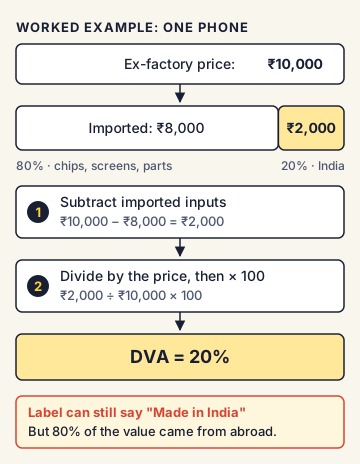
- DVA (%) = (Value of the product minus value of imported inputs) ÷ Value of the product × 100
- "Value of the product" is usually the ex-factory price (the price at which it leaves the factory, before taxes and shop margins).
- "Imported inputs" include parts, raw materials and sub-assemblies bought from abroad.
- What counts as "domestic" depends on the rule book of each scheme. For example, in mobile phones, assembling and testing imported battery packs or chargers in India is counted as domestic work. This makes the DVA number look somewhat better than the true share of parts made in India.
Where did the idea come from?
The idea of "value added" comes from national income accounting, where the value added at each stage of production is added up to get Gross Value Added (GVA) and GDP. As trade grew through global value chains (GVCs), where one product is made in steps across many countries, normal trade figures became misleading. A country that only assembles a phone gets credit for the full export value.
To fix this, the OECD and the WTO built the Trade in Value Added (TiVA) database. It measures how much of a country's exports is really its own value added, and how much is "foreign value added" coming from imported inputs.
How has India used DVA in its policies?
India has used DVA as a goal and a condition in several steps:
- Phased Manufacturing Programme (PMP), from 2016-17: For mobile phones, the government raised customs duty on imported parts in stages. Simple items like chargers, battery packs and headsets came first, then more complex parts. Higher duty made it cheaper to make these parts in India.
- Public Procurement (Preference to Make in India) Order, 2017: When government bodies buy goods, a Class-I local supplier (local content of 50% or more) gets purchase preference. A Class-II local supplier has local content of at least 20% but less than 50%. Ministries can set higher thresholds for their sectors.
- PLI schemes, from 2020: Some PLIs pay only if a minimum DVA is met, such as 50% for advanced auto technology products, and 25% in 2 years rising to 60% in 5 years for ACC battery cells.
- Electronics Component Manufacturing Scheme (ECMS), launched in April 2025: It supports making parts like circuit boards and camera modules in India, to raise DVA in electronics. Its outlay was ₹22,919 crore and was raised to ₹40,000 crore in the Union Budget of 1 February 2026.
Where does India stand?
India has become one of the world's largest makers of mobile phones. But much of the value still comes from imported chips, displays and other parts. As of 2025-26, different estimates put DVA in Indian mobile phones at about 18% to 23%. In August 2026, the Secretary of the Ministry of Electronics and IT (MeitY) put it at about 22-23% and said the target is 35-40%.
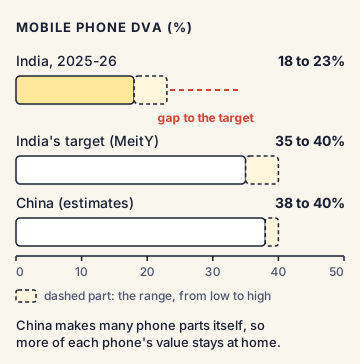
Reports estimate China's phone DVA at about 38-40%, because China makes many of the parts itself. For cars, India's DVA is much higher, as the auto parts industry has grown over decades.
Commonly confused concepts
- DVA vs local content: They mean nearly the same thing. "Local content" is the term used in procurement rules (the 50% and 20% thresholds), while "DVA" is the common term in PLI and trade analysis. Each rule book defines what to count.
- DVA vs GVA (Gross Value Added): GVA is the total value added by all producers in a sector or the whole economy, used to measure economic size. DVA is a share (a percentage) for one product or one industry's output.
- DVA vs "Made in India" label: The label depends on where the last major step of making happens. DVA tells you how much of the value came from India.
- Domestic value added vs foreign value added in exports: In TiVA data, a country's gross exports are split into its own value added and the value of imported inputs used. A falling DVA share in exports is not always bad: it can mean the country has joined global value chains and is exporting much more in total.
Issues, criticism and the way forward
- The screwdriver critique: Critics say much of India's electronics boom is final assembly, with low DVA and thin profit margins. Supporters reply that assembly is the first step, and that countries like China and Vietnam also started this way.
- Measurement problems: Different schemes count DVA differently, and some count assembly of imported sub-parts as local. This can overstate progress.
- Trade rules: WTO rules (the TRIMs Agreement and GATT Article III) do not allow countries to force local content on investors. In the DS456 case (2016), the WTO ruled against India's domestic content requirement for solar cells and modules under the National Solar Mission. So India now mostly uses incentives, tariffs and government purchase preference instead of direct mandates.
- Higher costs: Making parts at home can cost more at first, raising product prices and hurting export competitiveness.
- Way forward: Build supplier networks for components (chips, displays, batteries), invest in skills and research, keep tariffs on inputs predictable, and link incentives to measurable DVA gains. Schemes like ECMS and the semiconductor mission aim at exactly this deeper layer.
Concepts to Know
- Global value chain (GVC): A way of making a product in steps spread across many countries. For example, a phone may be designed in one country, its chips made in another, and assembled in a third.
- Ex-factory price: The price of a product when it leaves the factory, before taxes, transport and shop margins are added.
- Sub-assembly: A group of parts already joined together (like a camera module) that is then fitted into the final product.
- Customs duty (basic customs duty): A tax charged on goods imported into the country. A higher duty makes imported goods costlier.
- OECD: The Organisation for Economic Co-operation and Development, a group of 38 mostly rich countries that does economic research and sets common standards. India is not a member.
- TRIMs Agreement: A WTO agreement on Trade-Related Investment Measures. It bans rules that force investors to use local goods, because such rules discriminate against imports.
- DVA (%) = (product value minus imported input value) ÷ product value × 100
- TiVA database: built by the OECD and WTO to measure value added in trade
- Phased Manufacturing Programme for mobile phones: phases from 2016-17, raised customs duty on parts in stages
- Public Procurement (Make in India) Order, 2017: Class-I local supplier ≥50% local content; Class-II ≥20% and <50%
- Auto PLI: minimum 50% DVA; ACC battery PLI: 25% DVA in 2 years, 60% in 5 years
- ECMS: launched April 2025 with ₹22,919 crore; raised to ₹40,000 crore in Budget 2026-27
- Mobile phone DVA in India: about 18-23% (as of 2025-26); target 35-40%; China about 38-40% (estimates)
- WTO case DS456 (India: Solar Cells and Modules): ruled against India's domestic content requirement in 2016
● Tracked since November 12, 2026 · last seen November 12, 2026 · updates as the daily brief publishes