Doctrine of Temporal Reasonableness
When a Valid Law Becomes Unreasonable With Time
The doctrine of temporal reasonableness says that a law can be fair and valid when it is made, but become unfair and invalid later, because the facts that justified it have changed. "Temporal" simply means "related to time". So courts do not judge a law only by the conditions of the year it was passed.
They also ask: does the reason for this law still exist today? If the reason has disappeared, the law may become arbitrary (without good reason) and can violate the right to equality under Article 14.
Why does this idea exist?
Laws are made to solve the problems of a particular time. But society, the economy and technology keep changing. Think of a school rule made during an exam season: "No one may leave the hostel after 6 PM." It makes sense in exam weeks. If the school keeps the rule for ten years, long after the exams are over, the rule stops making sense and simply restricts students for no reason. Courts use the doctrine to stop old laws from continuing to hurt people after their purpose is gone.
How does it connect to Article 14?
Article 14 says the State shall not deny any person equality before the law or the equal protection of the laws. Courts allow a law to treat groups differently only if it passes the test of reasonable classification, laid down in cases like State of West Bengal v. Anwar Ali Sarkar (1952):
- Intelligible differentia: there must be a clear, understandable basis for separating one group from another.
- Rational nexus: that basis must have a sensible link to the purpose of the law.
Later, in E.P. Royappa v. State of Tamil Nadu (1974), the Court said that arbitrariness is the opposite of equality. Temporal reasonableness adds a time angle to these tests. A classification may have had a rational nexus with its purpose in 1960, but if the purpose no longer exists in 2026, the link breaks, and the law fails Article 14.
Where did it come from? The rent-control cases
The doctrine grew mainly in cases on rent control laws. These laws were passed during and after the Second World War, when housing was scarce, to stop landlords from raising rent too much.
- Motor General Traders v. State of Andhra Pradesh (decided October 1983, reported 1984): A State rent law exempted new buildings (built after 26 August 1957) from rent control, to encourage construction. The Supreme Court held that this exemption, which continued indefinitely, had become discriminatory over time and struck down Section 32(b) of the Andhra Pradesh Buildings (Lease, Rent and Eviction) Control Act, 1960 under Article 14.
- Rattan Arya v. State of Tamil Nadu (1986): applied the same reasoning to a provision of the Tamil Nadu rent law.
- Malpe Vishwanath Acharya v. State of Maharashtra (decided 19 December 1997): The Bombay rent law froze "standard rent" at the 1940 level. The Court said that what was reasonable in 1940 had become unreasonable decades later, because landlords could not even pay for repairs. It did not strike the law down at once, since the provisions were due to lapse and a new law was expected. This led to the Maharashtra Rent Control Act, 1999.
- Satyawati Sharma v. Union of India (16 April 2008): Section 14(1)(e) of the Delhi Rent Control Act, 1958 let landlords evict tenants for their own need only from residential premises, not commercial ones. The Court said this difference, which may have made sense in 1958, had become arbitrary by 2008, and held the provision partly violative of Article 14.
How does a court apply it?
In simple steps:
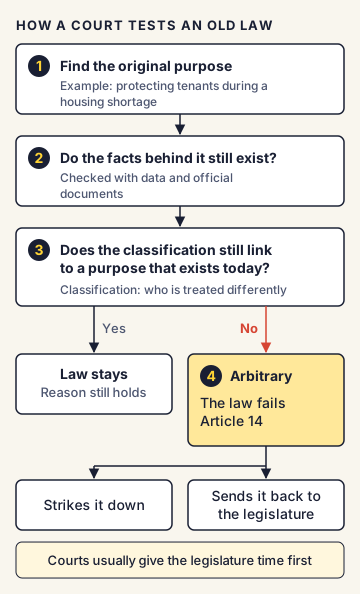
- Find the original purpose of the law (for example, controlling population or protecting tenants during a housing shortage).
- Ask whether the facts behind that purpose still exist, using data and official documents.
- Ask whether the law's classification (who is treated differently) still has a sensible link to a purpose that exists today.
- If not, the law has become arbitrary and may be struck down or sent back to the legislature to fix.
Courts are careful here. They usually give the legislature time, or ask it to review the law, because changing laws is mainly Parliament's and the State legislatures' job.
India's position and examples
Apart from rent laws, Indian courts have used the idea that a law must keep up with changing society in other areas. For example, in Navtej Singh Johar v. Union of India (2018), the Court read down Section 377 of the old Indian Penal Code, noting how social understanding had changed since the colonial era.
In the two-child norm case (Mangala Bhimrao Ingle, 2026), the Court relied on Malpe, Satyawati Sharma and State of Maharashtra v. Super Max International (2009) to say that population control laws made when TFR was about 3.0 may no longer be reasonable when TFR is 1.9.
Commonly confused concepts
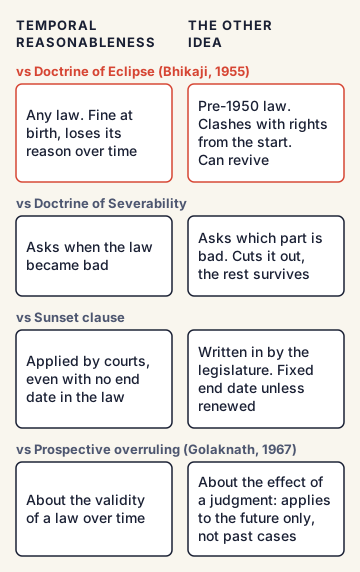
- Temporal reasonableness vs Doctrine of Eclipse: The doctrine of eclipse applies to laws made before the Constitution (pre-1950) that clash with fundamental rights. Such laws are not dead; they are "eclipsed" (put in shadow) and can revive if the fundamental right is amended (Bhikaji Narain Dhakras v. State of Madhya Pradesh, 1955). Temporal reasonableness applies to any law, and the problem is not a clash at birth but a loss of reason over time.
- Temporal reasonableness vs Doctrine of Severability: Severability means only the invalid part of a law is cut out and the rest survives. It is about which part is bad, not when it became bad.
- Temporal reasonableness vs Sunset clause: A sunset clause is written into a law by the legislature itself, saying the law will end on a fixed date unless renewed. Temporal reasonableness is applied by courts, even when the law has no end date.
- Temporal reasonableness vs Prospective overruling: Prospective overruling (first used in I.C. Golaknath v. State of Punjab, 1967) means a court's new ruling applies only to the future, not to past cases. It is about the effect of a judgment, not the validity of a law over time.
Issues, criticism and the way forward
- Judicial overreach concern: Some argue that judges should not decide when social facts have changed enough to cancel a law; that is a policy question for elected legislatures.
- Uncertainty: If any law can become invalid with time, citizens and governments may not know which old laws are safe to rely on.
- Support for the doctrine: Others argue it protects people from old laws that legislatures forget to repeal, and keeps the Constitution a "living document".
- Way forward: Experts suggest regular review of old laws by the legislature (the Law Commission has recommended repeal of many outdated laws), sunset clauses in laws based on temporary conditions, and courts giving legislatures time to act before striking laws down.
Concepts to Know
- Arbitrary: Done without a good reason or fair basis. An arbitrary law treats people differently for no sensible reason.
- Classification: When a law treats one group of people differently from another (for example, residential tenants vs commercial tenants).
- Read down: When a court keeps a law but narrows its meaning so that it no longer violates the Constitution.
- Larger bench: A group of more judges. A smaller bench cannot overrule a judgment of a bench of equal or larger size, so it refers the question to a larger bench.
- Standard rent: Under old rent control laws, the maximum rent a landlord could legally charge for a premises.
- Basis: Article 14 (equality; non-arbitrariness)
- Reasonable classification test: intelligible differentia + rational nexus (Anwar Ali Sarkar, 1952)
- Arbitrariness as the opposite of equality: E.P. Royappa (1974)
- Motor General Traders (1983/1984): Section 32(b), AP rent law, struck down
- Rattan Arya (1986): Tamil Nadu rent law provision
- Malpe Vishwanath Acharya (19 December 1997): frozen 1940 rents unreasonable; led to the Maharashtra Rent Control Act, 1999
- Satyawati Sharma (16 April 2008): Section 14(1)(e), Delhi Rent Control Act, 1958, partly violative of Article 14
- Doctrine of eclipse: Bhikaji Narain Dhakras (1955); prospective overruling: Golaknath (1967)
● Tracked since November 04, 2026 · last seen November 04, 2026 · updates as the daily brief publishes