Delimitation of Municipal Wards
How Cities Are Divided into Wards
A city is too big to elect its local government as one unit. So it is divided into smaller areas called wards, and the voters of each ward elect one councillor (also called a corporator) to the municipal body. Delimitation of wards means deciding how many wards a city will have and where the exact boundary of each ward will run.
It also decides which wards are reserved for Scheduled Castes, Scheduled Tribes, women and, in many states, Other Backward Classes. Because ward lines decide who votes together, delimitation quietly shapes the result of every civic election.
Why does it exist?
The basic idea is "one person, one vote, one value". Each ward should have roughly the same number of people, so that one councillor does not represent 20,000 people while another represents 80,000. Cities also grow: new colonies come up, nearby villages are added, and the population shifts. Without fresh delimitation, some wards would become huge and others nearly empty. Delimitation is also needed to rotate reserved seats among wards, as the Constitution requires.
Where does the power come from?
Before 1992, urban local bodies existed only under state laws, and states could postpone their elections or dissolve them at will. The 74th Constitutional Amendment Act, 1992 (in force from 1 June 1993) added Part IXA (Articles 243P to 243ZG) to the Constitution and made municipalities constitutional bodies. The key provisions for wards are:
- Article 243R: all seats in a municipality are filled by direct election from territorial constituencies, which are called wards.
- Article 243T: seats are reserved for SCs and STs in proportion to their population, and not less than one-third of seats are reserved for women. Reserved seats are given by rotation to different wards. States may also reserve seats for backward classes.
- Article 243ZA(2): the state legislature may make laws on all matters relating to municipal elections. Delimitation of wards is done under such state laws.
- Article 243ZG(a): the validity of any law on delimitation of constituencies or allotment of seats made under Article 243ZA cannot be called in question in any court. Article 243ZG(b) says a municipal election can be challenged only through an election petition before the authority set up by state law.
Who does the delimitation?
This depends on each state's law. In some states, the State Election Commission draws the wards; in others, the state government or a special delimitation commission does it, and the State Election Commission then conducts the polls. For example, Maharashtra amended its municipal laws with effect from 11 March 2022 to move the power of ward delimitation from the State Election Commission to the state government.
In West Bengal, the KMC Act, 1980 lists Kolkata's wards in Schedule II, and Section 601 lets the state government amend that Schedule. The Act originally had 141 wards, later raised to 144 when new areas such as Joka were added.
How does the process usually work?
The steps in most states look like this:
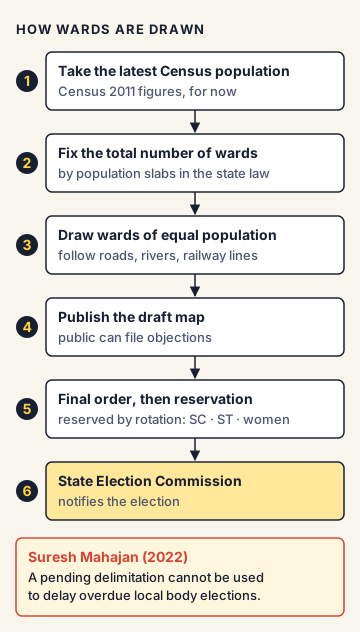
- The authority takes the latest Census population of the city (for now, Census 2011 data, as the new Census is still under way).
- It fixes the total number of wards, usually based on population slabs given in the state law.
- It divides the city into wards of roughly equal population, using natural boundaries like roads, rivers and railway lines, and keeping each ward compact and connected.
- It publishes a draft map and invites objections from the public.
- After hearing objections, it publishes the final order, then decides which wards are reserved (for SC, ST, women and so on) by rotation.
- Only after this does the State Election Commission notify the election.
What is gerrymandering?
Gerrymandering means drawing boundaries on purpose to help one side win more seats than its votes deserve. The word comes from Massachusetts in the United States. In 1812, under Governor Elbridge Gerry, a state senate district was drawn so oddly that a newspaper cartoon showed it as a salamander, and named it the "Gerry-mander". Two common methods are:
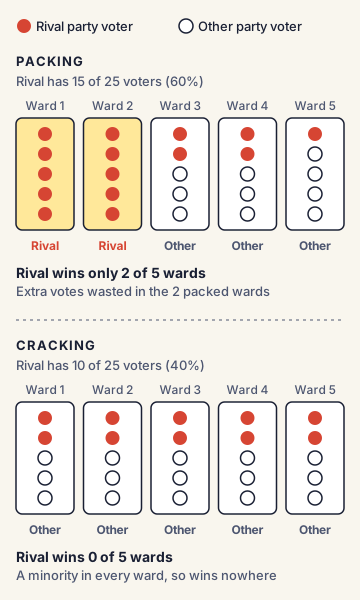
- Packing: putting as many of a rival's supporters as possible into a few wards, so they "waste" votes winning those wards by huge margins.
- Cracking: splitting a rival's supporters across many wards, so they are a minority everywhere and win nowhere.
The safeguards against this are the rules of equal population, contiguity (a ward must be one connected piece), compactness (no strange long shapes), respect for natural and administrative boundaries, public objections, and an independent authority drawing the lines.
What have the courts said?
- Kishansing Tomar v. Municipal Corporation of the City of Ahmedabad (2006): a five-judge bench held that, under Article 243U, elections to a municipality must be completed before its five-year term ends. Only rare situations, such as a natural calamity, can justify delay, so preparatory work like delimitation and reservation must be finished in time.
- State of Goa v. Fouziya Imtiaz Shaikh (2021): a three-judge bench explained that the bar in Article 243ZG(a) protects state laws on delimitation and allotment of seats from court challenge, much like Article 329(a) does for Parliament and Assembly constituencies. It held that the bar did not apply on the facts of that case. It also held that a State Election Commissioner must be an independent person, not a serving state government official.
- Suresh Mahajan v. State of Madhya Pradesh (2022): the Supreme Court said a pending or fresh delimitation cannot be used to delay overdue local body elections. It directed the Madhya Pradesh State Election Commission to notify polls within two weeks on the basis of the wards as they stood before the new delimitation, and said this applies to all states and Union Territories.
- Vikas Kishanrao Gawali v. State of Maharashtra (2021): OBC reservation in local bodies needs a "triple test": a dedicated commission to study backwardness, seat shares fixed on its findings, and total reservation (SC, ST and OBC) not crossing 50%.
So courts are cautious about stopping delimitation itself, but they act firmly against delaying elections. In practice, High Courts still hear challenges to the way an executive order on wards was made (for example, whether the right authority made it, or whether the rules were followed), and may give interim orders before the election is notified.
Commonly confused concepts
- Ward delimitation vs Lok Sabha and Assembly delimitation: Parliamentary and Assembly seats are redrawn by a Delimitation Commission set up by Parliament under Articles 82 and 170 (latest under the Delimitation Act, 2002), and its orders cannot be questioned in court (Article 329(a)). Municipal wards are drawn under state laws made under Article 243ZA, protected by Article 243ZG(a).
- State Election Commission vs Election Commission of India: The SEC (Article 243K for panchayats, applied to municipalities by Article 243ZA) conducts local body elections. The ECI (Article 324) conducts elections to Parliament, state legislatures, and the offices of President and Vice-President. They are separate and independent of each other.
- Delimitation vs reservation: Delimitation draws the ward lines. Reservation decides which of those wards are reserved for SC, ST, women or OBC, by rotation.
- Dissolution vs supersession by administrator: When a municipal body is dissolved or its members resign, the state may appoint an administrator to run it for a time. Article 243U(3) requires a fresh election within six months of a dissolution. An administrator is a temporary official, not an elected body.
- Gerrymandering vs malapportionment: Gerrymandering is about the shape of boundaries to favour one side. Malapportionment is about unequal population across wards, so that some votes count for more than others.
Issues, criticism and the way forward
- State control over ward lines: Where the state government draws the wards, critics say the ruling side can shape them for its benefit. Others argue that the elected state government is accountable to the Assembly and the public for such decisions.
- Delayed elections: Fresh delimitation, reservation disputes and court cases have often delayed civic polls for years, leaving cities run by appointed administrators. This goes against the 74th Amendment's aim of regular local democracy.
- Old population data: Wards are still drawn on 2011 Census figures, which no longer match fast-growing cities.
- Limited court review: Article 243ZG(a) makes it hard to challenge a delimitation law, so citizens depend mostly on the objection stage.
- Way forward suggested by experts: give ward delimitation to the State Election Commission or an independent delimitation commission; publish clear rules on population variation, contiguity and compactness; use GIS (digital) maps and data for transparency; and fix timelines so that delimitation is finished well before a body's term ends, as Kishansing Tomar requires.
Concepts to Know
- Ward: The smallest electoral unit of a city. Each ward elects one councillor to the municipal body.
- Councillor (corporator): An elected member of a municipal corporation or council, representing one ward.
- Schedule (of an Act): A list attached at the end of a law, holding details like names of areas or ward boundaries. Changing a Schedule changes the detail without rewriting the main law.
- Writ petition: A case filed in a High Court (Article 226) or the Supreme Court (Article 32) asking the court to protect a legal or fundamental right.
- Interim order: A temporary order by a court while the main case is still being heard, to keep things as they are.
- Prima facie: A Latin phrase meaning "at first sight". A prima facie case is one that looks valid before full arguments are heard.
- Election petition: A special case filed after an election to challenge its result, before an authority named by law.
- Contiguity and compactness: Contiguity means a ward is one connected piece of land. Compactness means it has a sensible shape, not long arms reaching into other areas.
- 74th Constitutional Amendment Act, 1992; in force 1 June 1993; added Part IXA (Articles 243P to 243ZG) and the Twelfth Schedule (18 subjects)
- Article 243R: municipal seats filled by direct election from wards
- Article 243T: SC/ST reservation in proportion to population; at least one-third seats for women; rotation of reserved seats
- Article 243U: five-year term; election before expiry, or within six months of dissolution
- Article 243ZA: SEC conducts municipal elections; state legislature makes laws on municipal elections
- Article 243ZG(a): courts cannot question the validity of laws on delimitation or allotment of seats; 243ZG(b): elections challenged only by election petition
- Gerrymandering: term coined in 1812, Massachusetts, after Governor Elbridge Gerry; methods: packing and cracking
- Kishansing Tomar (2006): elections must be held on time; Fouziya Imtiaz Shaikh (2021): SEC must be independent; Suresh Mahajan (2022): delimitation cannot delay elections
- Triple test for OBC reservation in local bodies: Vikas Kishanrao Gawali (2021)
- Maharashtra moved ward delimitation from SEC to state government from 11 March 2022
● Tracked since November 07, 2026 · last seen November 07, 2026 · updates as the daily brief publishes