Deep-Sea Minerals
Polymetallic Nodules, Polymetallic Sulphides and Cobalt Crusts
Deep-sea minerals are rocks and deposits on the floor of the deep ocean that contain valuable metals like nickel, cobalt, copper, manganese, zinc, silver and gold. There are three main types: polymetallic nodules (lumps lying loose on the seabed), polymetallic sulphides (deposits formed around hot springs on underwater mountain ranges) and cobalt-rich crusts (hard coatings on the sides of underwater mountains). "Polymetallic" simply means "containing many metals". Countries are interested in them because these metals are needed for batteries, electric vehicles and power grids.
Why does the world want them?
The shift to clean energy needs huge amounts of certain metals. An electric vehicle battery needs nickel, cobalt and manganese. Wind turbines, solar systems and power lines need a lot of copper. On land, these metals are found in only a few countries. For example, most of the world's cobalt comes from the Democratic Republic of Congo, and China controls much of the processing.
A country that depends on a few suppliers can face sudden shortages or price shocks. Deep-sea minerals offer a new source, which is why India and many other countries are exploring them.
Type 1: Polymetallic nodules
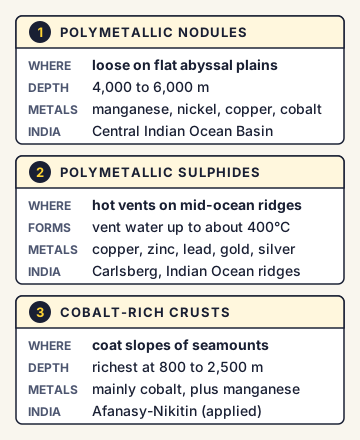
These are potato-sized, dark lumps lying on the flat, muddy floor of the deep ocean (the abyssal plains), usually at depths of about 4,000 to 6,000 metres.
- How they form: Metals dissolved in seawater and in the mud slowly settle in layers around a tiny core, such as a shark's tooth or a bit of shell. It is like the way layers build up on a pearl.
- How slowly: They grow only a few millimetres in a million years. So a nodule the size of a fist may be millions of years old. Once removed, they will not come back in any human timescale.
- What they contain: Mainly manganese, with nickel, copper and cobalt.
- Where: The richest known field is the Clarion-Clipperton Zone (CCZ) in the Pacific Ocean, between Hawaii and Mexico. India's area is in the Central Indian Ocean Basin (CIOB).
Type 2: Polymetallic sulphides (also called seafloor massive sulphides). These form at hydrothermal vents, which are hot springs on the ocean floor.
- Where: Along mid-ocean ridges, the long underwater mountain chains where the Earth's plates move apart, and near underwater volcanoes.
- How they form: Seawater seeps into cracks in the seabed, gets heated by magma (melted rock) below to temperatures up to about 400°C, and picks up metals from the rocks. When this hot, metal-rich water shoots out and meets cold seawater, the metals settle as sulphide minerals. Some vents look like chimneys pouring black smoke, so they are called "black smokers". These were first confirmed in 1979 on the East Pacific Rise.
- What they contain: Copper, zinc, lead, iron, silver and gold, among others.
- Special life: Vents support unusual ecosystems (tube worms, special shrimps and bacteria) that live on chemical energy instead of sunlight. This process is called chemosynthesis.
Type 3: Cobalt-rich ferromanganese crusts
These are hard, dark layers that coat the rocky slopes and tops of seamounts (underwater mountains). They can form at depths of 400 to 7,000 metres, but the thickest and most cobalt-rich crusts are found at about 800 to 2,500 metres. They grow very slowly, often over tens of millions of years, and can be up to about 25 cm thick. Their main attraction is cobalt, along with manganese, nickel and rare elements like platinum and tellurium.
Who controls these minerals? The law of the sea
Under the United Nations Convention on the Law of the Sea (UNCLOS), 1982:
- Minerals inside a country's Exclusive Economic Zone (EEZ) (up to 200 nautical miles from the coast) and on its continental shelf belong to that country. In India, these are governed by the Offshore Areas Mineral (Development and Regulation) Act, 2002, which was amended in 2023.
- The seabed beyond any country's control is called "the Area". Article 136 of UNCLOS says the Area and its resources are the "common heritage of mankind": they belong to all humanity, not to any one country.
- The International Seabed Authority (ISA), based in Kingston, Jamaica, controls all mineral activity in the Area.
How does a country get rights? Step by step
- A country (or a company sponsored by a country) applies to the ISA for an exploration area, with a plan of work.
- The ISA's Legal and Technical Commission checks it, and the ISA Council approves it.
- The ISA signs a 15-year exploration contract, which can be extended. The contractor may survey, sample and test technology, but not mine commercially.
- Commercial mining (called exploitation) needs separate rules, known as the Mining Code. As of 2026, the ISA has not finished these rules, so no commercial mining is allowed in the Area.
The ISA has separate exploration rules for each mineral type: for nodules (2000), for sulphides (2010) and for cobalt crusts (2012). As of 31 January 2026, the ISA had 31 exploration contracts in force: 19 for nodules, 8 for sulphides and 4 for cobalt crusts.
India's position and Indian examples
India was one of the earliest countries in this field:
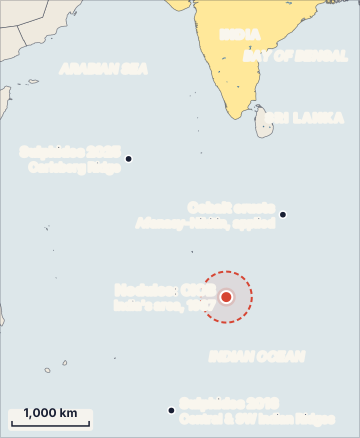
- In 1987, India became the first country to be given a mine site as a "pioneer investor": about 1,50,000 sq km in the Central Indian Ocean Basin. After giving back parts of it in stages, as the rules require, India now keeps about 75,000 sq km.
- India signed its nodule exploration contract with the ISA on 25 March 2002. It has been extended in 2017 and 2022.
- Detailed surveys estimate about 380 million tonnes of nodules in India's area, containing about 4.7 million tonnes of nickel, 4.29 million tonnes of copper, 0.55 million tonnes of cobalt and 92.59 million tonnes of manganese.
- Sulphides, contract 1: signed on 26 September 2016 for an area on the Indian Ocean Ridge (valid until 2031).
- Sulphides, contract 2: signed on 15 September 2025 for about 10,000 sq km on the Carlsberg Ridge in the north-west Indian Ocean. This made India the first country to hold two sulphide contracts with the ISA.
- Cobalt crusts: In January 2024, India applied for about 3,000 sq km on the Afanasy-Nikitin Seamount in the Central Indian Ocean. The application is pending; part of this area falls within a claim made by Sri Lanka for an extended continental shelf.
- India's main programme for this work is the Deep Ocean Mission, which includes developing a mining system and the crewed submersible Matsya-6000.
Commonly confused concepts
- Nodules vs sulphides vs crusts: Nodules lie loose on flat plains at 4,000–6,000 m (manganese, nickel, copper, cobalt). Sulphides form at hot vents on mid-ocean ridges (copper, zinc, gold, silver). Crusts coat seamount slopes at 800–2,500 m (mainly cobalt).
- Exploration vs exploitation: Exploration means searching, sampling and testing. Exploitation means commercial mining. ISA contracts so far are only for exploration.
- EEZ vs the Area: Within its EEZ and continental shelf, a country controls the seabed minerals itself. Beyond that is the Area, managed by the ISA for all humanity.
- ISA (Seabed Authority) vs ISA (International Solar Alliance): Same short form, completely different bodies. The Seabed Authority is in Kingston, Jamaica; the Solar Alliance is headquartered in Gurugram, India.
- Deep-sea minerals vs offshore oil and gas: Oil and gas lie trapped in rocks under the seabed and are drilled. Deep-sea minerals sit on or near the seabed surface and would be collected or cut.
Issues, criticism and the way forward
- Damage to unknown ecosystems: Scientists know very little about deep-sea life. Mining machines would scrape the seabed and destroy habitats. Because nodules take millions of years to form, the damage would last almost forever. A 1989 disturbance experiment in the Pacific (DISCOL, off Peru) showed the seabed had still not recovered decades later.
- Sediment plumes: Mining stirs up clouds of mud that can drift far and smother sea life. Noise and light can also disturb deep-sea animals.
- New science: A 2024 study suggested nodules may produce small amounts of oxygen on the dark seabed ("dark oxygen"). The finding is debated, but it shows how much is still unknown.
- Calls for a pause: Many countries, scientists and some large companies have called for a precautionary pause (moratorium) until the science is clearer. Others argue that the metals are needed urgently for clean energy and that land mining also causes heavy damage.
- Rules and fairness: The ISA is still negotiating the Mining Code, including how profits will be shared with all countries as "common heritage of mankind". Some countries have also looked at going ahead under their own national laws, which critics say weakens the shared UN system.
- Fishers' concerns: Coastal communities worry about effects on fish. Officials point out that India's sites are very far from the coast and very deep, but full environmental impact assessments are required before any mining.
- Way forward: Experts suggest finishing a strong Mining Code, baseline studies of deep-sea life, protected reference zones where no mining is allowed, and recycling of battery metals to reduce demand.
Concepts to Know
- Abyssal plain: The flat, deep floor of the ocean, usually 3,000 to 6,000 metres below the surface.
- Mid-ocean ridge: A long underwater mountain range where two of the Earth's plates move apart and new seabed is made from rising magma.
- Hydrothermal vent: A crack in the seabed where very hot, mineral-rich water comes out, like a hot spring under the sea.
- Seamount: A mountain under the sea, usually an old volcano, that does not reach the surface.
- Exclusive Economic Zone (EEZ): The sea area up to 200 nautical miles from a country's coast, where that country alone can use the resources.
- Common heritage of mankind: A legal idea that some areas, like the deep seabed and outer space, belong to all humanity and should be used for everyone's benefit.
- Polymetallic nodules: 4,000–6,000 m depth; manganese, nickel, copper, cobalt; grow a few mm per million years
- Polymetallic sulphides: at hydrothermal vents on mid-ocean ridges; copper, zinc, lead, gold, silver
- Cobalt-rich crusts: on seamounts, richest at 800–2,500 m
- UNCLOS Article 136: the Area and its resources are the "common heritage of mankind"; ISA is in Kingston, Jamaica
- ISA contracts as of 31 January 2026: 31 (19 nodules, 8 sulphides, 4 crusts); exploration contracts last 15 years
- India: pioneer investor 1987; CIOB area about 75,000 sq km; nodule contract 25 March 2002 (extended 2017, 2022)
- India's nodule resource: about 380 million tonnes
- India's sulphide contracts: Indian Ocean Ridge (2016) and Carlsberg Ridge (15 September 2025, about 10,000 sq km)
- Afanasy-Nikitin Seamount (cobalt crusts) application: January 2024, pending
● Tracked since November 15, 2026 · last seen November 15, 2026 · updates as the daily brief publishes