Cropping Seasons in India
Kharif, Rabi and Zaid
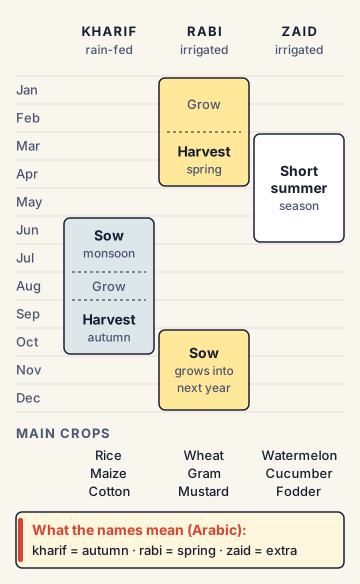
India grows crops in three main seasons: kharif, rabi and zaid. Kharif crops are sown with the start of the southwest monsoon and harvested in autumn. Rabi crops are sown in winter and harvested in spring. Zaid is a short summer season in between. Which crop grows in which season depends mainly on temperature, rainfall and the availability of water.
Why does India have different seasons for crops?
Every crop needs a certain temperature and amount of water to grow. Rice needs a lot of water and heat. Wheat needs cool weather while growing and warm, dry weather while ripening. India's weather changes a lot across the year: hot and rainy in summer, cool and mostly dry in winter. So farmers match each crop to the season that suits it. This also lets farmers grow two or even three crops a year on the same land, which is called multiple cropping.
Where do the names come from?
The words come from Arabic. "Kharif" means autumn, because kharif crops are harvested in autumn. "Rabi" means spring, because rabi crops are harvested in spring. "Zaid" means extra or additional, because it is an extra short season.
The kharif season (monsoon crops)
- Sowing: June-July, with the arrival of the southwest monsoon. In some areas, sowing begins with the first rains at the end of May.
- Harvest: September-October (in some areas, up to November).
- Water: Mostly depends on monsoon rain. A weak or late monsoon hurts kharif crops directly.
- Main crops: Rice (paddy), maize, jowar, bajra, ragi, tur (arhar), moong, urad, cotton, jute, groundnut and soybean.
The rabi season (winter crops)
- Sowing: October to December, after the monsoon ends.
- Harvest: March to April (in some areas, up to June).
- Water: Winter has little rain, so rabi crops depend on irrigation (canals, tube wells) and on soil moisture left by the monsoon. In northwest India, western disturbances bring some winter rain. These are storm systems that start near the Mediterranean Sea and move east. This winter rain is very helpful for wheat.
- Main crops: Wheat, barley, gram (chickpea), masur (lentil), peas, rapeseed and mustard, and safflower.
- Main regions: Punjab, Haryana, Uttar Pradesh, Madhya Pradesh and Rajasthan are major rabi states. The Green Revolution of the 1960s, with high-yielding wheat seeds and irrigation, made rabi wheat the base of India's food security.
The zaid season (summer crops)
- Timing: Roughly March to June, between rabi harvest and kharif sowing.
- Water: Fully depends on irrigation, because it is hot and dry.
- Main crops: Watermelon, muskmelon, cucumber, vegetables and fodder (animal feed) crops. Some moong is also grown as a summer crop.
How the seasons link to government policy
- Minimum Support Price (MSP): The government announces MSP for 22 mandated crops: 14 kharif crops, 6 rabi crops and 2 commercial crops (jute and copra). The 6 rabi crops are wheat, barley, gram, masur, rapeseed and mustard, and safflower. MSP is recommended by the Commission for Agricultural Costs and Prices (CACP) and approved by the Cabinet Committee on Economic Affairs (CCEA). Rabi MSPs are announced before sowing so farmers can plan.
- Marketing season: Rabi crops sown in late 2026 are sold in the Rabi Marketing Season 2027-28. For it, the CCEA fixed the wheat MSP at ₹2,610 per quintal on 30 September 2026, up ₹25 from ₹2,585.
- Fertiliser planning: The Department of Fertilizers plans supply season by season (kharif and rabi), with month-wise targets. Urea and DAP demand rise sharply at sowing time.
- Sowing data: The Ministry of Agriculture releases weekly figures of the area sown, compared with the same week last year. This helps the government spot early problems, like late sowing or a shift from one crop to another.
India's position
India's agricultural year runs from July to June, so it starts with kharif and ends with rabi and zaid. Kharif is the bigger season by area. Rabi wheat is the backbone of the public distribution system's wheat supply. Climate change is making seasons less predictable: late monsoon withdrawal can delay rabi sowing, and early heat waves in March can shrivel wheat grains before harvest.
Commonly confused concepts
- Kharif vs rabi: Kharif = sown with the monsoon (June-July), harvested in autumn; rabi = sown in winter (October-December), harvested in spring.
- Rabi (season) vs Rabi Marketing Season (RMS): Crops sown in rabi 2026-27 are bought and sold in RMS 2027-28. The year in the marketing season is one step ahead.
- Moong in both seasons: Moong is a kharif MSP crop, but it is also grown in zaid. Such crops can confuse exam questions, so check the season mentioned.
- Cotton and sugarcane: Cotton is a kharif crop. Sugarcane is a long-duration crop that stays in the field for about a year. It has a Fair and Remunerative Price (FRP), not an MSP.
- Western disturbances vs northeast monsoon: Western disturbances bring winter rain to northwest India. The northeast monsoon (October-December) brings rain mainly to Tamil Nadu and nearby coastal areas.
Issues, criticism and the way forward
- Delayed sowing: If the monsoon withdraws late or fields stay wet, rabi sowing slips. Late-sown wheat faces more risk from early heat in March.
- Cropping pattern skewed to rice and wheat: MSP and assured procurement have pushed farmers in Punjab and Haryana towards a rice-wheat cycle. This drains groundwater and leads to stubble burning between the kharif harvest and rabi sowing.
- Input supply at the right time: Even when national stocks are high, local shortages of fertiliser or seed at sowing time can hurt yields.
- Way forward: Crop diversification towards pulses and oilseeds, better weather forecasting, timely input supply, and heat-tolerant seed varieties.
Concepts to Know
- Irrigation: Giving water to crops by human-made means, like canals, wells and tube wells, instead of depending only on rain.
- Southwest monsoon: The seasonal winds that bring most of India's rain from June to September.
- Quintal: A unit of weight equal to 100 kilograms.
- Procurement: Government agencies, like the Food Corporation of India, buying crops directly from farmers, usually at MSP.
- Green Revolution: The use of high-yielding seeds, fertilisers and irrigation from the mid-1960s, which greatly increased wheat and rice production in India.
- Kharif: sown June-July, harvested September-October; rabi: sown October-December, harvested March-April; zaid: roughly March-June
- "Kharif" = autumn, "Rabi" = spring (Arabic)
- MSP for 22 mandated crops: 14 kharif, 6 rabi, 2 commercial (jute, copra)
- 6 rabi MSP crops: wheat, barley, gram, masur, rapeseed and mustard, safflower
- MSP recommended by CACP, approved by CCEA
- Wheat MSP: ₹2,585 per quintal (RMS 2026-27); ₹2,610 per quintal (RMS 2027-28, approved 30 September 2026)
- Western disturbances bring winter rain to northwest India, which helps rabi wheat
● Tracked since November 09, 2026 · last seen November 09, 2026 · updates as the daily brief publishes