Compounding of Offences
Compounding means settling a criminal offence without a full trial. Either the victim agrees to settle with the accused, or (in tax and business laws) the government agrees to accept a fixed sum of money instead of prosecuting. Once an offence is compounded, the criminal case ends. In ordinary criminal law, the accused is treated as acquitted; in tax laws, prosecution is either not started or, if already started, it is dropped.
Why does it exist?
Not every wrong needs a long criminal trial. Many offences are mainly private quarrels (like simple hurt between neighbours) or technical lapses by businesses (like a late filing). Taking all of them through court wastes years and clogs the system. Compounding lets the parties, or the state, close such cases quickly. The victim or the government gets compensation, the accused avoids a criminal record and jail, and the courts get time for serious crimes.
Think of it like paying a fixed fine to the traffic police on the spot instead of going to court for a minor traffic offence.
Where did it come from?
The idea is old. In criminal law, Section 320 of the Code of Criminal Procedure, 1973 (CrPC) listed which offences under the Indian Penal Code could be compounded. From 1 July 2024, the Bharatiya Nagarik Suraksha Sanhita, 2023 (BNSS) replaced the CrPC, and the same rule now sits in Section 359 of the BNSS. Separately, almost every economic law has its own compounding clause, because these laws create many technical offences.
Over the last decade, India has widened compounding as part of decriminalisation: turning small business offences from crimes into civil matters. The Jan Vishwas (Amendment of Provisions) Act, 2023 did this for 183 provisions in 42 central laws.
How does compounding work in criminal law?
Section 359 of the BNSS (like Section 320 of the CrPC before it) divides compoundable offences into two lists:
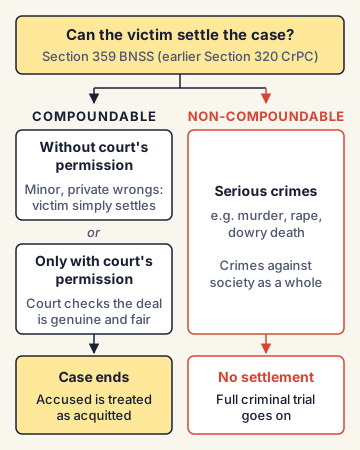
- Compoundable without the court's permission: less serious offences, mostly private in nature. The victim can simply settle with the accused, and the court records it.
- Compoundable only with the court's permission: somewhat more serious offences. The court checks that the settlement is genuine and fair before allowing it.
All other offences are non-compoundable. Murder, rape or dowry death, for example, are crimes against society as a whole, so a private settlement cannot end the case.
How does it work in tax and business laws?
Here the "victim" is the state, so a government authority does the compounding. The person applies, admits the offence, and pays a compounding amount fixed by law or guidelines. In return, the government does not prosecute or withdraws the prosecution. Main examples:
- GST (Section 138, CGST Act, 2017): The Commissioner can compound offences under Section 132, either before or after prosecution starts. Since the Finance Act, 2023, the amount is 25% to 100% of the tax involved (earlier it was 50% to 150%). Compounding is not allowed for fake invoice cases, for some repeat offenders, or for a person already convicted by a court. Once paid, no further proceedings can start and pending criminal proceedings end.
- Income tax: Section 279(2) of the Income-tax Act, 1961 allowed compounding. The CBDT simplified its guidelines from 17 October 2024. The Income-tax Act, 2025, which came into force on 1 April 2026, carries the power forward [Unverified: exact section number in the 2025 Act].
- Foreign exchange (Section 15, FEMA, 1999): The RBI (or the Enforcement Directorate) can compound contraventions, except those under Section 3(a), when the person applies.
- Company law (Section 441, Companies Act, 2013): Offences punishable with fine only, or with fine or imprisonment, can be compounded by the Regional Director (if the maximum fine is up to ₹25 lakh) or by the National Company Law Tribunal (above that). Offences punishable with imprisonment only, or imprisonment and fine, cannot be compounded.
- Cheque bounce (Section 147, Negotiable Instruments Act, 1881): All offences under this Act are compoundable. In Damodar S. Prabhu v. Sayed Babalal H. (2010), the Supreme Court said compounding can happen at any stage, even in appeal, and set graded costs to encourage early settlement: 10% of the cheque amount before the magistrate, 15% before the Sessions Court or High Court, and 20% before the Supreme Court.
India's position: where compounding fits in decriminalisation
In GST, compounding is one of three tools: (1) recovery of tax, interest and penalty, (2) compounding for offences that do not need a trial, and (3) prosecution for serious fraud. The proposal before the GST Council leans more on the first two, keeping jail for genuine large frauds. This matches the wider policy direction behind the Jan Vishwas Acts: fewer criminal provisions for business lapses, more monetary penalties, and faster closure.
Commonly confused concepts
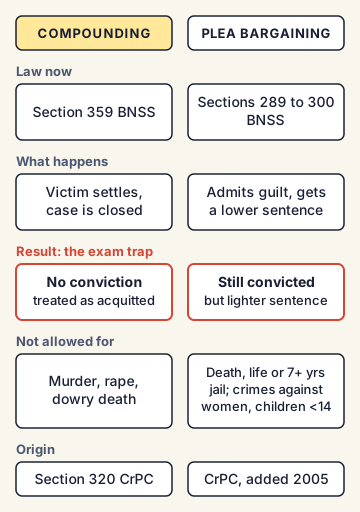
- Compounding vs plea bargaining: In plea bargaining, the accused admits guilt and gets a lower sentence from the court; he is still convicted. It was added to the CrPC in 2005 (Chapter XXI-A) and is now in Sections 289 to 300 of the BNSS. It is not allowed for offences punishable with death, life imprisonment or more than seven years, or for offences against women or children below 14, or for notified socio-economic offences. In compounding, the case ends and there is no conviction.
- Compounding vs quashing: Quashing is the High Court's inherent power (earlier Section 482 CrPC, now Section 528 BNSS) to end proceedings to prevent misuse of the court process or "to secure the ends of justice". In Gian Singh v. State of Punjab (2012), the Supreme Court said that a High Court can quash even some non-compoundable cases where the parties have settled, mainly disputes of a civil nature (commercial, financial, family). But this is a different power from compounding, and it is refused for heinous crimes, corruption cases and offences by public servants.
- Compounding vs penalty: A penalty is a civil money punishment decided by an officer; it does not end or replace a criminal case on its own. Compounding is specifically a way to settle a criminal offence.
- Compoundable vs bailable: "Bailable" is about whether the accused can get bail as a right during the case. "Compoundable" is about whether the case can be settled and closed. An offence can be bailable but non-compoundable, or the other way round.
Issues, criticism and the way forward
- Equality concerns: Critics say compounding can let rich offenders "buy their way out" while poorer people face trial. Supporters reply that the compounding amount is often large, and that it frees investigators to chase serious fraud.
- Deterrence: If the cost of compounding is low compared to the gain from cheating, it may not stop wrongdoing. That is why GST keeps fake invoice cases outside compounding.
- Officer discretion: In tax laws, the officer decides whether to allow compounding. Uneven decisions across offices can look unfair. Clear, published guidelines (like the CBDT's 2024 guidelines) reduce this.
- Pending cases: India's courts have a huge backlog of criminal cases, a large share of them technical or cheque bounce cases. Wider compounding is seen as one way to cut this.
- Way forward: Experts generally suggest a graded approach: civil penalties and compounding for technical or first-time lapses, and fast, focused prosecution for large, deliberate fraud, with clear rules so that officers and businesses both know where the line is.
Concepts to Know
- Decriminalisation: Changing a law so that an act is no longer a crime punished with jail, but is dealt with by a fine or penalty instead.
- Cognizable offence: An offence where police (or authorised officers) can arrest without a warrant from a magistrate. Non-cognizable offences need a magistrate's permission to arrest or investigate.
- Bailable and non-bailable offence: In a bailable offence, the accused has a right to bail. In a non-bailable offence, bail is at the court's discretion.
- Prosecution: Taking a person to a criminal court so that a judge can decide whether they are guilty and punish them.
- Acquittal: A court's decision that the accused is not guilty, or the legal effect that the person is treated as not guilty.
- Input Tax Credit (ITC): The GST a business has already paid on its purchases, which it can subtract from the GST it owes on its sales.
- Inherent power: A power that a High Court has simply because it is a superior court, used to stop abuse of the legal process even where no specific rule covers the situation.
- Criminal law compounding: Section 320 CrPC, now Section 359 BNSS (from 1 July 2024); two lists, with and without court permission
- Effect in criminal law: compounding = acquittal of the accused
- GST: Section 138, CGST Act; amount 25% to 100% of tax involved since Finance Act, 2023 (earlier 50% to 150%); not for fake invoice cases
- Income tax: Section 279(2), Income-tax Act, 1961; revised CBDT guidelines from 17 October 2024
- FEMA: Section 15; RBI compounds contraventions except under Section 3(a)
- Companies Act, 2013: Section 441; Regional Director up to ₹25 lakh maximum fine, NCLT above
- NI Act, 1881: Section 147; Damodar S. Prabhu (2010) graded costs 10%, 15%, 20%
- Plea bargaining: CrPC Chapter XXI-A (2005), now Sections 289 to 300 BNSS
- Quashing: Section 482 CrPC, now Section 528 BNSS; Gian Singh v. State of Punjab (2012)
- Jan Vishwas Act, 2023: 183 provisions in 42 central laws decriminalised
● Tracked since March 30, 2026 · last seen October 05, 2026 · updates as the daily brief publishes