Composition Scheme Under GST (Section 10, CGST Act)
The composition scheme is a simple, optional way for small businesses to pay GST. Instead of charging GST on every bill and claiming credit for GST paid on purchases, the business pays a small fixed percentage of its turnover (its total sales) as tax. For example, a small trader pays just 1% of turnover. In return, it files fewer returns and keeps fewer records, but it cannot collect GST from customers or claim input tax credit.
Why does it exist?
Normal GST compliance is heavy. A regular taxpayer must issue proper tax invoices, file returns, match its purchases with its suppliers' returns, and keep detailed accounts. For a big company with an accounts team, this is routine. For a small kirana shop, a sweet shop or a small workshop, it can cost more in time and accountant fees than the tax itself.
The composition scheme gives such businesses a "simple lane": pay a small flat tax, file a short statement, and focus on running the business. It also brings small businesses into the tax net without scaring them away with paperwork.
Where did it come from?
Before GST, many State VAT laws already had composition schemes for small dealers. GST kept the idea.
- The scheme is in Section 10 of the Central Goods and Services Tax (CGST) Act, 2017, and in Rules 3 to 7 of the CGST Rules, 2017. Each State GST Act has a matching provision.
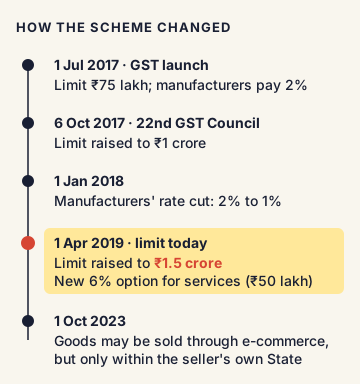
- At the launch of GST on 1 July 2017, the turnover limit was ₹75 lakh (₹50 lakh in some special category States).
- The 22nd GST Council meeting (6 October 2017) raised the limit to ₹1 crore (Notification 46/2017-Central Tax).
- The CGST (Amendment) Act, 2018 raised the ceiling the government can fix to ₹1.5 crore. Notification 14/2019-Central Tax (7 March 2019) then set the limit at ₹1.5 crore from 1 April 2019.
- From 1 April 2019, a separate composition option at 6% was opened for small service providers (Notification 2/2019-Central Tax (Rate)). It was later written into the Act itself as Section 10(2A).
- The Finance Act, 2023 allowed composition taxpayers to sell goods through e-commerce platforms within their own State, from 1 October 2023.
Who can join? (the turnover limits)
- Goods suppliers and restaurants (Section 10(1)): turnover up to ₹1.5 crore in the previous financial year.
- Eight States with a lower limit of ₹75 lakh: Arunachal Pradesh, Manipur, Meghalaya, Mizoram, Nagaland, Sikkim, Tripura and Uttarakhand.
- Service providers (Section 10(2A)): turnover up to ₹50 lakh. A goods supplier under Section 10(1) may also supply some services, but only up to 10% of its turnover or ₹5 lakh, whichever is higher.
- Turnover here means aggregate turnover: all supplies of all businesses under the same PAN across India.
How much tax? (the rates)
| Type of business | Rate (CGST + SGST) |
|---|---|
| Manufacturers | 1% (0.5% + 0.5%) |
| Traders | 1% of turnover of taxable goods (0.5% + 0.5%) |
| Restaurants (not serving alcohol) | 5% (2.5% + 2.5%) |
| Service providers under Section 10(2A) | 6% (3% + 3%) |
At launch, manufacturers paid 2%. It was cut to 1% from 1 January 2018.
Who cannot join?
The law keeps some businesses out, because their supplies cross State lines, carry high risk, or would weaken the tax base:
- Suppliers making inter-State outward supplies (sales from one State to another)
- Casual taxable persons and non-resident taxable persons
- Those supplying services through an e-commerce operator that must collect tax at source
- Those supplying goods that are not taxable under the CGST Act (for example, alcohol for drinking or petrol)
- Manufacturers of notified goods: ice cream and other edible ice, pan masala, tobacco and tobacco substitutes, and aerated waters
How does it work, step by step?
- Opting in: An existing taxpayer files Form GST CMP-02 before the start of the financial year (that is, by 31 March). A new applicant can choose it while applying for registration.
- Same choice for all units: If a business has several registrations under one PAN, all of them must join the scheme together. You cannot keep one unit in and one out.
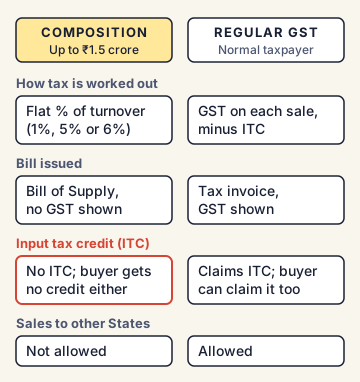
- Billing: The business issues a Bill of Supply, not a tax invoice. It must not charge GST separately on the bill. It must write "composition taxable person, not eligible to collect tax on supplies" on bills and display this at its shop.
- Paying tax: It pays tax every quarter through Form GST CMP-08 (by the 18th of the month after the quarter).
- Return: It files one annual return in Form GSTR-4.
- Leaving: If its turnover crosses the limit during the year, it leaves the scheme and becomes a regular taxpayer. It can also leave by choice.
A simple example: a sweet shop in Indore sells ₹80 lakh worth of sweets in a year. Under the composition scheme it pays 1% of turnover on its taxable sales (about ₹80,000), in four quarterly payments. A regular taxpayer would instead charge GST on every bill, claim credit on every purchase and file regular returns.
What does the business give up?
The scheme is simple, but it has costs:
- No input tax credit: It cannot claim credit for GST paid on its purchases. So that tax becomes a cost.
- Buyers get no credit either: Since it does not charge GST on bills, a registered business buying from it cannot claim credit. So larger businesses often prefer to buy from regular taxpayers.
- Local market only: It cannot sell to other States, which limits growth.
- Reverse charge: If it buys something on which the buyer must pay GST (reverse charge), it pays that tax at the normal rate, not the composition rate.
- Penalty for misuse: If a person joins without being eligible, it must pay the full tax due under the normal system plus a penalty (Section 10(5)).
India's position and examples
The composition scheme is used mostly by small traders, small manufacturers and local restaurants. Several reforms tried to make small-business compliance lighter. The QRMP scheme (Quarterly Return Monthly Payment, from 2021) lets regular taxpayers with turnover up to ₹5 crore file quarterly. Firms with nothing to report can file NIL returns by SMS. Small e-commerce sellers within one State can sell without full registration.
The 57th GST Council meeting (8 October 2026) also approved in principle an optional annual return with quarterly payment for B2C (business-to-consumer) firms with turnover up to ₹5 crore.
Commonly confused concepts
- Composition scheme vs registration threshold: Below the registration threshold (₹40 lakh for goods, ₹20 lakh for services in most States), a business need not register at all. The composition scheme is for businesses that are registered but are still small (up to ₹1.5 crore).
- Composition scheme vs QRMP: Composition is a different way of calculating tax (a flat rate on turnover, no credit). QRMP is only a different filing frequency for a regular taxpayer, who still charges full GST and claims full credit.
- Bill of Supply vs Tax Invoice: A tax invoice shows GST charged and lets the buyer claim credit. A bill of supply shows no GST and gives the buyer no credit. Composition dealers and sellers of exempt goods issue bills of supply.
- Section 10(1) vs Section 10(2A): 10(1) covers goods suppliers and restaurants (₹1.5 crore, 1% or 5%). 10(2A) covers service providers (₹50 lakh, 6%).
Issues, criticism and the way forward
- Low uptake: Many small businesses avoid the scheme because big buyers want suppliers who can pass on input tax credit. So the scheme helps mainly those who sell directly to consumers.
- Stuck in the local market: The ban on inter-State sales limits small firms that want to sell across India, especially online.
- Tax becomes a cost: Without input tax credit, the GST paid on purchases is lost. For businesses with costly inputs, this can make the scheme expensive.
- Turnover tax, not value-added tax: Experts note that taxing turnover goes against the GST idea of taxing only the value added at each step.
- Way forward: Suggestions include allowing limited inter-State sales, easier movement between composition and regular schemes, and more pre-filled, simple returns. The government has moved towards simpler options for small firms, such as e-commerce access within a State and an optional annual return for small B2C businesses.
Concepts to Know
- Turnover: The total value of everything a business sells in a year, before costs are taken out.
- Input tax credit (ITC): The credit a business gets for GST it already paid on its purchases. It subtracts this from the GST it owes on its sales.
- Aggregate turnover: The total of all supplies (taxable, exempt and exports) made by all business units that share the same PAN across India.
- Reverse charge: A system where the buyer, not the seller, pays the GST to the government for certain notified supplies.
- Special category States: Mostly hill and north-eastern States that the GST law treats differently, for example with lower limits for registration or for the composition scheme.
- E-commerce operator: A company that runs an online platform where others sell goods or services, such as an online shopping app.
- Legal basis: Section 10 of the CGST Act, 2017; Rules 3 to 7 of the CGST Rules, 2017
- Limit: ₹1.5 crore from 1 April 2019 (Notification 14/2019-Central Tax); ₹75 lakh in Arunachal Pradesh, Manipur, Meghalaya, Mizoram, Nagaland, Sikkim, Tripura and Uttarakhand
- History of the limit: ₹75 lakh (July 2017) → ₹1 crore (October 2017, 22nd Council meeting) → ₹1.5 crore (April 2019)
- Rates: manufacturers 1% (was 2% until 31 December 2017); traders 1% of taxable turnover; restaurants 5%; service providers 6% (Section 10(2A), limit ₹50 lakh)
- Forms: CMP-02 (opt in), CMP-08 (quarterly payment), GSTR-4 (annual return); issues a Bill of Supply
- Cannot: claim ITC, collect GST, make inter-State supplies, supply services through e-commerce operators
- Excluded manufacturers: ice cream, pan masala, tobacco, aerated waters
- Goods sales through e-commerce within a State allowed from 1 October 2023
● Tracked since October 09, 2026 · last seen October 09, 2026 · updates as the daily brief publishes