Climate Change Performance Index (CCPI)
The Climate Change Performance Index (CCPI) is a yearly report card that ranks countries on how well they are fighting climate change. It looks at how much greenhouse gas a country releases, how much clean energy it uses, how efficiently it uses energy, and how strong its climate policies are. It is published by three non-government groups: Germanwatch, the NewClimate Institute and the Climate Action Network (CAN).
It covers about 60 big countries plus the European Union (EU) as one unit, which together release more than 90% of the world's greenhouse gases.
Why does it exist?
Under the Paris Agreement, every country decides its own climate targets. But there is no world police to check who is really doing well. The CCPI tries to fill this gap. It puts all major emitters on one common scale, so that citizens, journalists and governments can compare them. Think of it like a class ranking: a public rank creates pressure on the weak students and rewards the good ones.
Where did it come from?
The CCPI was first published in 2005. It is released every year during the UN climate summit, the COP (Conference of the Parties). In 2017, its method was changed to match the Paris Agreement of 2015. Since then, it also checks whether a country's current performance and future targets fit the Paris goal of keeping warming "well below 2°C". Because the method changed, ranks from before 2017 cannot be fully compared with ranks after it.
How is a country scored?
A country is judged in four categories. Each category carries a fixed weight in the final score:
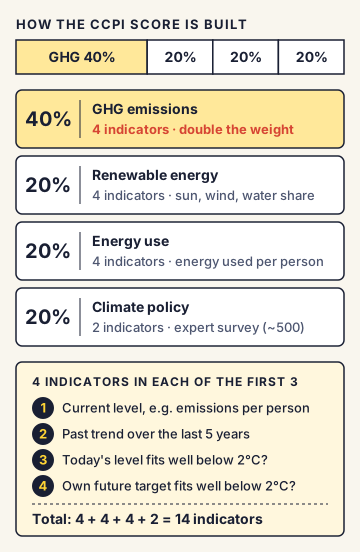
- GHG emissions: 40%. How much greenhouse gas the country releases.
- Renewable energy: 20%. How much of its energy comes from sources like sun, wind and water.
- Energy use: 20%. How much energy it uses, especially per person.
- Climate policy: 20%. How good its national and international climate policies are.
There are 14 indicators in total. The first three categories have four indicators each:
- Current level (for example, emissions per person today).
- Past trend (is it going up or down over the last five years).
- Well-below-2°C fit of the current level (is today's level in line with the Paris goal).
- Well-below-2°C fit of the future target (is the country's own target in line with the Paris goal).
The climate policy category has two indicators: national climate policy and international climate policy. These are judged through a yearly questionnaire filled in by climate and energy experts from the countries being assessed (about 500 experts in total).
Where does the data come from?
About 80% of the score comes from hard numbers. These come from the International Energy Agency (IEA), the Food and Agriculture Organization (FAO), the PRIMAP emissions database and the national greenhouse gas reports that countries send to the UN. Only emissions produced inside a country are counted. Emissions linked to goods a country imports are not counted against it.
Why are the top three ranks always empty?
The makers say that no country is yet doing enough to meet the Paris goals. So no country gets a "very high" score in every category. To make this point, ranks 1, 2 and 3 are left blank every year. The best country is therefore placed 4th. This is why Denmark, the top performer, is shown as "4th" and not "1st". Countries are also grouped into rating bands: very high, high, medium, low and very low.
How has India performed?
India's story on the CCPI has two halves:
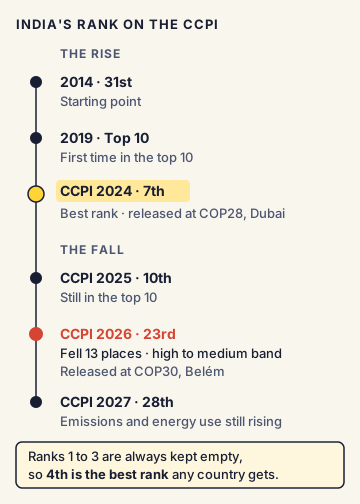
- The rise: India was 31st in 2014. It entered the top 10 for the first time in 2019. It stayed in the top 10 for six editions in a row, reaching 7th in CCPI 2024 (released at COP28 in Dubai). Low emissions per person, low energy use per person and strong renewable growth lifted it.
- The fall: India dropped to 10th in CCPI 2025, then fell 13 places to 23rd in CCPI 2026 (released at COP30 in Belém, Brazil), and to 28th in CCPI 2027. The main reason is that its emissions and energy use, though still low per person, are rising. India also still depends heavily on coal for electricity.
India's clean energy growth is real. As of July 2026, India had about 300 GW of non-fossil power capacity (solar, wind, hydro, nuclear and bio-power), more than 54% of its total installed capacity of about 552 GW. But the CCPI rewards falling emissions, and a fast-growing economy like India's is still increasing its total energy demand.
Commonly confused concepts
- CCPI vs Climate Risk Index (CRI): Both come from Germanwatch. The CCPI measures what a country does to fight climate change. The CRI measures how badly a country suffers from extreme weather like floods and storms.
- CCPI vs Environmental Performance Index (EPI): The EPI is made by Yale and Columbia universities in the US. It covers the whole environment (air, water, forests, waste, climate) for about 180 countries. The CCPI covers only climate and energy, for about 60 major emitters.
- CCPI vs Emissions Gap Report: The Emissions Gap Report is made by the UN Environment Programme (UNEP). It does not rank countries. It measures the gap between what the world is set to emit and what it should emit to meet the Paris goals.
- Rank vs rating: A country can fall in rank but stay in the same rating band, or the reverse. India fell from the "high" band to the "medium" band in CCPI 2026.
Issues, criticism and the way forward
- Per person vs total emissions: India argues that what matters is fairness. The average Indian emits far less than the average person in rich countries. Critics of the index say it does not give enough weight to this, or to the fact that rich countries caused most past emissions.
- Development needs: Hundreds of millions of Indians still need more electricity, homes, roads and jobs. Some energy growth is unavoidable. Giving a "very low" rating to rising energy use can look unfair to a developing country.
- Relative scoring: More than half of the indicators judge countries against each other, not against a fixed standard. So a country can fall because others improved, even if it did not get worse.
- Expert opinion: The policy score depends on expert surveys, which can be subjective.
- The other side: The makers argue that the atmosphere responds only to total emissions, and every country's rising emissions make the problem worse. They point out that none of the largest emitters is on a path that fits the Paris Agreement.
- The way forward suggested for India: better energy efficiency, more investment in grids and battery storage so that renewable power is fully used, and a clear plan and timeline to reduce coal use.
Concepts to Know
- Greenhouse gases (GHGs): Gases like carbon dioxide and methane that trap heat in the air, like a blanket around the Earth. More of them means a hotter planet.
- Renewable energy: Energy from sources that do not run out, like sunlight, wind and flowing water.
- Non-fossil capacity: Power plants that do not burn coal, oil or gas. It includes renewables and also nuclear power.
- Installed capacity: The maximum power that all power plants in a country can produce. A solar plant does not produce at full capacity at night, so capacity is not the same as the electricity actually generated.
- Well below 2°C: The main goal of the Paris Agreement: keep the rise in the Earth's average temperature well below 2°C above the level before industries began (around 1850 to 1900), and try to limit it to 1.5°C.
- Germanwatch: A non-profit group based in Bonn, Germany, that works on climate and development issues.
- Published by Germanwatch, NewClimate Institute and Climate Action Network (CAN); first published in 2005; released every year at the COP
- CCPI 2027 covers 64 countries + the EU; together more than 90% of global GHG emissions
- 4 categories: GHG emissions 40%, renewable energy 20%, energy use 20%, climate policy 20%
- 14 indicators; method revised in 2017 to match the Paris Agreement
- Ranks 1 to 3 are always kept empty; the best performer is placed 4th
- India: 31st (2014) → first time in top 10 (2019) → 7th (CCPI 2024) → 10th (CCPI 2025) → 23rd (CCPI 2026) → 28th (CCPI 2027)
● Tracked since August 14, 2026 · last seen November 12, 2026 · updates as the daily brief publishes