Climate Change Litigation
Climate change litigation means going to court to make governments or companies act on climate change, or to make them pay for climate harm. People and groups file such cases to force deeper cuts in greenhouse gas emissions, to protect rights hurt by climate change, or to win compensation for damage like floods and melting glaciers. It has grown fast in the last two decades and is now a major tool of climate action alongside treaties and laws.
Why does it exist?
Countries have signed climate treaties like the Paris Agreement, but these mostly rely on voluntary promises. Many people feel governments and big polluters are not doing enough. Courts offer another route. A court can order a government to meet its targets, or hold a company responsible for its share of harm. In simple words: when promises are not kept, people ask a judge to step in.
Where did it come from?
Early cases in the 2000s, mostly in the United States, tried to use environmental laws against emissions. The big turn came after 2015:
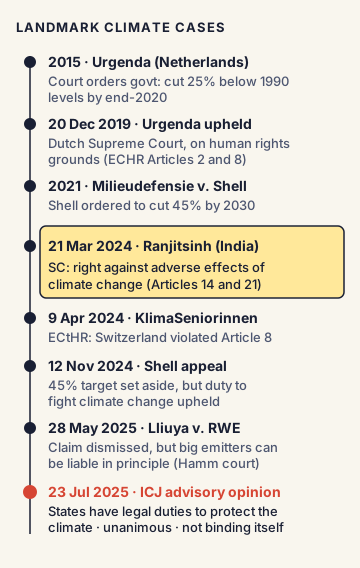
- Urgenda Foundation v. State of the Netherlands: A Dutch court in 2015 ordered the government to cut emissions by at least 25% below 1990 levels by the end of 2020. The Dutch Supreme Court upheld this on 20 December 2019, saying the government's duty came from the rights to life and to private and family life (Articles 2 and 8 of the European Convention on Human Rights). It was the first time a court ordered a country to cut emissions on human rights grounds.
- Juliana v. United States (filed 2015): 21 young people argued that US energy policy violated their constitutional rights. A federal appeals court dismissed it in 2020, and the US Supreme Court declined to hear it on 24 March 2025.
- Milieudefensie v. Royal Dutch Shell: In 2021, a Dutch court ordered Shell to cut its emissions by 45% by 2030 (compared with 2019). On 12 November 2024, the appeal court set aside that specific target, but agreed that Shell has a duty to help fight dangerous climate change.
- KlimaSeniorinnen v. Switzerland: On 9 April 2024, the European Court of Human Rights (Grand Chamber) held that Switzerland had violated Article 8 of the European Convention by not doing enough on climate change. It was the first such finding by that court.
- Lliuya v. RWE (Germany): A Peruvian farmer, Saúl Luciano Lliuya, sued the German energy company RWE. He said melting glaciers threatened to flood his home town of Huaraz, and RWE had caused about 0.47% of global emissions since industrialisation. On 28 May 2025, the Higher Regional Court of Hamm dismissed his claim because the flood risk to his house was found to be low. But the court accepted that, in principle, a major emitter can be held liable under civil law for its share of climate harm.
- ICJ Advisory Opinion (23 July 2025): At the request of the UN General Assembly (Resolution 77/276 of 29 March 2023, led by Vanuatu), the International Court of Justice unanimously said that states have legal duties to protect the climate, and that breaking them can be an internationally wrongful act that may require full reparation.
How does a climate case work? The three main types
- Cases against governments (rights-based): Citizens argue that weak climate action violates their rights to life, health or a clean environment. Urgenda and KlimaSeniorinnen are examples. The usual remedy is an order to do more.
- Cases against companies for emission cuts: Groups ask a court to order a company to cut its emissions, as in the Shell case.
- Cases against companies for compensation (damages): Victims ask a polluter to pay for harm or for protection costs, as in Lliuya v. RWE. A Nepal case would fall in this group.
The legal hurdles: why compensation cases are hard
Most compensation cases are based on tort law, the part of civil law that deals with harm one person causes another (for example, a neighbour's wall falling on your car). To win, a victim normally must prove four things:
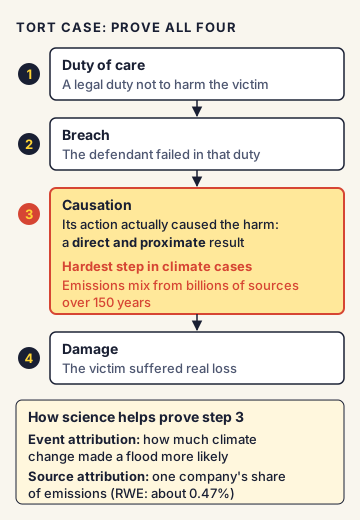
- Duty of care: the defendant had a legal duty not to harm the victim.
- Breach: the defendant failed in that duty.
- Causation: the defendant's action actually caused the harm. Courts often ask whether the harm was a direct and proximate (close, foreseeable) result of the action.
- Damage: the victim suffered real loss.
Climate cases struggle mainly with causation. Emissions from one company mix with emissions from billions of sources worldwide over 150 years. So it is hard to say that one company's emissions caused one particular flood. A second hurdle is jurisdiction: a Nepali victim would usually have to sue in the country where the company is based, under that country's law.
How science is helping: attribution
Two kinds of research are narrowing the causation gap:
- Extreme event attribution: scientists use climate models to estimate how much climate change made a particular flood or heatwave more likely or more intense.
- Source attribution (the "Carbon Majors" research): a 2014 study by Richard Heede found that 90 entities (oil, gas, coal and cement producers) were linked to about 63% of industrial carbon dioxide and methane emitted between 1751 and 2010. A 2024 update found that 57 producers were linked to about 80% of global fossil fuel and cement carbon dioxide emissions from 2016 to 2022. Together, these allow lawyers to argue that a company caused a measurable share of a measurable harm, as in the RWE case.
India's position and Indian examples
- In M.K. Ranjitsinh v. Union of India (judgment of 21 March 2024), a case about protecting the Great Indian Bustard from power lines, the Supreme Court recognised a right to be free from the adverse effects of climate change, linked to Article 21 (right to life) and Article 14 (right to equality).
- Indian courts have long protected the environment through Public Interest Litigation (PIL) and doctrines like the polluter pays principle and the precautionary principle.
- In international talks, India stresses Common But Differentiated Responsibilities and Respective Capabilities (CBDR-RC): rich countries that emitted most in the past should do more and pay more. India has supported the Loss and Damage Fund as a way for developed countries to help vulnerable developing countries.
Commonly confused concepts
- Climate litigation vs climate negotiation: Litigation happens in courts and can produce binding orders in a single case. Negotiation happens between countries at UN conferences (COPs) and produces treaties and decisions.
- Mitigation vs adaptation vs loss and damage: Mitigation means cutting emissions. Adaptation means adjusting to climate change (like building flood walls). Loss and damage means the harm that remains even after both.
- Advisory opinion vs judgment (ICJ): A judgment settles a dispute between two countries and binds them. An advisory opinion is legal advice to a UN body and is not binding in itself, though it carries great legal weight.
- Liability vs responsibility: In climate talks, "responsibility" (as in CBDR) is a political and moral idea. "Liability" means a legal duty to pay compensation, which most rich countries refuse to accept in treaty texts.
- Polluter pays vs precautionary principle: Polluter pays means whoever causes pollution must bear the cost of fixing it. The precautionary principle means acting to prevent serious harm even before full scientific proof.
Issues, criticism and the way forward
- Supporters' view: Litigation gives voice to victims, especially in poor countries that contributed little to climate change. Even lost cases, like Lliuya v. RWE, set useful legal principles.
- Critics' view: Some argue courts are the wrong place for climate policy, because judges are not elected and climate choices involve trade-offs best made by parliaments. Others say suing a few companies ignores the role of every consumer of fossil fuels.
- Practical barriers for South Asian victims: Cases in foreign courts are expensive and slow, need foreign lawyers, and depend on foreign laws. The causation standard of "direct and proximate" harm remains hard to meet.
- Way forward: Experts suggest stronger attribution science, collective cases by groups of victims, using the ICJ advisory opinion as a guide, and pairing litigation with funding routes such as the Fund for responding to Loss and Damage.
Concepts to Know
- Tort: A wrongful act by one person that causes harm to another, for which the victim can claim compensation in a civil court. Negligence and nuisance are common torts.
- Causation: The link between an action and a harm. In law, the victim must show the defendant's action actually led to the injury.
- Jurisdiction: The authority of a court to hear a case, based on where the parties are or where the events happened.
- Reparation: Making up for a wrong. It can mean restoring what was lost (restitution), paying money (compensation) or formally acknowledging the wrong (satisfaction).
- Attribution science: A branch of climate science that estimates how much human-caused climate change contributed to a particular weather event.
- European Convention on Human Rights: A human rights treaty of the Council of Europe (1950). The European Court of Human Rights in Strasbourg enforces it.
- Urgenda (Netherlands): at least 25% cut below 1990 levels by end-2020; upheld by Dutch Supreme Court, 20 December 2019
- Juliana v. United States: filed 2015; US Supreme Court declined to hear it, 24 March 2025
- Milieudefensie v. Shell: 2021 order of 45% cut by 2030 set aside on appeal, 12 November 2024
- KlimaSeniorinnen v. Switzerland: ECtHR Grand Chamber, 9 April 2024, violation of Article 8
- Lliuya v. RWE: Higher Regional Court of Hamm, 28 May 2025; claim dismissed, but corporate liability accepted in principle; RWE share about 0.47% of historical global emissions
- ICJ Advisory Opinion on climate change: 23 July 2025, unanimous; requested by UNGA Resolution 77/276 (29 March 2023)
- Carbon Majors: 90 entities about 63% of emissions 1751-2010 (2014); 57 producers about 80% of CO2 emissions 2016-2022 (2024)
- India: M.K. Ranjitsinh v. Union of India, 21 March 2024, right against adverse effects of climate change (Articles 14 and 21)
● Tracked since November 09, 2026 · last seen November 09, 2026 · updates as the daily brief publishes