Climate and Clean Air Coalition (CCAC)
The Climate and Clean Air Coalition, or CCAC, is a voluntary global partnership that works to cut short-lived climate pollutants: methane, black carbon, hydrofluorocarbons (HFCs) and ground-level ozone. Its partners are governments, international bodies and non-governmental organisations. It is not a treaty and sets no legally binding targets. Instead, it helps countries plan, find money and share know-how to cut these pollutants, which both warm the planet and dirty the air we breathe.
Why does it exist?
Most climate talks focus on carbon dioxide (CO₂). CO₂ stays in the air for centuries, so cutting it today slows warming only slowly. Short-lived climate pollutants are different. They leave the air within a few days to a few decades (methane, the longest-lived of the main ones, lasts about 12 years). So cutting them reduces warming within a few decades.
They also cause air pollution, which kills millions of people every year. So one action brings two benefits: cleaner air now and less warming soon. Before the CCAC, no global body focused only on these pollutants.
Which pollutants does it target?
- Methane: a gas from rice fields, cattle, landfills, coal mines and oil and gas leaks. It stays in the air for about 12 years. Over 20 years, it traps about 80 times more heat than the same amount of CO₂.
- Black carbon: soot from incomplete burning of fuels, wood and waste. It stays in the air for only days to weeks.
- Hydrofluorocarbons (HFCs): man-made gases used in air conditioners and refrigerators. They do not harm the ozone layer, but many of them trap hundreds to thousands of times more heat than CO₂.
- Ground-level (tropospheric) ozone: a harmful gas that is not released directly. It forms near the ground when sunlight acts on other pollutants, such as nitrogen oxides, volatile organic compounds (gases from fuels, paints and solvents) and methane. Methane is a major cause of ground-level ozone across the world. It damages lungs and reduces crop yields.
Where did it come from?
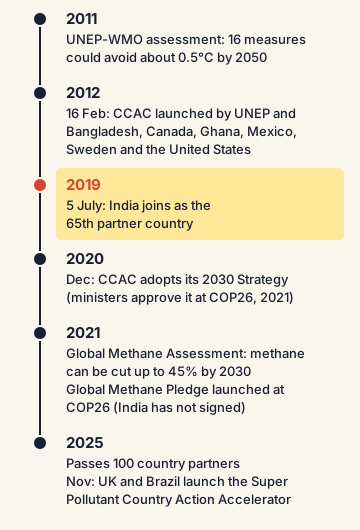
In 2011, UNEP (the UN Environment Programme) and WMO (the World Meteorological Organization) published an Integrated Assessment of Black Carbon and Tropospheric Ozone. It found that 16 measures, if put in place by 2030, could avoid about 0.5°C of warming by 2050. This report gave the scientific push for a coalition. On 16 February 2012, UNEP and six countries launched the CCAC: Bangladesh, Canada, Ghana, Mexico, Sweden and the United States. Over time, more countries joined. India joined on 5 July 2019 as the 65th partner country.
How has it grown?
- 2020 to 2021: the CCAC adopted its 2030 Strategy (December 2020), which ministers approved at COP26 in Glasgow in November 2021. The strategy set up "hubs" for key sectors, such as agriculture, waste, household energy, cooling, oil and gas, transport and brick making.
- 2021: UNEP and the CCAC released the Global Methane Assessment. It found that human-caused methane can be cut by up to 45% this decade (by 2030), avoiding nearly 0.3°C of warming by the 2040s and about 2,60,000 early deaths a year.
- 2021 onwards: the CCAC was asked to support countries in carrying out the Global Methane Pledge, launched at COP26 by the US and the EU.
- 2025: the CCAC passed 100 country partners. By the end of 2025 it had 102 country partners and 104 non-state partners. In November 2025, the UK and Brazil launched the Super Pollutant Country Action Accelerator under the CCAC. It aims to help 30 developing countries make fast cuts in super pollutants by 2030, starting with funding for seven.
How does it work?
The CCAC works through cooperation, not rules. Think of it like a study group: no one is forced to study, but members share notes, help each other and sometimes pool money for a tutor.
- Partners: countries (state partners) and non-state partners such as UN bodies, research institutes and NGOs.
- Ministerial meeting: ministers from partner countries meet every year to set direction and raise ambition.
- Board: a smaller group (earlier called the Steering Committee) that oversees work plans and budgets. Two countries serve as co-chairs; as of 2025, the United Kingdom and Brazil.
- Secretariat: hosted by UNEP in Paris. It runs meetings and manages money.
- Trust Fund: a UN-hosted fund, filled by donor countries, that pays for projects approved in the yearly work plan.
What does it aim for?
The CCAC says fast global action could cut methane by at least 40% and black carbon by up to 70% by 2030, compared with 2010 levels. It supports national plans on SLCPs, helps countries add these pollutants to their climate pledges (NDCs), and runs projects such as cleaner brick kilns, landfill gas capture, cleaner diesel vehicles and clean cooking.
India's position and Indian examples
India joined the CCAC in 2019, saying it would share lessons from its National Clean Air Programme (NCAP), launched in January 2019. Many Indian schemes match the CCAC's sectors:
- Pradhan Mantri Ujjwala Yojana (2016): LPG connections that replace smoky chulhas, cutting black carbon.
- Bharat Stage VI fuel standards (2020): cleaner diesel vehicles.
- Zig-zag brick kilns: a cleaner kiln design promoted to cut soot from brick making.
- Kigali Amendment: India's Union Cabinet approved ratification in August 2021. India will freeze HFC use in 2028 and then cut it in steps from 2032.
But India has not joined the Global Methane Pledge. Most of India's methane comes from farming, mainly rice paddies and cattle. The government has said that cutting it could hurt the livelihoods of small farmers and food security.
Commonly confused concepts
- CCAC vs UNFCCC: the UNFCCC is a binding treaty with yearly COPs. The CCAC is a voluntary partnership with no legal targets.
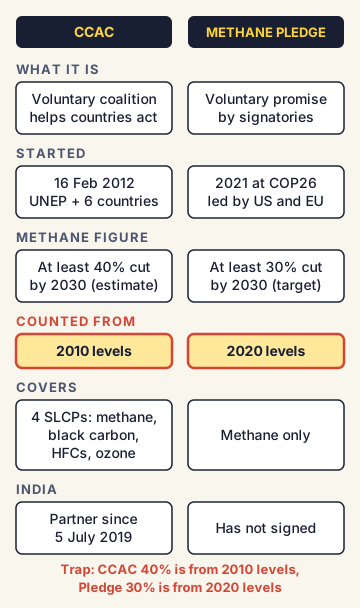
- CCAC vs Global Methane Pledge: the Pledge (2021) is a promise by signatories to cut global methane at least 30% below 2020 levels by 2030. The CCAC is the coalition that helps carry it out. India is a CCAC partner but has not signed the Pledge. Do not mix up the numbers: the Pledge's 30% is counted from 2020 levels, while the CCAC's estimate of at least 40% is counted from 2010 levels.
- CCAC vs Clean Air Fund: the Clean Air Fund is a separate philanthropic organisation that funds clean-air work and supports groups like the black carbon peer network. It is not part of the UN.
- CCAC vs Kigali Amendment: the Kigali Amendment (2016) to the Montreal Protocol legally binds countries to phase down HFCs. The CCAC only helps countries act; it binds no one.
- Tropospheric ozone vs stratospheric ozone: ozone high up in the stratosphere is "good" because it blocks harmful ultraviolet rays. Ozone near the ground (troposphere) is "bad" because it harms lungs and crops. The CCAC works on the ground-level kind.
- UNEP headquarters vs CCAC secretariat: UNEP's headquarters is in Nairobi, Kenya. But the CCAC secretariat sits in UNEP's office in Paris, France.
Issues, criticism and the way forward
- Voluntary nature: since the CCAC sets no binding targets, progress depends on each country's will and money.
- Too little money: a 2025 Clean Air Fund assessment found that black carbon projects got less than 0.5% of development finance in 2023.
- Methane still rising: global methane emissions have kept rising despite the pledges.
- Livelihood concerns: in countries like India, methane comes from small farms, so cuts must protect farmers' incomes.
- Not a substitute for CO₂ cuts: experts stress that cutting SLCPs buys time but does not replace cutting CO₂, which decides long-term warming.
- Way forward: more finance for developing countries, adding SLCPs to national climate plans, better emissions data, and linking clean-air goals with health and farm policies.
Concepts to Know
- Short-lived climate pollutant (SLCP): a pollutant that warms the planet but stays in the air for a short time (a few days to a few decades), unlike CO₂, which stays for centuries.
- Super pollutants: a newer, popular name for strong short-lived warming agents, mainly methane, HFCs and black carbon.
- UNEP (United Nations Environment Programme): the UN's main environment body. Its headquarters is in Nairobi, Kenya. It hosts the CCAC secretariat at its office in Paris, France.
- NDC (Nationally Determined Contribution): each country's own climate action plan under the Paris Agreement.
- Montreal Protocol (1987): a treaty to protect the ozone layer by phasing out ozone-harming chemicals. Its Kigali Amendment (2016) added HFCs. HFCs do not harm the ozone layer; they were added because they trap a lot of heat.
- Non-state partner: a member that is not a government, such as a research institute, UN agency or NGO.
- Launched 16 February 2012 by UNEP and six countries: Bangladesh, Canada, Ghana, Mexico, Sweden and the United States
- Targets four SLCPs: methane, black carbon, HFCs and tropospheric (ground-level) ozone
- Secretariat hosted by UNEP in Paris; voluntary, not a treaty
- India joined on 5 July 2019 as the 65th partner country
- 2030 Strategy adopted December 2020, approved by ministers at COP26 (November 2021)
- 2011 UNEP-WMO assessment: 16 measures could avoid about 0.5°C of warming by 2050
- 2021 Global Methane Assessment: methane can be cut by up to 45% this decade (by 2030), avoiding nearly 0.3°C of warming by the 2040s
- 2025: passed 100 country partners; 102 country partners and 104 non-state partners by the end of the year
- Super Pollutant Country Action Accelerator: launched November 2025 by the UK and Brazil; aims to help 30 developing countries by 2030
- Global Methane Pledge (COP26, 2021): at least 30% cut below 2020 levels by 2030; India has not signed
● Tracked since November 19, 2026 · last seen November 19, 2026 · updates as the daily brief publishes