Black Carbon as a Short-Lived Climate Pollutant (SLCP)
Black carbon is the black soot that comes out when fuel does not burn completely. You see it in the dark smoke from an old diesel truck, a wood-fired chulha or a burning crop field. It is a tiny particle that floats in the air, damages our lungs and heart, and also warms the planet. Because it stays in the air for only a few days to weeks, it is called a short-lived climate pollutant (SLCP).
Why does it matter?
Black carbon causes two problems at once.
- Health: it is a major toxic part of PM2.5 (fine particles small enough to go deep into the lungs and blood). Harmful chemicals stick to the soot particles, so they are more dangerous than other dust of the same weight.
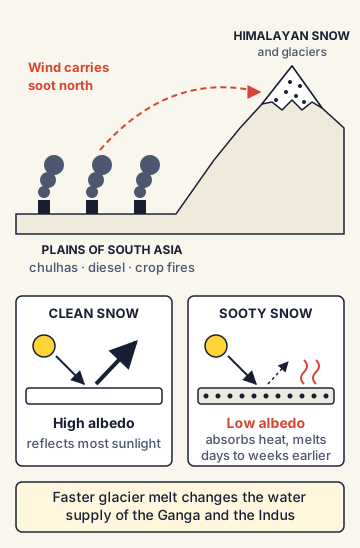
- Climate: being black, it absorbs sunlight and heats the air around it. When it settles on snow and ice, it darkens the white surface. A darker surface reflects less sunlight and absorbs more heat, so the ice melts faster.
So cutting black carbon is called a "double win": cleaner air for people now, and less warming in the near term.
How is it formed, and where does it come from?
Fuel burns fully when it gets enough oxygen and heat. Then it turns mostly into carbon dioxide and water. When burning is incomplete, part of the carbon is left as tiny black particles. The main sources are:
- Transport: diesel vehicles, especially old ones without filters.
- Household fuel: cooking and heating with wood, cow dung cakes, crop waste, coal and kerosene lamps.
- Open burning: crop residue (stubble) burning, forest fires and garbage burning.
- Industry: brick kilns, small factories and diesel generators.
In India, household burning of solid fuels and diesel use are among the biggest sources.
How long does it last, and why does that matter?
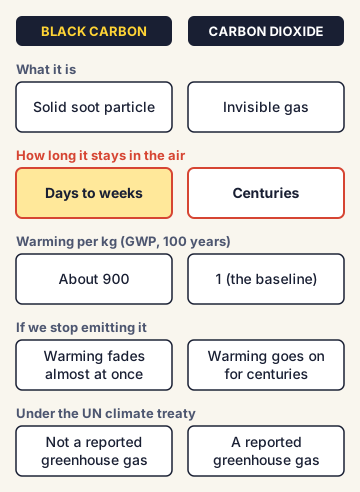
Carbon dioxide stays in the atmosphere for centuries. Black carbon falls out of the air within days to weeks, washed down by rain or settling on the ground. This has a big advantage. If we stop emitting it, its warming effect fades almost at once. Think of a tap and a bucket: CO2 fills a bucket that takes centuries to empty, while black carbon is like water running through a sieve, which stops as soon as you close the tap.
That is why scientists say cutting SLCPs is one of the fastest ways to slow warming over the next few decades, while CO2 cuts work over the long term.
How strong a warming agent is it?
Per kilogram, black carbon traps far more heat than CO2. The IPCC's Fifth Assessment Report (2013) gave it a Global Warming Potential (GWP) of about 900 over 100 years, meaning one kilogram warms about 900 times as much as one kilogram of CO2 over a century (and much more over 20 years). A major scientific assessment in 2013 (Bond and others) found black carbon to be the second most important human-made warming agent after CO2, though other studies give lower estimates.
Its effect is complicated, because it is often released with other particles that cool the planet. So the net effect differs from source to source.
The other SLCPs
Black carbon is one of four main short-lived climate pollutants:
- Black carbon (days to weeks)
- Methane (about 12 years)
- Tropospheric (ground-level) ozone (weeks)
- Hydrofluorocarbons (HFCs) (most last about 15 years)
Black carbon and ground-level ozone are air pollutants, not greenhouse gases in the legal sense of the UN climate treaty.
Black carbon and the Himalayas
Soot from the plains of South Asia travels with winds and settles on Himalayan snow and glaciers. Studies in Nepal have found that black carbon can reduce how much sunlight the snow reflects (its albedo) by several per cent, making snow melt days to weeks earlier. Faster glacier melt affects water supply for rivers like the Ganga and the Indus, which hundreds of millions of people depend on.
How is it governed internationally?
There is no global treaty that sets binding black carbon cuts.
- UNFCCC and Paris Agreement: black carbon is not one of the greenhouse gases that countries must report under the climate treaty. But countries may include it in their national climate plans (NDCs). Mexico, for example, pledged in 2015 to cut black carbon by 51% by 2030.
- Gothenburg Protocol (under the UNECE Convention on Long-range Transboundary Air Pollution, covering Europe and North America): amended on 4 May 2012 (in force 7 October 2019). It became the first binding agreement with targets for PM2.5, and asks countries to give priority to cutting PM2.5 from sources rich in black carbon. Reporting of black carbon itself is voluntary.
- Climate and Clean Air Coalition (CCAC): launched on 16 February 2012 by Bangladesh, Canada, Ghana, Mexico, Sweden and the United States, with the UN Environment Programme (UNEP). It is a voluntary partnership to cut SLCPs. India joined in July 2019.
- Arctic Council: its members agreed in 2015 to voluntary steps to cut black carbon and methane, because soot speeds up Arctic ice melt.
- WHO Global Air Quality Guidelines (2021): they have no number limit for black carbon, but advise countries to measure it and reduce it.
India's position and Indian examples
India has no separate legal standard for black carbon; it is controlled as part of PM2.5 and PM10. Several Indian policies cut black carbon even though that is not their main label:
- Pradhan Mantri Ujjwala Yojana (PMUY, 2016): free LPG connections to poor households, to replace smoky chulhas.
- Bharat Stage VI (BS-VI) fuel and vehicle norms (April 2020): require diesel particulate filters that trap soot.
- National Clean Air Programme (NCAP, 2019): targets cutting PM levels in over 130 cities.
- Rules on brick kilns (zig-zag technology) and crop residue burning (happy seeder machines, bio-decomposers).
Commonly confused concepts
- Black carbon vs brown carbon: black carbon is pure soot that strongly absorbs all sunlight. Brown carbon comes from burning wood and organic matter at lower temperatures; it absorbs mainly ultraviolet and blue light and is weaker.
- Black carbon vs carbon dioxide: CO2 is an invisible gas that lasts centuries. Black carbon is a solid particle that lasts days to weeks.
- Black carbon vs PM2.5: PM2.5 is a size class (all particles 2.5 micrometres or smaller). Black carbon is one type of particle inside PM2.5.
- Black carbon vs "blue carbon": blue carbon is carbon stored by coastal ecosystems like mangroves and seagrass. It has nothing to do with soot.
Issues, criticism and the way forward
- No binding targets: cuts are mostly voluntary, and black carbon falls in a gap between air pollution law and climate law.
- Poor monitoring: most countries, including India, do not measure black carbon regularly in their air quality networks, so inventories (lists of how much comes from where) are weak.
- Hard-to-reach sources: millions of small sources (household chulhas, small industries, farm fires) are difficult to regulate. Many Ujjwala users still go back to firewood because refills cost money.
- Not a substitute for CO2 cuts: experts warn that cutting SLCPs buys time but cannot replace deep cuts in CO2.
- Way forward: add black carbon to air quality monitoring, build emission inventories, put clear targets in NDCs, push clean cooking and clean transport, and count the health savings when deciding policies.
Concepts to Know
- Incomplete combustion: Burning without enough oxygen or heat, which leaves behind soot, smoke and carbon monoxide.
- Albedo: How much sunlight a surface reflects. Fresh snow has high albedo (very reflective); dark soil or soot has low albedo.
- Global Warming Potential (GWP): A number comparing how much heat a gas or particle traps compared with the same weight of CO2 over a period, usually 100 years. CO2 has a GWP of 1.
- Microgram per cubic metre (µg/m³): The unit for air pollution. One microgram is one millionth of a gram, measured in one cubic metre of air.
- Emissions inventory: A detailed list showing how much of a pollutant is released, and from which sources, in a country or city.
- Black carbon: product of incomplete burning; part of PM2.5; lasts days to weeks
- One of four main SLCPs: black carbon, methane, tropospheric ozone, HFCs
- GWP (100-year) about 900 (IPCC AR5); second-largest human warming agent after CO2 in Bond et al. (2013)
- Gothenburg Protocol amendment: adopted 4 May 2012, in force 7 October 2019; first binding PM2.5 targets
- CCAC: launched 16 February 2012 (six countries plus UNEP); India joined July 2019
- WHO Global Air Quality Guidelines: 2021; WHO black carbon health review first done in 2012
- India: PMUY (2016), BS-VI (2020), NCAP (2019) all reduce black carbon
● Tracked since September 18, 2026 · last seen November 17, 2026 · updates as the daily brief publishes