China–Pakistan Strategic Partnership and Military-Technical Cooperation
China and Pakistan are two neighbours of India that have built one of the closest partnerships in the world. China is Pakistan's biggest supplier of weapons, its biggest investor through a corridor of roads, power plants and ports, and its strongest diplomatic friend. The two call it an "all-weather" friendship, meaning it stays firm in good and bad times. For India, this partnership matters because it links its two hostile borders into one security problem.
Why did the two come together?
The main reason is a shared rival: India. China fought India in 1962 and has an unsettled border with it. Pakistan has fought India several times over Jammu and Kashmir. Each country sees the other as a way to keep India busy on a second front. There is an old saying that fits: "the enemy of my enemy is my friend." Pakistan also gives China a land route to the Arabian Sea, and China gives Pakistan weapons and money that it cannot easily get elsewhere.
How did the partnership begin?
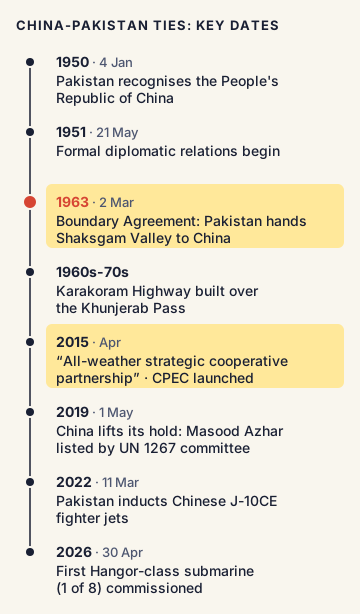
- Pakistan recognised the People's Republic of China on 4 January 1950, one of the first countries to do so. The two set up formal diplomatic relations on 21 May 1951. They marked 75 years of ties in May 2026.
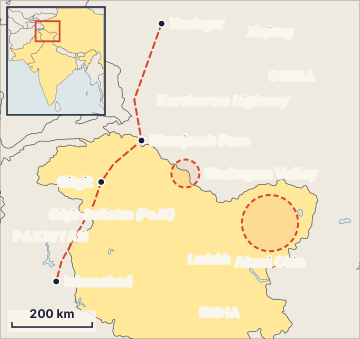
- On 2 March 1963, they signed the Sino-Pakistan Boundary Agreement. Under it, Pakistan handed over the Shaksgam Valley in the Trans-Karakoram Tract to China. India says this is Indian territory, about 5,180 sq km, which Pakistan had no right to give away. India has never accepted this agreement.
- Article 6 of the agreement itself says it is provisional: after the Kashmir dispute is settled, the "sovereign authority concerned" will reopen talks on the boundary with China.
- From the 1960s to the late 1970s, the two built the Karakoram Highway, which links Pakistan to China's Xinjiang region over the Khunjerab Pass. It runs through Gilgit-Baltistan, part of Pakistan-occupied Jammu and Kashmir (PoJK).
- In April 2015, during the Chinese President's visit to Pakistan, the two raised ties to an "all-weather strategic cooperative partnership". The same year, the China-Pakistan Economic Corridor (CPEC) was formally launched.
How does the military-technical cooperation work?
"Military-technical cooperation" means more than buying weapons off a shelf. It includes building weapons together, sharing technology, training, and giving access to systems such as satellites. Think of it like a family business: one side brings the factory and know-how, the other brings the workshop and the users. The main parts are:
- Fighter jets: the JF-17 Thunder was jointly developed by China's Chengdu Aircraft Corporation and the Pakistan Aeronautical Complex at Kamra, and is built in Pakistan. Pakistan also formally inducted the Chinese J-10CE fighter on 11 March 2022.
- Missiles: Pakistan uses the Chinese PL-15E long-range air-to-air missile on its JF-17 Block III and J-10CE jets. Its export version is reported to have a range of about 145 km.
- Air defence: Pakistan has acquired the Chinese HQ-9/P long-range surface-to-air missile system.
- Navy: four Type 054A/P (Tughril-class) frigates were built in China and delivered to Pakistan by 2023. In 2015, Pakistan signed a deal for eight Hangor-class submarines: four to be built in China and four in Pakistan. The first, PNS Hangor, was commissioned on 30 April 2026.
- Nuclear energy: China has built nuclear power reactors for Pakistan, including at Chashma and Karachi.
The key numbers
According to the Stockholm International Peace Research Institute (SIPRI), China supplied 81% of Pakistan's arms imports in 2020 to 2024, up from 74% in 2015 to 2019. SIPRI's March 2026 data put the share at 80% for 2021 to 2025. Pakistan is also the largest buyer of Chinese weapons: roughly 61% to 63% of China's arms exports in 2020 to 2024 went to Pakistan (estimates differ slightly between sources).
Diplomatic cover at the UN
China has often used its position as a permanent member of the UN Security Council to protect Pakistan-based terrorists from being listed. A listing under the UNSC "1267" sanctions committee freezes a person's money and bans travel and weapons supply. China can stop a listing by placing a "technical hold" on it.
- China blocked the listing of Jaish-e-Mohammed chief Masood Azhar several times, and lifted its hold only on 1 May 2019, when he was listed.
- China put a hold on the India-US proposal to list Lashkar-e-Taiba's Abdul Rehman Makki in June 2022; he was finally listed on 16 January 2023.
What did India see during Operation Sindoor?
In July 2025, India's Deputy Chief of Army Staff, Lieutenant General Rahul R. Singh, said that during the May 2025 conflict China gave Pakistan "live inputs" on Indian military positions. He said about 81% of Pakistan's military hardware is Chinese, and that China used the conflict like a "live lab" to test its weapons against other systems.
He also said India faced three adversaries on one border, with Turkey also supplying drones to Pakistan. Pakistan denied these claims, and China neither confirmed nor denied its role.
India's position and the "two-front" problem
A two-front war means having to fight on two borders at the same time: with Pakistan in the west and China in the north. Indian military planners have treated this as a serious risk for years. India's position has three parts:
- India objects to CPEC because it passes through Gilgit-Baltistan, which India says is part of Jammu and Kashmir. India calls this a violation of its sovereignty and territorial integrity.
- India does not accept the 1963 boundary agreement or China's control of the Shaksgam Valley.
- India is building its own defences: modernising its armed forces, making more weapons at home, and working more closely with partners such as the United States, France and the Quad countries.
Commonly confused concepts
- Shaksgam Valley vs Aksai Chin: both are claimed by India and held by China. But Aksai Chin (in Ladakh) was occupied by China itself in the 1950s and the 1962 war. The Shaksgam Valley was handed to China by Pakistan under the 1963 agreement.
- "All-weather strategic cooperative partnership" vs a military alliance: China and Pakistan have no formal mutual defence treaty that forces one to fight for the other. Their partnership is very close, but it is not a treaty alliance like NATO.
- CPEC vs BRI: the Belt and Road Initiative (BRI) is China's worldwide plan for roads, ports and railways, launched in 2013. CPEC is one part of the BRI, running from Xinjiang in China to Gwadar port in Pakistan's Balochistan.
- Arms import share vs hardware share: "81% of Pakistan's arms imports" (SIPRI, 2020 to 2024) is about new weapons bought in a period. It is not the same as the share of all weapons Pakistan owns. Do not mix up the two.
Issues, criticism and the way forward
- Combined threat: Chinese satellites, radars and long-range missiles can make Pakistan's forces stronger in a crisis even if China does not fire a shot. This makes a short India-Pakistan conflict harder to manage.
- Debt and security in Pakistan: CPEC has added to Pakistan's debt, and Chinese workers on CPEC projects have been attacked by militant groups, especially in Balochistan.
- Limits of the partnership: some experts point out that China wants stability in South Asia to protect its investments, so it may not back Pakistan in every escalation.
- The way forward suggested by experts: stronger air defence and long-range strike for India, faster domestic defence production, better space-based surveillance, and diplomacy that keeps the India-China border calm while India builds strength.
Concepts to Know
- Military-technical cooperation: Working together on weapons: joint design, joint production, sharing technology and training, not just buying and selling.
- Technical hold: A tool in UN sanctions committees that lets one member pause a listing proposal. Committees decide by consensus, so one hold can stop a listing.
- 1267 sanctions committee: A UN Security Council committee that lists people and groups linked to ISIL (Da'esh) and Al-Qaida. Listing freezes their money and bans their travel and arms supply.
- Two-front war: A war in which a country must fight enemies on two different borders at the same time.
- SIPRI: The Stockholm International Peace Research Institute, a research body in Sweden that tracks global arms sales and military spending.
- Strategic autonomy: A country's freedom to decide its foreign policy by its own interests, without being tied to any one big power.
- Diplomatic relations: 21 May 1951; Pakistan recognised the PRC on 4 January 1950
- Sino-Pakistan Boundary Agreement: 2 March 1963; Shaksgam Valley (about 5,180 sq km, per India) handed to China; Article 6 calls it provisional
- "All-weather strategic cooperative partnership": April 2015; CPEC formally launched in 2015
- SIPRI: China supplied 81% of Pakistan's arms imports in 2020 to 2024 (74% in 2015 to 2019)
- J-10CE inducted by Pakistan on 11 March 2022; JF-17 jointly developed by Chengdu Aircraft Corporation and Pakistan Aeronautical Complex
- Eight Hangor-class submarines ordered in 2015; first commissioned 30 April 2026
- Masood Azhar listed by the UN 1267 committee on 1 May 2019; Abdul Rehman Makki on 16 January 2023, after China lifted its holds
● Tracked since May 12, 2026 · last seen November 21, 2026 · updates as the daily brief publishes