BRICS Parliamentary Forum
How BRICS Parliaments Work Together
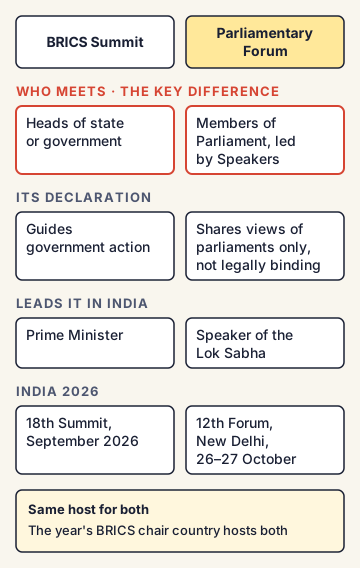
The BRICS Parliamentary Forum is a yearly meeting of members of Parliament from the BRICS countries. BRICS is a group of major emerging economies such as Brazil, Russia, India, China and South Africa. Leaders of these countries meet at the BRICS Summit; the Parliamentary Forum is the place where their parliaments meet. Delegations are usually led by the presiding officers (Speakers or Chairpersons) of each Parliament. Each forum ends with a joint declaration that sets out the shared views of the member parliaments.
Why does it exist?
BRICS began as a club of governments. Its summits and ministers' meetings are run by the executive (the government of the day). But in a democracy, Parliament makes laws, approves budgets and ratifies or debates international agreements. Many BRICS decisions, such as on trade, finance, counter-terrorism laws or digital rules, finally need laws passed by national parliaments.
The forum lets lawmakers understand these commitments, share experience and build friendship among people's representatives. This kind of contact between legislatures is called parliamentary diplomacy. Think of it as a "second track" beside the governments: if the leaders' summit is the main road, the parliamentary forum is a parallel road that carries the same traffic of ideas.
Where did it come from?
BRIC lawmakers first met informally in 2011, on the sidelines of a G20 parliamentary meeting. The forum proper began in 2015.
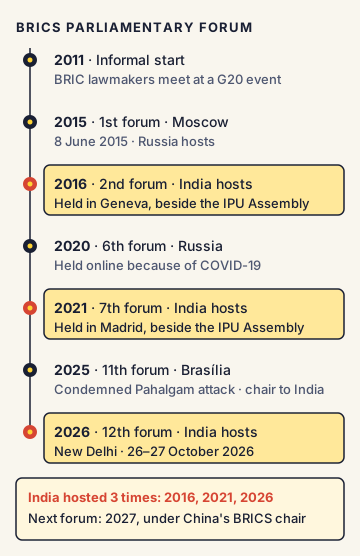
- 1st forum: Moscow, Russia, 8 June 2015.
- 2nd: hosted by India, October 2016, held in Geneva on the sidelines of the 135th Assembly of the Inter-Parliamentary Union (IPU).
- 3rd to 5th (2017–2019): hosted by China, South Africa and Brazil, each held on the sidelines of IPU Assemblies (St Petersburg, Geneva and Belgrade).
- 6th: Russia, 27 October 2020, held online because of COVID-19.
- 7th: hosted by India, 27 November 2021, on the sidelines of the 143rd IPU Assembly in Madrid.
- 8th: China, 6 September 2022, online.
- 9th: South Africa, Johannesburg, 27–28 September 2023.
- 10th: Russia, St Petersburg, July 2024. Theme: "Role of Parliaments in Strengthening Multilateralism for Just Global Development and Security".
- 11th: Brazil, Brasília, June 2025. Its declaration condemned the Pahalgam terrorist attack of 22 April 2025. India was handed the chair for the next forum.
- 12th: India, New Delhi, 26–27 October 2026.
How does it work?
The forum follows the yearly BRICS chairship, which rotates among the members, broadly in the order of the letters B-R-I-C-S. The country that chairs BRICS in a year also hosts the Parliamentary Forum.
- The host Parliament's presiding officer (in India, the Speaker of the Lok Sabha) chairs the forum. In India, the Lok Sabha Secretariat organises it.
- Delegations from each member Parliament attend, usually led by their Speaker or deputy.
- Sessions are held on themes chosen by the host, for example development, technology, climate or security.
- At the end, members adopt a joint declaration by consensus (all agree; there is no voting).
- The chair then passes to the next BRICS chair country.
The key parts and facts
- Members: the parliaments of all 10 BRICS members. Egypt, Ethiopia, Iran and the UAE joined BRICS in January 2024, and Indonesia in January 2025. Partner countries are invited to take part as well.
- Nature: the forum is consultative. Its declarations are political statements of shared views. They are not legally binding on any country.
- BRICS Women Parliamentarians' Forum: a related track for women lawmakers. India hosted a meeting in Jaipur on 20–21 August 2016, which adopted the Jaipur Declaration. The 2026 declaration marked its 10th anniversary and called for making it a yearly event.
- Link with the IPU: many early forums were held on the sidelines of Inter-Parliamentary Union Assemblies. In 2026, members noted a proposal to form a "BRICS Plus" group inside the IPU.
India's position and Indian examples
India has hosted the forum three times: 2016, 2021 and 2026. India uses the forum to build support for its key concerns. The most important is terrorism: India has pushed for clear condemnation of cross-border terrorism, action against terror financing and safe havens, and the early adoption of the CCIT, which India proposed at the UN in 1996.
The forum's condemnation of the Pahalgam attack in both 2025 and 2026 reflects this. India also uses it to push for UN Security Council reform, Global South priorities, and digital public infrastructure (for example, the 2026 declaration noted a proposed BRICS repository for digital public infrastructure). India hosted the leaders' 18th BRICS Summit in September 2026 and the Parliamentary Forum in October 2026 under the same chairship.
Commonly confused concepts
- BRICS Parliamentary Forum vs BRICS Summit: The Summit is a meeting of heads of state or government; its declarations guide government action. The Parliamentary Forum is a meeting of legislators; its declarations express parliamentary views only.
- BRICS Parliamentary Forum vs Inter-Parliamentary Union (IPU): The IPU is a global organisation of national parliaments, founded in 1889 and based in Geneva; India is a member. The BRICS forum covers only BRICS member parliaments.
- BRICS Parliamentary Forum vs P20: The P20 is the G20 Parliamentary Speakers' Summit, linked to the G20. India hosted the 9th P20 in New Delhi in October 2023, at Yashobhoomi in Dwarka, with the theme "Parliaments for One Earth, One Family, One Future".
- Joint declaration vs treaty: A joint declaration is a political promise and is not legally binding. A treaty creates legal obligations once ratified.
Issues, criticism and the way forward
- Non-binding outcomes: Declarations do not oblige governments or parliaments to act. Critics say this limits real impact.
- Different political systems: BRICS members range from multi-party democracies to one-party systems and monarchies. Legislatures play very different roles in each, which can make shared "parliamentary" positions shallow.
- Consensus dilutes text: Because everything needs agreement, sensitive issues are often written in general terms. For example, the 2026 declaration condemned the 22 April 2025 attack without naming who was responsible.
- Expansion strains: With 10 members and more partners, finding common ground is harder, especially on regional conflicts.
- Way forward: Suggestions include follow-up mechanisms to track declarations, working groups on themes such as AI or terrorism financing, sharing of legislative best practices, and a stronger women parliamentarians' track.
Concepts to Know
- Presiding officer: The person who runs the proceedings of a House of Parliament, such as the Speaker of the Lok Sabha or the Chairman of the Rajya Sabha.
- Parliamentary diplomacy: Contact and cooperation between parliaments and lawmakers of different countries, alongside the formal diplomacy of governments.
- Consensus: A way of deciding where a text is adopted only if no member objects. There is no vote.
- Chairship (of BRICS): The yearly turn of one member country to lead BRICS, host its meetings and set its agenda.
- Unilateral coercive measures: Economic steps, such as sanctions, that one country imposes on another without UN Security Council approval. Secondary sanctions punish third countries that trade with the sanctioned country.
- 1st forum: Moscow, 8 June 2015; informal BRIC lawmakers' meeting in 2011
- 12th forum: New Delhi, 26–27 October 2026, Samvidhan Sadan; theme "Fostering Parliaments for People-Centric Development"
- India hosted in 2016 (Geneva), 2021 (Madrid) and 2026 (New Delhi)
- Host = the year's BRICS chair; chaired in India by the Lok Sabha Speaker
- 10 member parliaments: Brazil, China, Egypt, Ethiopia, India, Indonesia, Iran, Russia, South Africa, UAE
- Declarations adopted by consensus; not legally binding
- BRICS Women Parliamentarians' Forum: Jaipur, 20–21 August 2016 (Jaipur Declaration)
- Next forum: 2027, under China's BRICS chairship
● Tracked since October 27, 2026 · last seen October 27, 2026 · updates as the daily brief publishes