Bond Prices and Bond Yields
The Inverse Relationship
A bond is a loan that an investor gives to a government or a company. In return, the borrower pays a fixed interest every year and returns the full amount at the end. The yield is the actual return an investor earns on a bond, based on the price paid for it. The most important rule of the bond market is simple: when bond prices go up, yields go down, and when bond prices go down, yields go up. This "see-saw" link explains why interest-rate changes by the RBI move bond markets, bank profits and government borrowing costs.
What is a bond, in plain words?
Imagine the government needs ₹100 today. It gives you a paper that says: "I will pay you ₹7 every year for 10 years, and return your ₹100 at the end." That paper is a bond. The ₹100 is the face value (the amount returned at the end). The ₹7 a year is the coupon (the fixed interest), so the coupon rate is 7%.
The end date is the maturity. Bonds can be bought and sold in the market before maturity, so their market price can change every day, even though the coupon stays fixed.
Why does the inverse relationship happen?
The coupon on an old bond never changes. Only its market price can change. Suppose you hold the 7% bond above.
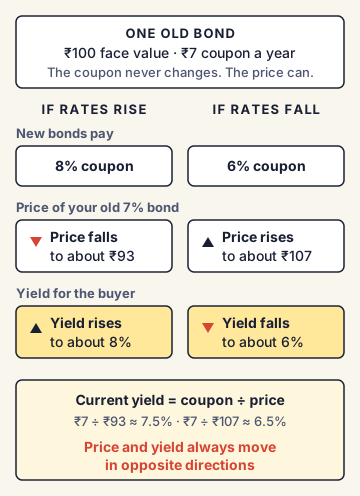
- Now the RBI raises interest rates, and new government bonds pay 8%. Nobody will pay ₹100 for your old bond that pays only ₹7, when a new one pays ₹8. To sell it, you must lower the price, say to about ₹93. A buyer now pays ₹93 and still gets ₹7 a year plus ₹100 at the end, so their return (yield) rises to about the new market level. Price fell, yield rose.
- If instead rates fall and new bonds pay 6%, your 7% bond becomes attractive. Buyers will pay more than ₹100 for it, say ₹107. Their return falls towards 6%. Price rose, yield fell.
A simple way to remember it: the yield is the coupon divided by the price you pay. The coupon is fixed, so if the price (the bottom number) goes up, the yield goes down.
Coupon rate, current yield and yield to maturity
- Coupon rate: the fixed yearly interest, as a percentage of face value. It never changes.
- Current yield: yearly coupon divided by today's market price. In the example, ₹7 ÷ ₹93 ≈ 7.5%.
- Yield to maturity (YTM): the full return if you buy today and hold until the end, counting both the coupons and the gain or loss when the bond is repaid at face value. When people say "the 10-year bond yield is X%", they usually mean YTM.
Why do longer bonds swing more?
A bond with 30 years left locks you into the old coupon for a very long time, so a change in market rates hits its price much harder than a bond with 1 year left. The measure of how sensitive a bond's price is to interest-rate changes is called duration. Higher duration means bigger price swings.
Government bonds in India
The government borrows mainly by selling Government Securities (G-Secs):
- Treasury Bills (T-Bills): short-term borrowing by the central government, for 91, 182 or 364 days. They pay no coupon. They are sold at a discount and repaid at face value; the difference is the investor's return.
- Dated securities: long-term bonds (usually 5 to 40 years) with a fixed or floating coupon.
- State Development Loans (SDLs): bonds sold by state governments.
- Cash Management Bills (CMBs): very short-term bills for temporary cash needs of the Centre.
The RBI manages government borrowing: it is the debt manager of the Centre under Section 21 of the RBI Act, 1934, and of states by agreement under Section 21A. It sells G-Secs through auctions. The Government Securities Act, 2006 governs how these securities are issued and transferred. The 10-year G-Sec yield is the country's "benchmark" rate. Banks, companies and investors watch it to judge long-term borrowing costs.
Who buys government bonds in India?
- Banks, partly because the Statutory Liquidity Ratio (SLR) requires them to keep a part of their deposits in safe assets such as G-Secs.
- Insurance companies, pension funds and mutual funds, which want safe, long-term returns.
- Foreign investors, especially after the RBI created the Fully Accessible Route (FAR) in 2020, under which certain government bonds have no limit on foreign holding. Indian government bonds joined J.P. Morgan's GBI-EM index from 28 June 2024, with India's weight rising 1% per month to a cap of 10% by March 2025. This brought in index-tracking foreign money.
- Ordinary people, through RBI Retail Direct, launched on 12 November 2021, which lets individuals open a gilt account directly with the RBI online, without fees.
How does the RBI's repo rate reach bond yields?
When the RBI raises the repo rate, short-term money becomes costlier. New bonds must offer higher yields to attract buyers. So yields on existing bonds rise and their prices fall. The RBI can also directly buy or sell G-Secs through Open Market Operations (OMOs). When the RBI buys bonds, it adds money to the system and pushes prices up (yields down). When it sells bonds, it takes money out and pushes prices down (yields up).
What do rising rates mean for banks?
Rising rates have two sides for banks:
- Good for margins: Loans linked to the repo rate (External Benchmark Lending Rate loans) reprice upward quickly. Deposit rates usually rise more slowly. So the gap between what banks earn and what they pay, called the Net Interest Margin (NIM), often widens for a while.
- Bad for bond holdings: Banks hold large amounts of G-Secs. When yields rise, the market value of these bonds falls. Banks must show some of these losses in their accounts, called mark-to-market (MTM) losses or treasury losses.
Why do bonds become attractive when rates peak?
An investor who buys bonds when yields are at their highest locks in a high return. If the RBI later starts cutting rates, yields fall and bond prices rise, giving the investor a capital gain too. That is why investors often return to bonds near the end of a rate-hike cycle.
India's position and examples
The Centre borrows mainly by selling dated G-Secs to fund its fiscal deficit (the gap between what it spends and what it earns). When bond yields rise, the government's cost of new borrowing goes up. Higher interest payments then use up a larger share of the Budget. Companies also pay more on their bonds, because corporate bond yields are usually set as "G-Sec yield plus an extra margin".
Commonly confused concepts
- Coupon rate vs yield: Coupon is fixed when the bond is issued. Yield changes every day with the market price.
- Repo rate vs 10-year bond yield: The repo rate is set by the RBI's MPC and is an overnight rate. The 10-year yield is set by buying and selling in the market and reflects expectations about inflation, government borrowing and future policy over 10 years.
- Bond vs share: A bondholder is a lender who gets fixed interest and is repaid first. A shareholder is an owner who gets a share of profits (dividends) and takes more risk.
- T-Bill vs dated security: T-Bills are short (up to 364 days) and have no coupon. Dated securities are long-term and pay coupons.
- Rising yields vs rising bond prices: These are opposites. "Bond markets rallied" means prices rose and yields fell.
Issues, criticism and the way forward
- Crowding out: Heavy government borrowing can push yields up and leave less money for private companies to borrow cheaply.
- Bank balance sheet risk: Sudden yield jumps can cause large mark-to-market losses for banks holding long bonds. The 2023 failure of Silicon Valley Bank in the US showed how unmanaged bond losses can hurt a bank.
- Foreign money can be fickle: Index-linked foreign investment brings funds but can also leave quickly, causing yield and rupee swings.
- Thin retail participation: Despite RBI Retail Direct, few households hold G-Secs directly.
- Way forward: Experts suggest a deeper corporate bond market, steady fiscal consolidation (cutting the deficit) to ease borrowing pressure, clear RBI communication to avoid sudden yield shocks, and wider retail access to bonds.
Concepts to Know
- Face value: The amount the borrower promises to repay at the end of the bond's life.
- Basis point (bp): One-hundredth of a percentage point. 100 bps = 1%. A rise in yield from 7.00% to 7.25% is a rise of 25 bps.
- Capital gain: The profit from selling something for more than you paid for it.
- Statutory Liquidity Ratio (SLR): The share of a bank's deposits it must keep in safe, liquid forms like cash, gold or government securities.
- Mark-to-market: Valuing an asset at today's market price, not the price paid for it.
- Fiscal deficit: The amount the government must borrow in a year because its spending is more than its income (excluding borrowing).
- Bond price and yield move in opposite directions
- Current yield = annual coupon ÷ market price; YTM = total return if held to maturity
- Longer duration = bigger price swing for the same change in rates
- T-Bills: 91, 182 and 364 days, issued at a discount, no coupon
- RBI is debt manager: Centre under Section 21, states by agreement under Section 21A, RBI Act, 1934; Government Securities Act, 2006
- Fully Accessible Route (FAR) for foreign investors: introduced 2020
- J.P. Morgan GBI-EM inclusion: from 28 June 2024, weight up to 10% (reached by March 2025)
- RBI Retail Direct: launched 12 November 2021
- 10-year G-Sec yield = India's benchmark long-term rate
● Tracked since October 10, 2026 · last seen October 10, 2026 · updates as the daily brief publishes