Blue-Water Navy
Sea Control, Reach and Staying Power
A blue-water navy is a navy that can sail far out into the open ocean, stay there for a long time, and fight there if needed, far away from its own coast. The name comes from the deep blue colour of the open sea, as opposed to the muddy brown of rivers and the greenish water near coasts.
Only a few countries have true blue-water navies, because it needs large ships, long-range weapons, and a strong system to keep ships supplied with fuel, food and ammunition. India has openly set itself the goal of becoming one.
Brown, green and blue: the three levels
Navies are often grouped by how far from home they can operate. These are not legal categories; they are a common way experts describe a navy's reach.
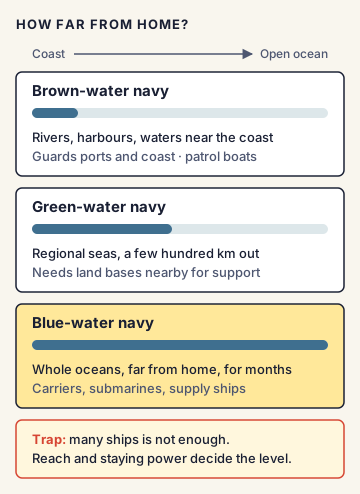
- Brown-water navy: Works in rivers, harbours and waters very close to the coast. Its job is mainly to guard ports and the coastline. Small patrol boats are typical.
- Green-water navy: Can operate in the seas near its own region, a few hundred kilometres out, but needs bases on land nearby for support.
- Blue-water navy: Can operate across whole oceans, far from home, for months. It needs aircraft carriers or long-range ships, submarines, and supply ships that refuel warships in the middle of the ocean.
Why does a country want a blue-water navy?
Think of a country's sea trade like goods moving on a highway. If someone blocks the highway far away from your city, your shop shelves become empty even though your own street is safe. About 95% of India's trade by volume (around 70% by value) and most of its oil imports come by sea. These ships pass through far-off narrow sea passages like the Strait of Hormuz and the Strait of Malacca. A navy that can only guard the coast cannot protect these routes. A blue-water navy can.
Where did the idea come from?
The modern thinking on sea power comes from an American naval officer, Alfred Thayer Mahan. In 1890 he wrote The Influence of Sea Power upon History. He argued that great powers rise when they control the sea lanes that carry trade. Britain in the 19th century and the United States after World War II are the classic examples of blue-water powers.
India's journey
After independence in 1947, India's Navy was small and focused on the coast. It grew step by step:
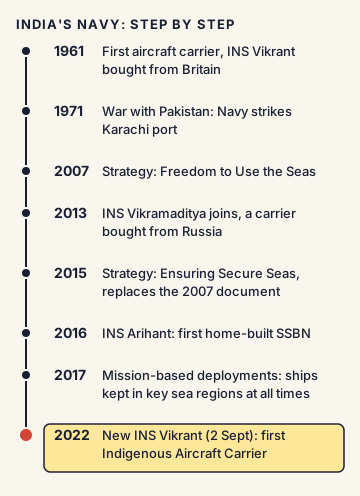
- 1961: India got its first aircraft carrier, INS Vikrant (bought from Britain).
- 1971: In the war with Pakistan, the Navy attacked Karachi port, showing it could strike beyond the coast.
- 2007: The Navy published Freedom to Use the Seas: India's Maritime Military Strategy.
- 2013: INS Vikramaditya, a carrier bought from Russia, joined the Navy.
- 2015: The Navy released a new strategy, Ensuring Secure Seas: Indian Maritime Security Strategy, which replaced the 2007 document.
- 2016: INS Arihant, India's first home-built nuclear-powered ballistic missile submarine, was commissioned.
- 2017: The Navy began mission-based deployments, keeping warships stationed in key parts of the Indian Ocean at all times instead of sending them only for short trips. Today the Navy keeps a continuous presence in about six key sea regions.
- 2022: The new, home-built INS Vikrant, India's first Indigenous Aircraft Carrier, was commissioned on 2 September 2022.
Sea control and sea denial: the two jobs
A blue-water navy does two kinds of fighting work. Students often mix these up.
- Sea control means you can use an area of sea freely for your own ships, while stopping the enemy from using it. It is like owning a road and putting your own guards on it.
- Sea denial means you stop the enemy from using the sea, even if you cannot use it safely yourself. It is like blocking a road so nobody can use it. Submarines and missiles are cheap tools of sea denial.
Sea control is harder and costlier. It needs carriers, many surface ships and air cover. Sea denial needs fewer, cheaper tools. A full blue-water navy can do both.
What does "sustain" mean, and why is it the hard part?
Fighting is only half the job. Ships burn fuel, sailors eat food, guns use ammunition, and machines break down. A ship far from home must get all of these at sea. This is done by fleet support ships (also called tankers or replenishment ships). They meet warships in the middle of the ocean and pass fuel and supplies while both ships keep moving.
This is called replenishment at sea. A navy that cannot do this must keep coming back to port, so its reach is short. When the Navy chief talks of a Navy that can "sustain without constraints", he means it should not depend on foreign ports, foreign spare parts or foreign supply chains in a crisis.
The building blocks of blue-water power
UPSC can ask about any of these:
- Aircraft carriers: Floating airbases. They give air cover far from land. India has two in service: INS Vikramaditya and INS Vikrant.
- Nuclear submarines: They can stay under water for months because they do not need air for their engines. India operates the Arihant class of nuclear-powered ballistic missile submarines (SSBNs).
- Destroyers and frigates: Large and medium warships that protect the fleet from air, surface and submarine threats.
- Fleet support ships: The "petrol pumps" of the ocean.
- Long-range maritime patrol aircraft: Planes like the P-8I that watch huge areas of ocean.
- Logistics agreements: Deals with friendly countries to use their ports and bases for fuel and repairs.
How big is India's Navy, and where is it going?
As of 2026, the Navy has roughly 130 to 145 warships and submarines, depending on how they are counted. Its plan is to grow to about 175 to 200 ships by 2035, with most of them built in India. The Navy has also said it aims to become a fully Aatmanirbhar (self-reliant) force by 2047, the 100th year of independence.
Logistics agreements: reach without bases
India does not build military bases abroad in the way some powers do. Instead, it signs logistics support agreements. These allow Indian ships to refuel and get repairs at a partner's base, and the partner gets the same at Indian bases. Payment is settled later.
- The first was LEMOA (Logistics Exchange Memorandum of Agreement) with the United States in 2016.
- India later signed similar deals with France (2018), Australia (2020), Japan (2020) and others, including Russia (RELOS, signed 2025).
- These agreements do not create foreign bases on Indian soil, and they do not make India a military ally of anyone.
India's position
India calls itself the "preferred security partner" and "first responder" in the Indian Ocean. Its regional vision is SAGAR (Security and Growth for All in the Region, 2015), widened to MAHASAGAR in 2025. A blue-water navy is what allows India to deliver on this: anti-piracy patrols in the Gulf of Aden since 2008, disaster relief, and evacuation of Indian citizens from war zones.
Commonly confused concepts
- Blue-water navy vs large navy: A navy can have many ships but still be a green-water navy if those ships are small and cannot stay far out at sea. Reach and staying power matter, not just numbers.
- Sea control vs sea denial: Control means you can use the sea; denial means only that the enemy cannot.
- Logistics agreement vs military alliance vs base: A logistics agreement only covers fuel, food, repairs and supplies on a pay-later basis. An alliance (like NATO) is a promise to defend each other. A base is a permanent military facility in another country. India has logistics agreements, but no formal military alliance.
- SSBN vs SSN: An SSBN is a nuclear-powered submarine that carries ballistic missiles (used for nuclear deterrence). An SSN is a nuclear-powered attack submarine used to hunt ships and other submarines.
Issues, criticism and the way forward
- Money: The Navy's share of the defence budget has often been smaller than the Army's and Air Force's. Big ships take many years and huge money to build.
- Slow shipbuilding: Indian shipyards have often delivered ships late. Faster building is needed to meet the 2035 target.
- Imported parts: Many engines, sensors and weapons on Indian ships still come from abroad. In a long war, a foreign supplier could stop deliveries.
- Carrier debate: Some experts argue a third aircraft carrier is essential for blue-water power. Others argue money is better spent on submarines, which are cheaper tools of sea denial.
- Way forward: Experts and official plans point to faster indigenous shipbuilding, more fleet support ships, more submarines, and deeper partnerships with friendly navies so that India can operate across the Indian Ocean and beyond.
Concepts to Know
- Sea lanes (Sea Lines of Communication, SLOCs): The main sea routes ships use to carry goods and oil between ports, like highways on the ocean.
- Choke point: A narrow sea passage that many ships must pass through, such as the Strait of Hormuz or the Strait of Malacca. Blocking it can stop a large part of world trade.
- Commissioned: The formal ceremony when a new ship officially joins the Navy and starts service.
- Nuclear deterrence: Keeping nuclear weapons so that no enemy dares to attack you, because they know you can hit back.
- Indian Ocean Region (IOR): The ocean area from the east coast of Africa to Australia, with India in the centre.
- Mahan's The Influence of Sea Power upon History: 1890
- Indian Navy strategy documents: Freedom to Use the Seas (2007); Ensuring Secure Seas (2015)
- Aircraft carriers in service: INS Vikramaditya (2013) and INS Vikrant (commissioned 2 September 2022, first Indigenous Aircraft Carrier)
- INS Arihant: first indigenous SSBN, commissioned 2016
- Fleet target: about 175 to 200 ships by 2035; fully Aatmanirbhar Navy by 2047
- LEMOA with the United States: 2016, India's first logistics agreement
- SAGAR announced 2015; MAHASAGAR in 2025
● Tracked since November 03, 2026 · last seen November 03, 2026 · updates as the daily brief publishes