Bigamy under Indian Law
Section 494 IPC and Section 82 BNS
Bigamy means marrying a second person while your first husband or wife is still alive and your first marriage has not legally ended. In India, for most people, bigamy is both a void marriage (the second marriage has no legal value) and a crime. The crime was in Section 494 of the Indian Penal Code (IPC), 1860. Since 1 July 2024, it is in Section 82 of the Bharatiya Nyaya Sanhita (BNS), 2023, which replaced the IPC.
Why does it exist?
Indian law for most communities follows monogamy: one person can have only one spouse at a time. Bigamy usually hurts the first spouse, mostly women, who may lose financial support, property rights and social standing. Making bigamy a crime protects the first spouse and the children of the first marriage.
Where did it come from?
The IPC of 1860 made bigamy a crime, but at that time many personal laws allowed more than one wife. After Independence, Parliament reformed Hindu law. The Hindu Marriage Act, 1955 made monogamy compulsory for Hindus, Buddhists, Jains and Sikhs. Other laws did the same for other groups, like the Special Marriage Act, 1954, the Parsi Marriage and Divorce Act, 1936 and the Indian Christian Marriage Act, 1872.
How does the law work?
The crime has a simple test with four parts:
- The person has a living husband or wife.
- The first marriage is legally valid and has not been dissolved.
- The person marries again.
- The second marriage is void because it takes place while the first spouse is alive.
The Hindu Marriage Act links the two laws. Section 5(i) says neither party may have a living spouse at the time of marriage. Section 17 says such a second marriage is void, and that the bigamy section of the criminal law applies to it.
Punishment and procedure
- Section 82(1) BNS (old Section 494 IPC): marrying again while a spouse is alive is punishable with imprisonment up to 7 years and a fine.
- Section 82(2) BNS (old Section 495 IPC): if the person hides the first marriage from the new partner, the punishment is up to 10 years and a fine.
- The offence is non-cognizable (police cannot arrest without a court warrant) and bailable.
- Under Section 219 of the Bharatiya Nagarik Suraksha Sanhita (BNSS), 2023 (old Section 198 CrPC), a court can take up the case only on a complaint by the person wronged, usually the first spouse, or certain close relatives on her behalf.
When is it not bigamy?
The law gives two exceptions:
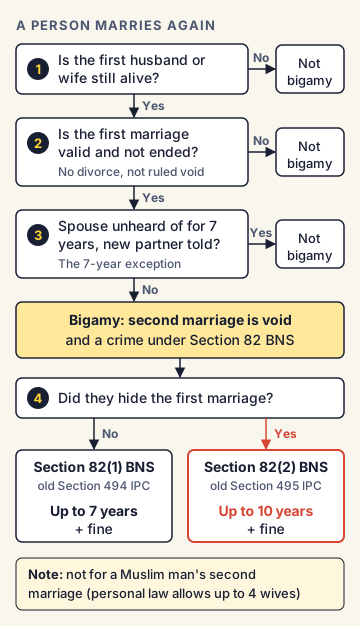
- the first marriage has been declared void by a competent court; or
- the first spouse has been continuously absent for 7 years and not heard of as alive, provided the person tells the new partner these facts before the marriage.
What about crimes abroad?
Indian criminal law applies to Indian citizens even for acts outside India. This was Section 4 of the IPC and is now in Section 1 of the BNS. In the 2026 ruling, the Court added a further point: the bigamy inquiry looks at the first marriage held in India, not just the place of the second marriage.
Landmark cases
- Sarla Mudgal v. Union of India (1995): A Hindu man cannot convert to Islam just to marry again without ending his first Hindu marriage. The first marriage continues, and the second marriage is bigamy.
- Lily Thomas v. Union of India (2000): Confirmed Sarla Mudgal. Converting to another religion does not by itself dissolve a Hindu marriage.
- Y. Narasimha Rao v. Y. Venkata Lakshmi (1991): A foreign divorce that does not meet Indian matrimonial law does not end the first marriage, so a second marriage after it can be bigamy.
India's position and Indian examples
Muslim personal law allows a man up to four wives. So, under central law, a Muslim man's second marriage is not void, and the bigamy section does not apply to him. Some states have gone further. Uttarakhand's Uniform Civil Code, 2024 bans bigamy and polygamy for all communities except Scheduled Tribes. Assam passed the Assam Prohibition of Polygamy Bill, 2025 in November 2025, with jail of up to 7 years (and up to 10 years for hiding an earlier marriage), and exemptions for Scheduled Tribes and Sixth Schedule areas. Goa's civil code also requires monogamy.
Commonly confused concepts
- Bigamy vs polygamy: Bigamy is having two spouses at once. Polygamy is the broader term for more than one spouse. Polygyny is one man with several wives; polyandry is one woman with several husbands.
- Void vs voidable marriage: A void marriage was never legally valid (like a bigamous marriage). A voidable marriage is valid until a court cancels it on a ground such as fraud or force.
- Section 82(1) vs 82(2) BNS: 82(1) is marrying again (up to 7 years). 82(2) is marrying again while hiding the first marriage (up to 10 years).
- Divorce vs annulment: Divorce ends a valid marriage. Annulment declares that a marriage was never valid.
Issues, criticism and the way forward
- Hard to prove: Courts require proof that the second marriage was performed with the essential ceremonies. Many cases fail because the second marriage was informal or hidden.
- Only the victim can complain: Because it is non-cognizable and needs the wronged spouse's complaint, many cases are never filed, often due to social or financial pressure.
- Unequal application: Different rules for different religions raise questions of equality under Article 14. Supporters of a Uniform Civil Code (Article 44) point to this. Others argue that personal law reform should come from within communities and respect religious freedom.
- Cross-border cases: NRI marriages create special problems: foreign divorces, remarriage abroad and spouses left behind in India. The way forward suggested by experts includes compulsory registration of marriages and clearer rules on recognising foreign divorces.
Concepts to Know
- Monogamy: Having only one husband or wife at a time.
- Bharatiya Nyaya Sanhita (BNS), 2023: The new criminal code that replaced the Indian Penal Code from 1 July 2024.
- Bharatiya Nagarik Suraksha Sanhita (BNSS), 2023: The new law on criminal procedure that replaced the Code of Criminal Procedure (CrPC) from 1 July 2024.
- Non-cognizable offence: A less serious offence where the police cannot arrest or investigate without a magistrate's permission.
- Bailable offence: An offence where the accused has a right to be released on bail.
- Personal laws: Laws on marriage, divorce, inheritance and adoption that differ by religion, like Hindu law and Muslim law.
- Bigamy: Section 494 IPC → Section 82(1) BNS; up to 7 years + fine
- Concealing the first marriage: Section 495 IPC → Section 82(2) BNS; up to 10 years + fine
- Complaint only by the aggrieved person: Section 198 CrPC → Section 219 BNSS
- Hindu Marriage Act, 1955: Section 5(i) (no living spouse), Section 17 (bigamous marriage void; criminal law applies)
- Exceptions: first marriage declared void, or spouse absent and unheard of for 7 years (with disclosure)
- Sarla Mudgal (1995) and Lily Thomas (2000): conversion does not dissolve a Hindu marriage
- Uttarakhand UCC (2024) and Assam's polygamy ban bill (2025) ban polygamy at state level, with Scheduled Tribe exemptions
● Tracked since November 11, 2026 · last seen November 11, 2026 · updates as the daily brief publishes