Bharatiya Antariksh Station (BAS)
The Bharatiya Antariksh Station (BAS) is India's planned space station: a large laboratory and home that will stay permanently in orbit around Earth, where Indian astronauts can live and work for weeks or months. It will be built in pieces, called modules, launched one by one and joined together in space. The first module, BAS-1, is targeted for 2028, and the full station with five modules is expected by 2035.
Today, the only space station run by a single country is China's Tiangong; the International Space Station is shared by several partners. BAS would make India, after China, only the second country of today to run a national space station of its own (the Soviet Union and the US ran their own stations in the past, such as Salyut, Mir and Skylab).
Why does India want a space station?
A short Gaganyaan trip of three days is like a short visit. A space station is like a permanent research base, similar to India's research stations in Antarctica. It allows:
- Long experiments in microgravity, the "nearly weightless" condition in orbit. Medicines, materials, plants and the human body behave differently there.
- Practice for longer journeys, such as an Indian crewed Moon landing by 2040. Astronauts must learn to live in space for long periods first.
- Independence: India would not have to depend on other countries' stations, such as the ageing ISS, for its astronauts.
- Commercial use and partnerships: Space stations can host experiments from industry, universities and other countries.
Where did it come from?
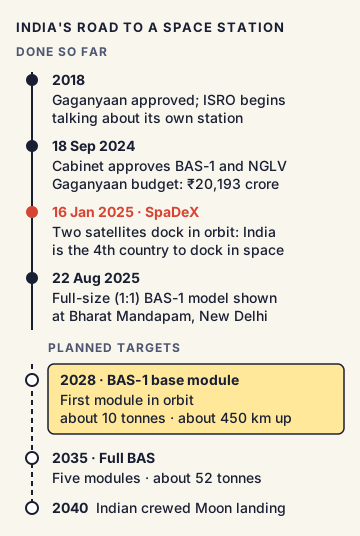
- ISRO began talking about its own space station after Gaganyaan was approved in 2018. The early target of about 2030 slipped because of Gaganyaan delays and the COVID-19 pandemic.
- On 18 September 2024, the Union Cabinet approved developing BAS-1 by widening the Gaganyaan programme. Its total budget was raised to ₹20,193 crore, with eight missions to be completed by December 2028.
- On the same day, the Cabinet also approved the Next Generation Launch Vehicle (NGLV), a new heavy rocket meant to help build the station and support later Moon missions.
- On 16 January 2025, ISRO's SpaDeX (Space Docking Experiment) mission docked two small satellites in orbit, making India the fourth country (after the US, Russia and China) to achieve space docking. Docking is the key skill needed to join station modules.
- On 22 August 2025, at the National Space Day celebrations at Bharat Mandapam, New Delhi, ISRO unveiled a full-size (1:1) model of the BAS-1 module.
How will the station be built?
Think of building a house in space, one room at a time:
- A rocket launches the first room, BAS-1 (the base module), into an orbit about 400-450 km above Earth.
- Later rockets bring more modules: a core module, a science module, a laboratory module and a berthing (connecting) module.
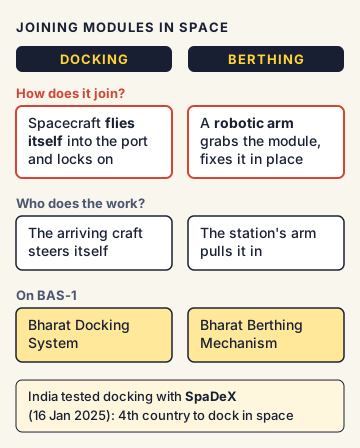
- Each new module meets the station and is joined using India's own Bharat Docking System and Bharat Berthing Mechanism.
- Gaganyaan spacecraft carry crews to and from the station.
- Supply flights bring food, water, air and equipment.
The key facts
- Modules planned: five (BAS-01 Base Module, plus core, science, laboratory and common berthing modules).
- Total mass: about 52 tonnes for the complete station, as reported (much smaller than the ISS).
- BAS-1 module: about 10 tonnes, planned for an orbit of about 450 km. It will carry an indigenous Environmental Control and Life Support System (ECLSS), the Bharat Docking System, the Bharat Berthing Mechanism and viewports.
- Crew: around 3-4 astronauts normally, with stays of a few months envisioned.
- Launch vehicles: LVM3 and, later, the Next Generation Launch Vehicle.
- Partners: ISRO and the European Space Agency (ESA) signed a joint statement of intent in May 2025 for cooperation, including on human spaceflight.
India's wider space roadmap
BAS fits into a step-by-step plan:
- Gaganyaan (first crewed flight) → BAS-1 in 2028 → full BAS by 2035 → Indian crewed Moon landing by 2040.
- Related missions include Chandrayaan-4, a planned lunar sample-return mission that will also use docking technology.
Commonly confused concepts
- BAS vs ISS vs Tiangong: The International Space Station (ISS) is run by the US, Russia, Europe, Japan and Canada. It has been occupied since 2000 and is planned to retire around 2030. Tiangong is China's own space station, completed in 2022. BAS is India's planned national station.
- Docking vs berthing: In docking, a spacecraft flies itself into the port and locks on. In berthing, a robotic arm grabs the arriving module and fixes it in place.
- Space station vs spacecraft: A spacecraft like Gaganyaan travels to orbit and returns. A space station stays in orbit for many years, and crews come and go.
- BAS vs Gaganyaan: Gaganyaan is the "taxi" that carries astronauts. BAS is the "house" they will live and work in.
Issues, criticism and the way forward
- Funding beyond BAS-1: The Cabinet approval covers BAS-1 and precursor missions. Money for the remaining modules will need further approvals.
- Dependent on Gaganyaan: The station needs a working crew vehicle. Delays in Gaganyaan push back the station too.
- Heavy-lift capacity: Building a 52-tonne station needs many reliable heavy launches. The new NGLV is important for this.
- Long-term operation: Running a station needs regular supply flights, repairs and a large budget every year, not just a one-time cost.
- Way forward: Experts suggest strong roles for private industry, international partnerships (such as with ESA), and using the station for paid research by industry to share costs.
Concepts to Know
- Module: A ready-made section of a space station, like one room or container, launched separately and joined to others in space.
- Microgravity: The condition in orbit where people and objects float, because they are falling around Earth continuously. Gravity is still there, but its effects are almost not felt.
- Docking: Joining two spacecraft together in orbit so that people, power or supplies can pass between them.
- Life support system (ECLSS): The equipment that supplies oxygen, removes carbon dioxide, controls temperature and humidity, and manages water and waste so that people can live in space.
- Next Generation Launch Vehicle (NGLV): A new, partly reusable heavy rocket that ISRO is developing to carry heavier loads than LVM3.
- Cabinet approval for BAS-1 (by widening Gaganyaan): 18 September 2024; Gaganyaan total raised to ₹20,193 crore (additional ₹11,170 crore); 8 missions by December 2028
- BAS-1 (base module) target: 2028; full station with 5 modules: 2035
- Planned orbit: about 400-450 km (BAS-1 at about 450 km); BAS-1 about 10 tonnes; complete station about 52 tonnes
- BAS-1 features: indigenous ECLSS, Bharat Docking System, Bharat Berthing Mechanism
- Full-size BAS-1 model unveiled: 22 August 2025, Bharat Mandapam, New Delhi (National Space Day celebrations)
- SpaDeX docking: 16 January 2025; India the 4th country to dock in space (after US, Russia, China)
- Next Generation Launch Vehicle approved: 18 September 2024
- Indian crewed Moon landing goal: 2040
● Tracked since March 23, 2026 · last seen October 21, 2026 · updates as the daily brief publishes