Battery Waste Management Rules, 2022
The Battery Waste Management Rules, 2022 are India's main rules for what must happen to batteries once they are used up. They make the companies that sell batteries responsible for collecting the old ones and getting them recycled or refurbished. They also set targets for how much material recyclers must recover from old batteries, and how much recycled material must go into new batteries. The rules cover every kind of battery: from a phone battery to an electric car battery.
Why do these rules exist?
A used battery is both a danger and a treasure. It is a danger because it holds toxic chemicals and metals that can poison soil and water, and lithium-ion batteries can catch fire if crushed or thrown in garbage. It is a treasure because it holds costly metals like lithium, cobalt and nickel that India mostly imports.
Without rules, old batteries end up in dumps or with informal scrap dealers who break them unsafely. The rules try to send every used battery to a proper recycler, so the metals come back into use and pollution is avoided.
Where did they come from?
Before 2022, India had the Batteries (Management and Handling) Rules, 2001. These dealt only with lead-acid batteries, the kind used in cars and inverters. As phones, laptops, solar storage and EVs spread, lithium-ion batteries became common, and the old rules did not cover them. A draft of new rules was published in February 2020. The Ministry of Environment, Forest and Climate Change (MoEFCC) then notified the Battery Waste Management Rules, 2022 in August 2022, replacing the 2001 rules.
They were made under the Environment (Protection) Act, 1986 (using powers under Sections 3, 6, 8 and 25). The rules have since been amended several times: in October 2023, March 2024, June 2024, December 2024 and February 2025.
Which batteries are covered?
The rules divide batteries into four types:
- Portable battery: sealed, weighs less than 5 kg, and is not meant for industrial use, EVs or vehicles (for example, phone, laptop and torch batteries).
- Automotive battery: used to start, light and ignite a vehicle.
- Electric vehicle (EV) battery: used to run an electric vehicle.
- Industrial battery: meant for industrial uses, including batteries used in energy storage systems.
How does Extended Producer Responsibility work here?
The heart of the rules is Extended Producer Responsibility (EPR). This means the company that puts a battery on the market stays responsible for it even after it is sold, until it is safely recycled. A "producer" includes a company that makes and sells batteries under its own brand, one that sells batteries made by others under its own brand, and one that imports batteries or equipment containing batteries. The steps are:
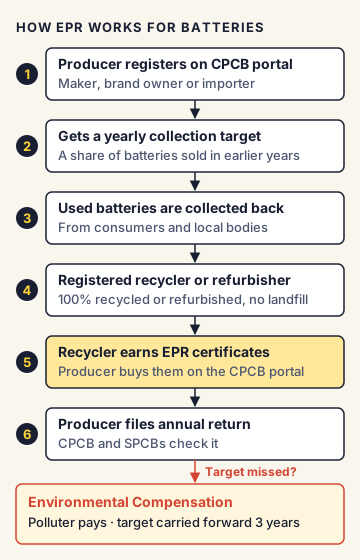
- Every producer must register with the Central Pollution Control Board (CPCB) on its online portal.
- Each year, the producer gets a collection target: it must make sure a fixed share of the batteries it sold in earlier years is collected back. For rechargeable consumer-electronics batteries, the target rose from 50% (2022-23) to 70% from 2024-25 onwards, measured against batteries sold some years earlier.
- All collected batteries must be 100% recycled or refurbished.
- Registered recyclers and refurbishers earn EPR certificates for the waste they process. Producers buy these certificates on the CPCB portal to show they have met their targets.
- Producers file annual returns, and the CPCB and State Pollution Control Boards (SPCBs) check them.
A simple way to picture it: think of a school that hands out library books. EPR is like making the school responsible for getting every book back, and the EPR certificate is the receipt from the library that says "this many books came back safely".
What must recyclers recover?
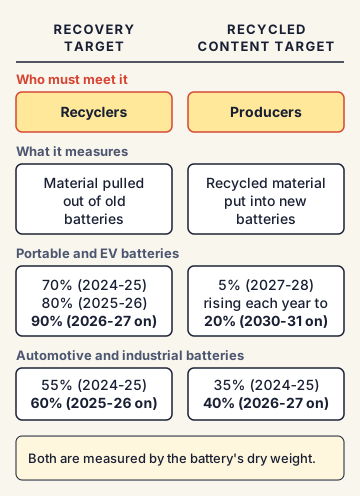
Recyclers must recover a minimum share of materials, measured as the weight of recovered material out of the dry weight of the battery:
- Portable batteries: 70% in 2024-25, 80% in 2025-26, 90% from 2026-27 onwards.
- EV batteries: 70% in 2024-25, 80% in 2025-26, 90% from 2026-27 onwards.
- Automotive batteries: 55% in 2024-25, then 60% from 2025-26 onwards.
- Industrial batteries: 55% in 2024-25, then 60% from 2025-26 onwards.
If a battery contains hazardous material that cannot be recovered, its target is reduced by that share.
How much recycled material must new batteries contain?
Producers must also use a minimum share of domestically recycled material in new batteries (by dry weight). For portable and EV batteries it is 5% in 2027-28, 10% in 2028-29, 15% in 2029-30 and 20% from 2030-31. For automotive and industrial batteries (mostly lead-acid, which is already widely recycled) it is 35% in 2024-25 and 2025-26, and 40% from 2026-27.
An importer who cannot meet this inside the battery can meet it by getting other businesses to use that much recycled material, or by exporting it.
Other key rules
- No landfill, no burning: waste batteries must not be sent to landfills or incinerated.
- Labelling: every battery must carry the crossed-out wheeled bin symbol, which tells the buyer not to throw it in normal garbage. Batteries with mercury, cadmium or lead must show "Hg", "Cd" or "Pb". Since the 2025 amendment, producers may print a barcode or QR code carrying their EPR registration number.
- Duties of consumers and local bodies: consumers must throw old batteries separately and hand them to a collector or recycler. Panchayats and municipalities must pass any waste batteries they collect to registered recyclers or refurbishers.
What happens if a company fails?
Under the polluter pays principle, the CPCB charges Environmental Compensation on producers that miss targets, and SPCBs charge it on recyclers and collectors that break the rules. Paying does not cancel the duty: the unmet target is carried forward for up to three years. If the company makes up the gap later, part of the money is returned: 75% if fixed within one year, 60% within two years and 40% within three years.
After three years, the whole amount is forfeited. The money goes into a separate account used to collect and recycle the batteries that were missed. Serious cases can also be punished under Section 15 of the Environment (Protection) Act, 1986.
India's position and Indian examples
India is a fast-growing battery market because of EVs, solar storage and phones. It has very small reserves of lithium and cobalt, so recovering them from old batteries ("urban mining") is a cheap and secure supply. The rules link to other national efforts: the National Critical Mineral Mission (2025), the Critical Mineral Recycling Incentive Scheme (2025), and the PLI scheme for Advanced Chemistry Cell (ACC) batteries.
Trade rules support them too: in November 2026 the government banned exports of lithium-ion battery black mass so that the metals stay with Indian recyclers.
Commonly confused concepts
- Battery Waste Management Rules, 2022 vs E-Waste (Management) Rules, 2022: E-waste rules cover discarded electrical and electronic equipment (phones, laptops, fridges). Battery rules cover the batteries themselves. A phone is e-waste; the battery inside it is battery waste.
- Battery Waste Management Rules vs Hazardous and Other Wastes Rules, 2016: the Hazardous Waste Rules control the import and export of dangerous wastes and need prior permission for such shipments. The battery rules control collection and recycling inside India.
- Recycling vs refurbishment: recycling breaks the battery down to recover its materials. Refurbishment repairs or reuses a battery for a "second life", for example an old EV battery used to store solar power at home.
- Recovery target vs recycled-content target: the recovery target is a duty on recyclers (how much material they pull out). The recycled-content target is a duty on producers (how much recycled material goes into new batteries).
Issues, criticism and the way forward
- Informal sector: a large share of used batteries, especially lead-acid, is still handled by informal dealers who break them unsafely. Bringing them into the formal system is hard.
- Fake or paper compliance: experts worry that EPR certificates can be issued for waste that was never truly recycled, so strong audits are needed.
- Recyclers starved of feedstock: many Indian recyclers run below capacity because not enough batteries reach them, and some valuable black mass was being sold abroad. The export ban on black mass tries to fix this.
- Collection does not mean recovery: critics say the rules mainly make sure old batteries reach a recycler, but not that high-value metals like lithium are actually refined back into battery-grade material.
- Way forward: suggestions include a digital "battery passport" to track each battery through its life (the European Union is moving to this from 2027), better tracing on the CPCB portal, support for refining technology, and bringing informal workers into registered units.
Concepts to Know
- Lithium-ion battery: a rechargeable battery in which lithium ions move between two ends (electrodes) when it charges and discharges. It powers phones, laptops and EVs.
- Black mass: the dark powder made when used lithium-ion batteries are shredded. It holds lithium, cobalt, nickel, manganese and graphite, which can be extracted and reused.
- Extended Producer Responsibility (EPR): a rule that makes the maker, brand owner or importer of a product responsible for it after use, including collecting and recycling it.
- Dry weight: the weight of a battery's materials without the liquid (electrolyte) inside.
- Polluter pays principle: the idea that whoever causes pollution should pay for the damage and the clean-up.
- CPCB and SPCB: the Central Pollution Control Board is the national pollution watchdog; each state has a State Pollution Control Board that enforces rules locally.
- Urban mining: getting metals from old products (batteries, electronics) instead of digging them out of the ground.
- Notified by MoEFCC in August 2022 under the Environment (Protection) Act, 1986; replaced the Batteries (Management and Handling) Rules, 2001 (which covered only lead-acid batteries)
- Four battery types: portable (sealed, under 5 kg), automotive, EV, industrial
- Producers (including importers) register with CPCB; meet EPR through EPR certificates bought from registered recyclers and refurbishers
- Material recovery targets: portable and EV 70% (2024-25), 80% (2025-26), 90% (2026-27 onwards); automotive and industrial 55%, 60%, 60%
- Domestic recycled content in new portable and EV batteries: 5% (2027-28) rising to 20% (2030-31 onwards); automotive and industrial 35% rising to 40% (2026-27 onwards)
- Landfilling and incineration of waste batteries banned
- Environmental Compensation: levied by CPCB on producers, SPCBs on other entities; refund of 75% / 60% / 40% if shortfall fixed within 1 / 2 / 3 years
- Crossed-out wheeled bin symbol mandatory; QR code or barcode with EPR number allowed since the 2025 amendment
● Tracked since November 11, 2026 · last seen November 11, 2026 · updates as the daily brief publishes