Bal Vivah Mukt Bharat Abhiyan
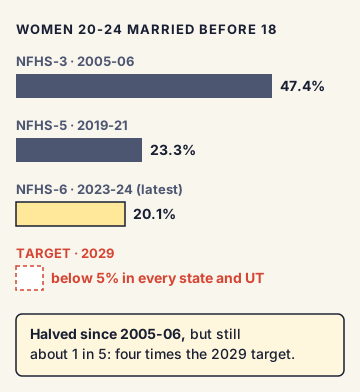
Bal Vivah Mukt Bharat Abhiyan (meaning "Child Marriage Free India Campaign") is a national campaign of the Government of India to end child marriage. It was launched on 27 November 2024 by the Ministry of Women and Child Development (MWCD). Its main goal is to bring the child marriage rate in every state and Union Territory below 5% by 2029. It works by combining law enforcement, a public complaint portal and awareness drives in schools, villages and religious places.
Why does it exist?
India's child marriage rate has fallen a lot, from 47.4% in NFHS-3 (2005-06) to 23.3% in NFHS-5 (2019-21). But about one in five young women was still married before 18. The fall had slowed, and a few states and districts carried most of the burden. A law already existed (the Prohibition of Child Marriage Act, 2006), but it was weakly enforced.
Many states had not even appointed full-time officers to enforce it. The campaign was started to give the existing law a push on the ground, with clear targets and close tracking.
Where did it come from?
The campaign builds on three earlier strands:
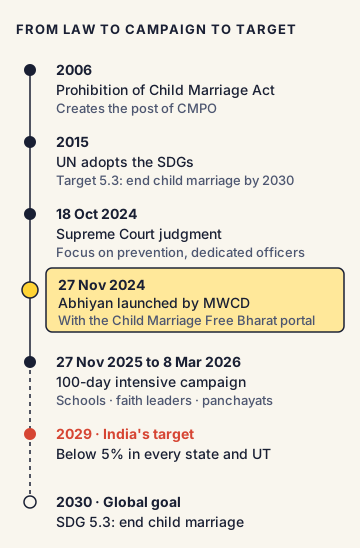
- The Prohibition of Child Marriage Act, 2006, which created the post of Child Marriage Prohibition Officer.
- The Supreme Court's judgment of 18 October 2024 (Society for Enlightenment and Voluntary Action v. Union of India), which asked governments to focus on prevention and to appoint dedicated officers.
- India's promise under the Sustainable Development Goals (SDGs). SDG Target 5.3 asks all countries to end child, early and forced marriage by 2030.
How does it work?
- Targets for states: States and UTs were asked to make their own action plans to bring child marriage below 5% by 2029.
- Focus on high-burden areas: The campaign gives special attention to seven high-burden states (West Bengal, Bihar, Jharkhand, Rajasthan, Tripura, Assam and Andhra Pradesh) and about 300 high-burden districts.
- Child Marriage Free Bharat portal: An online portal was launched along with the campaign. Any citizen can report a child marriage. The complaint goes directly to the Child Marriage Prohibition Officer (CMPO) of that area. States must register their CMPOs on the portal so that cases can be tracked in real time.
- Awareness and pledges: Schools, colleges, panchayats, faith leaders and community groups take pledges and run campaigns.
- Convergence with other schemes: The campaign works with schemes that keep girls in school and support families, such as Beti Bachao Beti Padhao (under Mission Shakti) and state cash-incentive schemes for girls' education.
The 100-day intensive campaign
On completing one year, the MWCD ran a 100-day intensive awareness campaign from 27 November 2025 to 8 March 2026 (International Women's Day). It had three phases:
- Phase 1: Schools, colleges and universities (debates, essays, sessions, pledges).
- Phase 2: Faith leaders, community influencers and marriage service providers (priests, caterers, tent houses, banquet halls), who were asked not to help in child marriages.
- Phase 3: Gram panchayats and municipal wards were encouraged to pass resolutions declaring their areas child-marriage-free.
India's position and examples
NFHS-6 (2023-24) shows the national rate at 20.1%, down from 23.3% in NFHS-5. Southern states show a mixed picture. Telangana fell from 23.5% to 17.9%. Some districts in the south, like Anantapuramu in Andhra Pradesh, still have rates above 40%. Several states, like Assam, have run their own special drives. Many civil society groups work alongside the government to stop weddings and help rescued girls.
Commonly confused concepts
- Bal Vivah Mukt Bharat vs the PCMA, 2006: The PCMA is a law passed by Parliament; it defines the offence and punishment. Bal Vivah Mukt Bharat is a campaign; it has no legal power of its own and works through the PCMA.
- CMPO vs Child Welfare Committee (CWC): The CMPO (under PCMA) works to prevent child marriages. The CWC (under the Juvenile Justice Act, 2015) takes decisions about the care and protection of a child, including a rescued girl.
- Child marriage vs POCSO offence: Child marriage is an offence under PCMA. Sexual relations with a person below 18 are also an offence under the POCSO Act, 2012, even within a marriage.
- Below 5% by 2029 (Indian target) vs end by 2030 (SDG 5.3): The Indian target is a step towards the global goal.
Issues, criticism and the way forward
- Root causes remain: Poverty, dowry, fear for girls' safety, lack of schools nearby and social pressure push early marriage. Awareness alone cannot fix these.
- Weak enforcement: In many districts, the CMPO is an officer with many other duties. Few cases are registered and very few end in conviction.
- Data gaps: The official portal records far fewer stopped marriages than civil society groups claim. Many marriages happen in secret and are never reported.
- Risk of over-punishment: The Supreme Court warned that punishment should be the last option; arresting parents can harm the very child the law is meant to protect.
- Way forward: Keep girls in school till Class 12 (through scholarships, cycles and hostels), link the campaign with jobs and skills for young women, make marriage registration compulsory, appoint full-time CMPOs, and involve local panchayats and faith leaders.
Concepts to Know
- High-burden district: A district where the child marriage rate is much higher than the national average.
- Convergence: Different government departments and schemes working together towards one goal, instead of working separately.
- Marriage service providers: People and businesses who help in conducting weddings, like priests, cooks, tent houses, printers and banquet halls.
- Sustainable Development Goals (SDGs): 17 global goals adopted by UN member countries in 2015, to be met by 2030. Goal 5 is about gender equality.
- Launched on 27 November 2024 by the Ministry of Women and Child Development
- Target: child marriage below 5% in every state and UT by 2029
- Seven high-burden states: West Bengal, Bihar, Jharkhand, Rajasthan, Tripura, Assam, Andhra Pradesh; about 300 high-burden districts
- Child Marriage Free Bharat portal: complaints go directly to the CMPO
- 100-day intensive campaign: 27 November 2025 to 8 March 2026, in three phases
- Child marriage (women 20-24 married before 18): 47.4% (2005-06) → 23.3% (2019-21) → 20.1% (2023-24)
- SDG Target 5.3: end child, early and forced marriage by 2030
● Tracked since October 09, 2026 · last seen October 09, 2026 · updates as the daily brief publishes