Astronaut Selection and Training
How Space Agencies Pick and Prepare Crews
Astronaut selection is the process a space agency uses to choose the people who will fly into space. Astronaut training is the long preparation that follows, so that those people can survive, work and come back safely. Space is a place with no air, no normal gravity, strong radiation and almost no room for mistakes. So agencies look for people who are very healthy, calm under pressure and quick to learn, and then train them for years before a flight.
Why is selection so strict?
Think of a submarine crew sealed in a small metal tube for weeks, but with no way to surface if something goes wrong. A space crew is in that kind of position. A small medical problem, a panic attack or one wrong switch can put the whole mission and the crew at risk. Every launch also costs thousands of crores of rupees. So agencies cannot risk sending someone whose body or mind may fail in space.
Why were the first astronauts test pilots?
A test pilot flies new or changed aircraft to check how they behave and to find design faults. Test pilots are used to:
- high g-forces (the heavy push you feel when a vehicle speeds up very fast)
- sudden emergencies, like loss of cabin pressure
- working closely with engineers and explaining exactly what went wrong
- staying calm and deciding fast when there is no time to think
These are the same skills a new, untested spacecraft needs. That is why the first astronauts of the United States, the Soviet Union and now India all came from military flying.
Where did it come from?
The modern astronaut selection system began in the space race of the late 1950s.
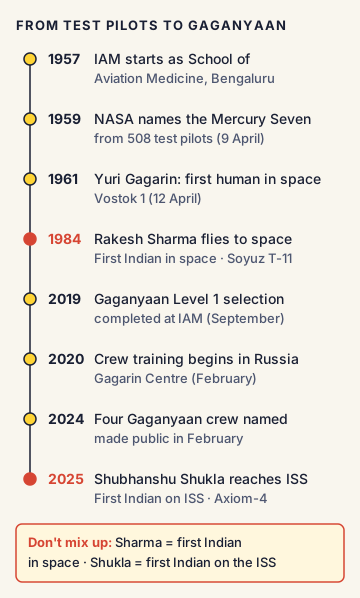
- United States (1959): For Project Mercury, NASA screened the records of 508 military test pilots and shortlisted 110. Candidates had to be under 40, shorter than 5 feet 11 inches (the capsule was tiny), graduates of test-pilot school, and have at least 1,500 hours of jet flying. Seven men, the "Mercury Seven", were announced on 9 April 1959.
- Soviet Union: It also chose young military pilots. One of them, Yuri Gagarin, became the first human in space on 12 April 1961, aboard Vostok 1.
- India (1984): India's first person in space, Rakesh Sharma, an Indian Air Force pilot, flew on the Soviet Soyuz T-11 mission in April 1984 to the Salyut 7 space station. This was a joint Indo-Soviet mission, not an Indian rocket.
How did India choose its Gaganyaan crew?
ISRO asked the Indian Air Force (IAF) to choose and help train the crew. The steps were:
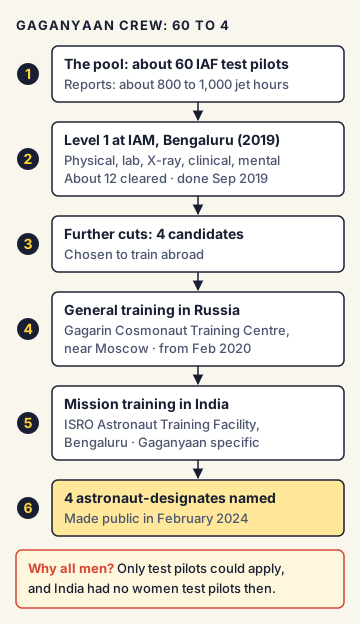
- The pool. The process started with about 60 IAF test pilots. Candidates needed a large number of jet flying hours (reports say about 800 to 1,000).
- Level 1 at IAM (2019). The Institute of Aerospace Medicine (IAM) in Bengaluru ran physical exercise tests, laboratory tests, X-ray and scan tests (radiological tests), clinical tests and psychological checks. The IAF announced that Level 1 was complete in September 2019. About 12 pilots cleared this stage.
- Further cuts. The list was narrowed further, and four candidates went abroad for training.
- Training in Russia (2020 to 2021). Under a 2019 agreement between ISRO's Human Space Flight Centre (HSFC) and Glavkosmos (a part of Russia's space agency, Roscosmos), the four trained at the Gagarin Research and Test Cosmonaut Training Centre near Moscow, starting in February 2020. This was general spaceflight training.
- Mission training in India. After returning, they began Gaganyaan-specific training at ISRO's temporary Astronaut Training Facility in Bengaluru.
- Public announcement. The four names were made public in February 2024.
Because only test pilots could apply, and India had no women test pilots at that time, the first batch was all men.
What does astronaut training include?
Training builds three things: knowledge, body and mind.
- Classroom work: how the rocket and spacecraft work, orbits, navigation, communication and emergency procedures.
- Simulators: the Bengaluru facility has several, including a static mock-up of the crew module, a dynamic simulator that copies motion, a virtual reality simulator and an independent training simulator. Crews practise every step, including failures, again and again.
- Physical fitness: to cope with launch forces, weightlessness and the heavy pull felt again when coming back to Earth.
- Survival training: a capsule may land far from rescue teams, so crews learn to survive at sea, in forests or in cold places until help arrives.
- Flight suit training: learning to work in the pressure suit, which keeps them alive if the cabin loses air.
- Psychological training: living in a tiny space with the same people for days, far from home, under stress.
What is bioastronautics?
Bioastronautics (also called space medicine) is the study of how the human body and mind react to spaceflight, and how to keep people healthy there. It deals with problems like:
- Microgravity: in orbit, astronauts float. Gravity is still there, but they do not feel their own weight, so muscles and bones carry no load. Muscles weaken and bones lose minerals (roughly 1% to 1.5% of bone density in some bones each month on long stays).
- Fluid shift: body fluids move towards the head, causing a puffy face and changes in the eyes.
- Space motion sickness: the inner ear, which controls balance, gets confused in the first days.
- Radiation: above the atmosphere, astronauts get far more radiation than people on the ground.
- Isolation and stress: small spaces, odd sleep cycles and distance from family affect the mind.
India's IAM is the main institution in the country for this science. It started as the School of Aviation Medicine in Bengaluru on 29 May 1957, became the Institute of Aviation Medicine in 1968, and was later renamed the Institute of Aerospace Medicine. It also gave medical support to India's 1984 Indo-Soviet spaceflight.
From pilots to mission specialists
Once a rocket and spacecraft have flown safely many times, agencies widen the pool. They add mission specialists: scientists, doctors and engineers who run experiments in space. The US, Russia, Europe and China all followed this path. As of April 2026, an ISRO committee on astronaut selection had recommended that the second batch be mixed: reports speak of about 10 astronauts in all, made up of six military pilots and four civilian specialists.
Formal criteria had not been announced at that time. This matters because India plans its own space station, the Bharatiya Antariksh Station, which will need crews who can do science for long periods.
Commonly confused concepts
- Astronaut vs cosmonaut vs taikonaut vs vyomanaut: all mean a person who travels to space. "Astronaut" is used by the US and most countries, "cosmonaut" by Russia, "taikonaut" informally for China, and "vyomanaut" (from Sanskrit vyoma, sky) is an informal word for Indian space travellers.
- Astronaut-designate vs astronaut: an astronaut-designate is chosen and in training; a person usually becomes an astronaut after actually flying to space.
- Pilot astronaut vs mission specialist vs spaceflight participant: a pilot flies and controls the spacecraft; a mission specialist runs experiments and tasks; a spaceflight participant (space tourist) is a paying or invited passenger with lighter training.
- Microgravity vs zero gravity: astronauts in orbit do not float because there is no gravity there. At the height of the International Space Station, Earth's gravity is still about 90% of its pull on the ground. They float because the spacecraft and the people inside are falling around Earth together. "Zero gravity" is a common but wrong description.
- IAM vs HSFC: IAM is an Indian Air Force medical institute that tested the candidates. HSFC is ISRO's centre that runs the Gaganyaan programme and its astronaut training.
- Rakesh Sharma vs Shubhanshu Shukla: Rakesh Sharma (1984) was the first Indian in space, on a Soviet Soyuz. Shubhanshu Shukla (2025) was the first Indian on the International Space Station, on the private Axiom-4 mission.
Issues, criticism and the way forward
- Narrow pool: only test pilots could apply to the first batch, which kept out women and civilian scientists. A mixed second batch is meant to fix this.
- Dependence on foreign training: the first crew's general training was done in Russia, and Indian astronauts have since trained abroad for other flights. India still lacks a full permanent astronaut training centre. The Bengaluru facility used today is temporary; a permanent centre is planned near Bengaluru, with crew isolation facilities at Sriharikota.
- Long timelines: delays in uncrewed test flights mean the trained crew has waited years. Selection and training of a new batch is estimated to take about four and a half years.
- Space medicine research: India needs more doctors and scientists trained in bioastronautics for longer missions and the planned space station.
- Way forward: build a permanent training centre in India, open selection to civilians and women, grow research in space medicine, and keep a steady pipeline of trained crew for Gaganyaan and the space station.
Concepts to Know
- g-force: a measure of the push a body feels when speeding up or slowing down fast. 1 g is normal gravity on Earth; at launch, astronauts may feel several g, as if their body weight has multiplied.
- Microgravity: the floating, near-weightless state in orbit. Gravity is still there, but the spacecraft and the people inside are falling around Earth together, so they float.
- Cabin depressurisation: a sudden loss of air pressure inside an aircraft or spacecraft. Without quick action or a pressure suit, a person can lose consciousness within seconds at high altitude.
- Psychological evaluation: tests and interviews that check how a person thinks, handles stress and works in a team.
- Radiological tests: medical tests that use X-rays or scans to see inside the body.
- Pool for Gaganyaan: about 60 IAF test pilots; Level 1 selection at IAM, Bengaluru, completed September 2019
- About 12 cleared Level 1; 4 final astronaut-designates, named publicly February 2024
- Russian training at Gagarin Research and Test Cosmonaut Training Centre, from February 2020, under an ISRO HSFC and Glavkosmos agreement (2019)
- IAM: started as School of Aviation Medicine on 29 May 1957; Institute of Aviation Medicine from 1968
- Mercury Seven (USA) announced 9 April 1959, picked from 508 test pilots' records
- Yuri Gagarin: first human in space, 12 April 1961, Vostok 1
- Rakesh Sharma: first Indian in space, April 1984, Soyuz T-11, Salyut 7
- Second Indian batch (recommended, April 2026): about 10 astronauts in all (6 military pilots + 4 civilian specialists)
● Tracked since November 18, 2026 · last seen November 18, 2026 · updates as the daily brief publishes