African Union (AU)
Structure, Agenda 2063 and India's Partnership
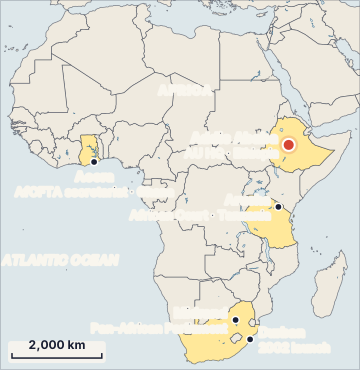
The African Union (AU) is the organisation of all the countries of Africa, working together for peace, development and unity. It has 55 member states and its headquarters is in Addis Ababa, Ethiopia. Think of it as Africa's version of a continental club, a little like the European Union, but with much less power over its members. The AU replaced an older body, the Organisation of African Unity (OAU), in 2002.
Why does it exist?
After colonial rule ended, African countries needed a common platform to protect their freedom, settle disputes, and speak with one voice to the world. By the 1990s, Africa faced civil wars, genocide (as in Rwanda in 1994) and poverty. Leaders felt the old OAU was too weak to stop such crises or to drive economic growth. The AU was created to do more: to step in during grave crises and to push Africa's economic integration.
Where did it come from?
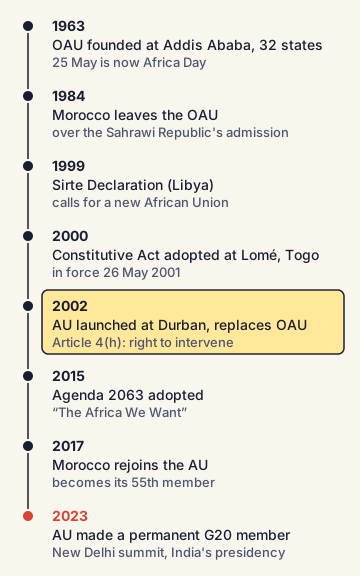
- OAU (25 May 1963): Leaders of 32 independent African states met in Addis Ababa and signed the charter of the Organisation of African Unity. Its main goals were ending colonial rule and apartheid. 25 May is still celebrated as Africa Day.
- Sirte Declaration (9 September 1999): OAU leaders, meeting in Sirte, Libya, called for a new African Union.
- Constitutive Act (11 July 2000): the AU's founding treaty, adopted at Lomé, Togo. It came into force on 26 May 2001.
- Launch (July 2002): The AU was formally launched at Durban, South Africa.
- Morocco: Morocco left the OAU in 1984 after the OAU admitted the Sahrawi Arab Democratic Republic (Western Sahara), a territory Morocco claims. Morocco rejoined the AU in January 2017, becoming its 55th member.
From non-interference to non-indifference
The OAU followed non-interference: it would not get involved in a member's internal affairs, even during mass killings. The AU changed this. Article 4(h) of the Constitutive Act gives the AU the right to intervene in a member state in grave circumstances: war crimes, genocide and crimes against humanity. This shift is often called moving to non-indifference.
The AU also suspends members whose governments change through unconstitutional means, such as military coups. For example, Sudan has been suspended since October 2021, and Mali, Guinea, Burkina Faso and Niger have also been suspended after coups.
How is the AU organised?
Its main organs are:
- The Assembly: the heads of state and government of all members; the supreme decision-making body. Its Chairperson is a head of state chosen for one year, rotating among Africa's five regions (North, West, Central, East and Southern). For 2026, the chair is Burundi.
- The Executive Council: foreign ministers, who prepare decisions for the Assembly.
- The AU Commission: the full-time secretariat in Addis Ababa, which runs daily work. It is headed by the Chairperson of the Commission: Mahmoud Ali Youssouf of Djibouti, since 2025.
- The Peace and Security Council (PSC): the AU's body for conflicts. Its protocol was adopted in Durban in July 2002 and came into force in December 2003. It has 15 members: 10 elected for two years and 5 for three years, spread across the regions.
- The Pan-African Parliament: first met in March 2004; its seat is Midrand, South Africa. It is mainly an advisory body, not a law-making one.
- The African Court on Human and Peoples' Rights: based in Arusha, Tanzania.
The AU also works through eight Regional Economic Communities (RECs), which it calls its "building blocks": the Arab Maghreb Union (UMA), COMESA, CEN-SAD, EAC, ECCAS, ECOWAS (West Africa), IGAD and SADC (Southern Africa).
Agenda 2063: "The Africa We Want." This is the AU's 50-year plan for Africa's growth and unity. It was adopted by the AU Assembly in January 2015 (24th session, Addis Ababa), shaped around the OAU's 50th anniversary in 2013. It is carried out through ten-year plans. Its big "flagship" projects include:
- African Continental Free Trade Area (AfCFTA): one single market for goods and services across Africa. It was signed in Kigali, Rwanda, on 21 March 2018 (44 countries signed that day), came into force on 30 May 2019, and trading began on 1 January 2021. Its secretariat is in Accra, Ghana. By the number of member countries, it is the world's largest free trade area.
- Silencing the Guns: ending wars and conflicts on the continent.
- Plans for an African passport, a single African air transport market and continental infrastructure.
India and the AU
- India works with the AU as a partner in the India-Africa Forum Summit, which is organised together with the AU Commission. In 2008 and 2011, the AU chose the attending countries using the Banjul Formula; in 2015 India invited all African countries.
- India pushed for the AU's permanent membership of the G20, which was granted on 9 September 2023 at the New Delhi summit under India's presidency. Before this, South Africa was the only African G20 member. The G20 is now sometimes described as having 21 members.
- India supports Agenda 2063 through its Lines of Credit, training and digital projects. The planned IAFS-IV was expected to link India's long-term development goal for 2047 with Agenda 2063.
Commonly confused concepts
- OAU vs AU: OAU (1963–2002) focused on ending colonial rule and followed non-interference. The AU (2002–) aims at integration and development and can intervene under Article 4(h).
- 55 AU members vs 54 African UN members: The AU includes the Sahrawi Arab Democratic Republic, which is not a UN member. So Africa has 54 UN member countries but the AU has 55 members.
- Chairperson of the AU vs Chairperson of the AU Commission: The first is a head of state who chairs the Assembly for one year. The second is the full-time chief of the Commission, elected for a four-year term.
- AU vs AfCFTA: The AU is the overall political organisation. AfCFTA is one trade agreement under it, with its own secretariat in Accra.
- AU vs ECOWAS or SADC: These are regional groups (RECs) within Africa; the AU covers the whole continent.
- AU vs EU: The EU has a common currency for many members, a strong parliament and laws that bind members. The AU does not have these powers.
Issues, criticism and the way forward
- Money: A large part of the AU's budget, especially for peace operations, has come from outside donors. In 2016, members agreed to a 0.2% levy on eligible imports to fund the AU themselves, but many have not applied it fully.
- Coups and weak enforcement: A wave of military coups, especially in the Sahel, has tested the AU. Suspensions have not always restored civilian rule. Mali, Burkina Faso and Niger formed their own Alliance of Sahel States and left ECOWAS.
- Conflicts: Wars in Sudan and the eastern Democratic Republic of the Congo show the limits of the Peace and Security Council, which often lacks troops and funds.
- Slow integration: AfCFTA trade is growing slowly because of poor roads and railways, border delays and rules of origin issues.
- Global voice: Africa demands reform of the UN Security Council. Under the Ezulwini Consensus (2005), the AU asks for at least two permanent seats (with veto rights) and five non-permanent seats for Africa. India and Africa both support Security Council reform.
- Way forward: Experts suggest self-funding, faster AfCFTA implementation, stronger early-warning systems for conflicts, and using the G20 seat to push for debt relief and climate finance.
Concepts to Know
- Genocide: The deliberate killing of a large group of people because of their ethnicity, religion or nationality, with the aim of destroying that group.
- Coup (military coup): When the army seizes power from a government by force, outside the constitution.
- Free trade area: A group of countries that remove or reduce taxes (tariffs) on goods traded among themselves.
- Regional Economic Community (REC): A group of neighbouring African countries that work together on trade and development, such as ECOWAS in West Africa.
- Rules of origin: Rules that decide which country a product "comes from", so that only goods truly made inside a free trade area get its tax benefits.
- Sahel: The dry belt of land just south of the Sahara Desert, stretching across countries like Mali, Burkina Faso, Niger and Chad.
- OAU founded 25 May 1963, Addis Ababa, by 32 states; 25 May = Africa Day
- Sirte Declaration: 9 September 1999; Constitutive Act: adopted Lomé, 11 July 2000, in force 26 May 2001
- AU launched: July 2002, Durban, South Africa
- Members: 55; Morocco rejoined in January 2017 (left OAU in 1984)
- Article 4(h): right to intervene for war crimes, genocide, crimes against humanity
- Peace and Security Council: 15 members (10 for 2 years, 5 for 3 years); in force December 2003
- Pan-African Parliament: Midrand, South Africa; African Court on Human and Peoples' Rights: Arusha, Tanzania
- 8 RECs recognised
- Agenda 2063 adopted: January 2015
- AfCFTA: signed 21 March 2018 (Kigali), in force 30 May 2019, trading from 1 January 2021, secretariat Accra
- AU joined G20 as permanent member: 9 September 2023 (New Delhi summit)
- 2026: AU chair Burundi; AU Commission chair Mahmoud Ali Youssouf (Djibouti)
● Tracked since May 21, 2026 · last seen October 10, 2026 · updates as the daily brief publishes