Aadhaar Act, 2016
The Law Behind India's Digital Identity
The Aadhaar Act, 2016 is the law that gives legal backing to Aadhaar, the 12-digit identity number given to residents of India. Its full name is the Aadhaar (Targeted Delivery of Financial and Other Subsidies, Benefits and Services) Act, 2016. Its main purpose is to make sure that government subsidies and welfare benefits reach the right person. It also set up the Unique Identification Authority of India (UIDAI) as a statutory body to run the Aadhaar system.
Why was it needed?
Welfare schemes in India long suffered from fake and duplicate names. One person could hold two ration cards, or a dead person's name could stay on a pension list while someone else took the money. Because every person's fingerprints and eyes are unique, a number linked to these body features (called biometrics) lets the government check that one person gets one benefit.
Before 2016, Aadhaar ran only on an executive order, with no law of Parliament behind it. Courts and critics asked on what legal basis the government was collecting people's fingerprints. The Act was passed to fill this gap.
Where did it come from?
- 28 January 2009: UIDAI was set up by an executive notification, attached to the Planning Commission. Nandan Nilekani was its first chairperson.
- 29 September 2010: The first Aadhaar numbers were given in Tembhli village, Nandurbar district, Maharashtra. Ranjana Sonawane was the first person to get one.
- 2010: A National Identification Authority of India Bill was introduced, but it lapsed after a Parliamentary Standing Committee raised concerns.
- March 2016: The Aadhaar Act was passed as a Money Bill (a bill only about taxes and government spending, which the Rajya Sabha cannot block or amend). This choice later became a major legal fight.
- 12 July 2016: UIDAI became a statutory authority under the Act, working under the Ministry of Electronics and Information Technology (MeitY).
- 24 August 2017: In Justice K.S. Puttaswamy v. Union of India, a nine-judge bench held that privacy is a Fundamental Right under Article 21. This set the test that Aadhaar would have to pass.
- 26 September 2018: In the Puttaswamy (Aadhaar) case, a five-judge bench upheld the Act by 4:1, but struck down or read down some parts (explained below).
- 2019: The Aadhaar and Other Laws (Amendment) Act, 2019 changed the law to follow the judgment.
- January 2021: Review petitions against the 2018 judgment, including on the Money Bill question, were dismissed by 4:1 (Beghar Foundation v. Justice K.S. Puttaswamy).
How does Aadhaar work?
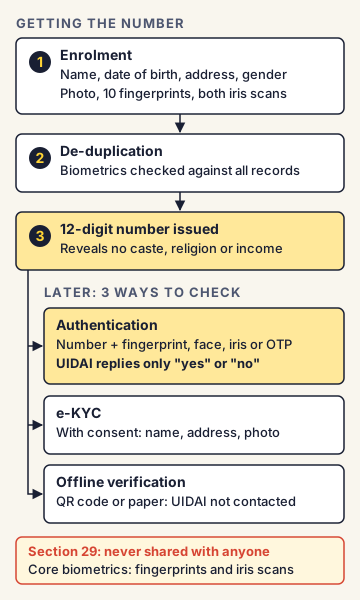
- Enrolment: A resident goes to an enrolment centre and gives demographic information (name, date of birth, address, gender) and biometric information (photograph, ten fingerprints and both iris scans).
- De-duplication: UIDAI's computers compare the new biometrics with all existing records to make sure the person is not already enrolled.
- Number generated: A unique, random 12-digit Aadhaar number is issued. It does not reveal caste, religion, income or anything else about the person.
- Authentication: Later, when the person claims a benefit, a machine sends their Aadhaar number and fingerprint (or face, iris, or a one-time password, OTP) to UIDAI. UIDAI only replies "yes" or "no". It does not share the person's details.
- e-KYC: With the person's consent, UIDAI can also share basic details (name, address, photo) so that a bank or office can verify identity without paper documents.
Think of it like a school attendance register where each student's thumbprint is stored. The teacher does not need to know anything else about you: the machine just says whether the thumb matches the name.
The key sections of the Act
- Section 2(v), who is a "resident": a person who has lived in India for 182 days or more in the 12 months before applying. So Aadhaar is for residents, not only citizens.
- Section 3: every resident is entitled to get an Aadhaar number.
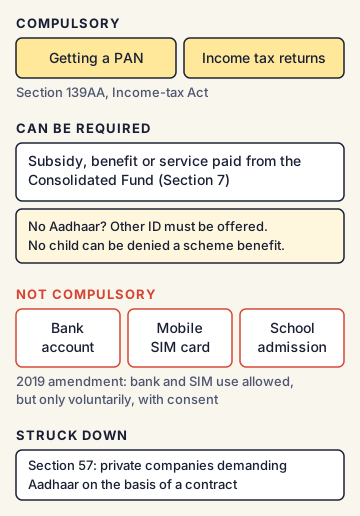
- Section 7: the Centre or a State may require Aadhaar (or proof of applying for it) to receive a subsidy, benefit or service whose cost is paid from the Consolidated Fund of India (or of the State). If a person has no Aadhaar, they must be offered other ways to identify themselves.
- Section 8: sets out authentication, with the person's consent.
- Section 9: Aadhaar is not proof of citizenship or domicile (permanent home).
- Section 12: UIDAI consists of a chairperson, two part-time members and a chief executive officer (CEO) who is the member-secretary.
- Section 29: core biometric information (fingerprints and iris scans) can never be shared with anyone for any reason, and cannot be used except for Aadhaar generation and authentication.
- Section 33: information can be disclosed only on the order of a court not lower than a High Court judge (after a hearing), or in the interest of national security on the direction of an officer not below the rank of Secretary to the Government of India, reviewed by an Oversight Committee.
- Section 33A (added in 2019): UIDAI can impose a civil penalty of up to ₹1 crore for each violation by an entity in the Aadhaar system.
- Section 57 (struck down in 2018, later removed): it had allowed private companies to use Aadhaar for any purpose under a contract.
What did the Supreme Court decide in 2018?
- Upheld: the Act as a whole, including Section 7, because using Aadhaar for welfare schemes serves a legitimate aim and is proportionate.
- Struck down: Section 57 to the extent it allowed private companies to demand Aadhaar on the basis of a contract.
- Not compulsory for: opening bank accounts, getting mobile SIM cards, or school admissions.
- Compulsory for: filing income tax returns and getting a PAN (under Section 139AA of the Income-tax Act).
- Children: no child can be denied a scheme benefit for lack of Aadhaar.
- Dissent: Justice D.Y. Chandrachud held that passing the Act as a Money Bill was a "fraud on the Constitution".
The 2019 amendment
It allowed voluntary use of Aadhaar for bank accounts and SIM cards (with consent), introduced offline verification (using a QR code or paper copy without contacting UIDAI), let a child cancel their Aadhaar within six months of turning 18, and added civil penalties. In January 2025, new rules under the Act allowed approved private entities to use Aadhaar authentication for certain services.
India's position and Indian examples
- As of September 2025, UIDAI had issued about 142.8 crore Aadhaar numbers.
- Aadhaar is one leg of the JAM Trinity (Jan Dhan accounts, Aadhaar, Mobile) that powers Direct Benefit Transfer (DBT) for PM-KISAN, LPG subsidy, scholarships and MGNREGA wages.
- The Election Laws (Amendment) Act, 2021 allowed electoral officers to ask voters for Aadhaar to clean up voter lists. Giving it is voluntary (Form 6B).
- Aadhaar-based fingerprint checks are used at ration shops under the National Food Security Act, 2013.
Commonly confused concepts
- Aadhaar vs citizenship: Aadhaar proves identity and residence, not citizenship (Section 9). A foreign national who has lived in India for 182 days can get one.
- Aadhaar vs voter ID (EPIC): Aadhaar is for all residents of any age and is issued by UIDAI. EPIC is only for citizens aged 18 or above who are on the voter list, and is issued by the Election Commission of India.
- Aadhaar vs PAN: PAN (Permanent Account Number) is a 10-character tax ID issued by the Income Tax Department. Aadhaar is a 12-digit identity number.
- Authentication vs e-KYC vs offline verification: Authentication gives only a "yes/no" match; e-KYC shares basic details with consent; offline verification checks identity without contacting UIDAI.
- Demographic vs core biometric information: Demographic data is name, address and so on. Core biometric data (fingerprints and iris) has the highest protection and can never be shared.
Issues, criticism and the way forward
- Exclusion errors: Fingerprints of old people and manual workers often fail to match. Poor internet in villages can also block authentication. Genuine people may then miss rations or pensions.
- Privacy and surveillance: Linking many databases to one number raises fears of profiling. The government's position is that core biometrics are never shared and that authentication logs are protected by law.
- Fake documents at enrolment: Aadhaar is only as good as the documents used to get it. Officials have pointed to fraud at some enrolment centres; UIDAI has tightened rules and uses de-duplication and penalties.
- Money Bill controversy: Many experts argue the Act should not have been passed as a Money Bill. A larger bench of the Supreme Court is examining the wider Money Bill question.
- Way forward: Experts suggest offline and face-based alternatives when fingerprints fail, a "no denial" rule for genuine beneficiaries, quick grievance redress, and strong enforcement of the Digital Personal Data Protection Act, 2023.
Concepts to Know
- Biometrics: Body features that are unique to each person, such as fingerprints, iris (the coloured ring of the eye) and face, used to confirm identity.
- Consolidated Fund of India: The main account of the Central government, into which taxes flow and from which most spending is made.
- Money Bill (Article 110): A bill dealing only with taxes, borrowing and government spending. The Rajya Sabha can only suggest changes and must return it within 14 days; the Speaker certifies whether a bill is a Money Bill.
- Statutory body: An organisation created by a law passed by Parliament or a state legislature.
- Read down: When a court keeps a law but narrows its meaning so that it does not break the Constitution.
- OTP (one-time password): A short code sent to your mobile phone that works only once, used to prove it is really you.
- Full name: Aadhaar (Targeted Delivery of Financial and Other Subsidies, Benefits and Services) Act, 2016; passed as a Money Bill in March 2016
- UIDAI: set up by executive notification on 28 January 2009; statutory from 12 July 2016; under MeitY
- First Aadhaar: 29 September 2010, Tembhli, Nandurbar (Maharashtra)
- Resident: 182 days or more in the 12 months before enrolment (Section 2(v))
- Section 7: Aadhaar can be required for subsidies paid from the Consolidated Fund; Section 9: not proof of citizenship
- Section 29: core biometrics never shared; Section 33A: civil penalty up to ₹1 crore (2019 amendment)
- Privacy as a Fundamental Right: Puttaswamy, 24 August 2017 (nine judges)
- Aadhaar Act upheld: 26 September 2018 (five judges, 4:1); Section 57 struck down for private use; review dismissed in 2021
- About 142.8 crore Aadhaar numbers generated (as of September 2025)
● Tracked since June 16, 2026 · last seen November 07, 2026 · updates as the daily brief publishes