Yellow Revolution
Technology Mission on Oilseeds
The Yellow Revolution is the name given to the sharp rise in India's oilseed production from the late 1980s to the mid-1990s. Oilseeds are crops such as mustard, groundnut and soybean whose seeds are crushed to get cooking oil. The colour yellow comes from the bright yellow flowers of mustard fields. The revolution was driven mainly by the Technology Mission on Oilseeds (TMO), launched in May 1986, and for a few years it made India almost self-sufficient in edible oil.
Why was it needed?
In the early 1980s, India was producing only about 11 million tonnes of oilseeds a year. This was far below what its growing population needed. So India had to import large amounts of edible oil, spending scarce foreign exchange (dollars earned from exports). Imagine a family that has to borrow money every month just to buy cooking oil.
The country was in a similar position. Oilseeds were also grown mostly on poor, rain-fed land by small farmers, using old seeds, so yields (output per hectare) were very low.
Where did it come from?
In the mid-1980s, the government set up several "technology missions" to solve national problems using science and good management. These missions are linked with technocrat Sam Pitroda, who led the technology mission effort at the time. The Technology Mission on Oilseeds started in May 1986. Its idea was simple: do not fix just one part of the problem. Fix the whole chain, from seed to farm to factory to market, at the same time.
How did the mission work?
It worked on four fronts together, often called the "mini-missions":
- Better crop technology: New high-yield seed varieties and better farming methods from research institutes.
- Inputs and support to farmers: Supply of seeds, fertilisers, plant protection and extension (teaching farmers new methods).
- Better processing: Modernising oil mills so more oil came out of each tonne of seed.
- Prices and marketing: A guaranteed minimum support price (MSP) and market intervention, so farmers were not hurt when prices crashed at harvest. Imports were also kept under tight government control.
Operation Golden Flow and Dhara
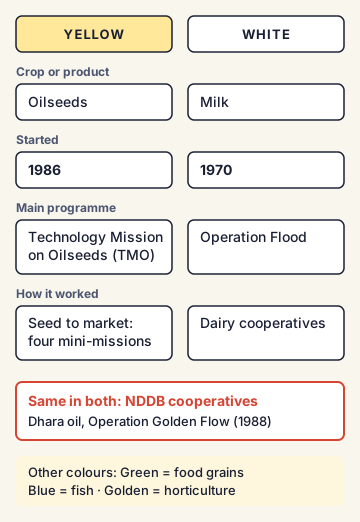
The National Dairy Development Board (NDDB), which had already led the White Revolution in milk, brought its cooperative model to oilseeds. Under the market intervention scheme, NDDB was asked to handle a part of the country's edible oil trade to steady prices. In 1988, it launched the Dhara brand of packaged oil to replace loose, often adulterated (mixed with cheap or harmful substances) oil. This cooperative push came to be known as Operation Golden Flow.
What did it achieve?
Oilseed production roughly doubled within about a decade, reaching around 24 to 25 million tonnes by the mid-1990s. By the early 1990s, India was close to self-sufficient in edible oil, and imports became a small share of what Indians consumed.
How did the mission change over time?
The mission was widened step by step:
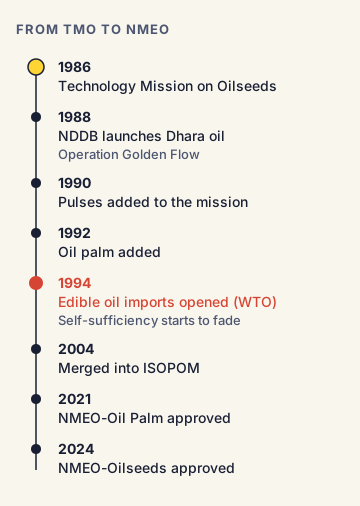
- Pulses were added in 1990.
- Oil palm was added in 1992.
- Maize was added in 1995-96.
- From April 2004, its schemes were merged into the Integrated Scheme of Oilseeds, Pulses, Oil Palm and Maize (ISOPOM).
- Later came the National Mission on Oilseeds and Oil Palm (NMOOP) in 2014-15, the National Mission on Edible Oils – Oil Palm (NMEO-OP) in August 2021, and the National Mission on Edible Oils – Oilseeds (NMEO-Oilseeds) in October 2024.
Why did the gains fade?
From 1994, as part of the economic reforms and India's new commitments under the World Trade Organization (WTO), India opened up edible oil imports and lowered import taxes on them. Cheap palm and soybean oil from abroad poured in. Indian farmers found it hard to compete, because their yields were still low and much of their land was rain-fed.
Also, as incomes rose, Indians started eating much more oil. Domestic production could not keep pace. Today India meets only about 40 to 45% of its edible oil needs from its own production. In the 2024-25 oil year, it imported about 16 million tonnes of edible oil worth about ₹1.61 lakh crore.
India's position today
India grows nine main annual oilseeds: groundnut, rapeseed-mustard, soybean, sunflower, sesame (til), safflower, niger, castor and linseed. Rajasthan, Madhya Pradesh, Maharashtra and Gujarat are among the leading oilseed states. Total oilseed output was about 429.89 lakh tonnes (about 43 million tonnes) in 2024-25. Palm oil comes mostly from Indonesia and Malaysia, while soybean oil comes mainly from Argentina and Brazil. The new missions aim for a "second Yellow Revolution" through better seeds, rice-fallow land (land left empty after the rice harvest), and oil palm plantations.
Commonly confused concepts
- Yellow Revolution vs Green Revolution: The Green Revolution (from the mid-1960s) raised production of food grains, mainly wheat and rice. The Yellow Revolution (from 1986) raised oilseed production.
- Yellow Revolution vs White Revolution: The White Revolution, under Operation Flood (from 1970), raised milk production through dairy cooperatives. Both used NDDB's cooperative model, which is why students mix them up.
- Yellow Revolution vs Blue Revolution: The Blue Revolution is about fish production (fisheries and aquaculture).
- Yellow Revolution vs Golden Revolution: "Golden Revolution" is generally used for growth in horticulture (fruits, vegetables, honey). Oilseeds are the Yellow Revolution.
- Technology Mission on Oilseeds vs NMEO: The TMO (1986) was the original oilseed mission. NMEO-OP (2021) and NMEO-Oilseeds (2024) are its modern successors with new targets.
Issues, criticism and the way forward
- Import dependence returned: Experts point out that opening imports after 1994 undid much of the self-sufficiency, which shows that production gains need stable trade policy to last.
- Rain-fed farming: Most oilseeds grow without irrigation, so output swings with the monsoon.
- Low yields: Indian yields of crops like soybean remain well below world averages, partly due to old seeds and slow approval of new varieties.
- Price signals: When import duties are cut to control cooking oil prices, domestic prices fall and farmers lose interest. When duties rise, consumers pay more. Balancing farmers and consumers is a constant challenge.
- Way forward: Suggestions include better seed varieties (including through new breeding tools like genome editing), oilseeds on rice-fallow land, oil palm in suitable irrigated areas, stable MSP and procurement, and predictable import duty policy.
Concepts to Know
- Oilseed: A crop grown mainly to get oil from its seeds, such as mustard, groundnut or soybean.
- Yield: How much crop is produced from one hectare of land. Higher yield means more output from the same land.
- Minimum Support Price (MSP): A price announced by the government at which it promises to buy certain crops, so farmers do not have to sell below that level.
- Market intervention: When a government agency buys or sells a product in the market to stop its price from crashing or shooting up.
- Foreign exchange: Money in foreign currencies (like US dollars) that a country earns from exports and spends on imports.
- Rain-fed farming: Farming that depends only on rain, with no canal or tube-well irrigation.
- Technology Mission on Oilseeds launched: May 1986
- Oilseed output: about 11 million tonnes (mid-1980s) to about 24 to 25 million tonnes (mid-1990s)
- NDDB's Dhara brand launched: 1988 (Operation Golden Flow)
- TMO widened: pulses (1990), oil palm (1992), maize (1995-96)
- ISOPOM: from April 2004
- NMEO-Oil Palm: approved August 2021; NMEO-Oilseeds: approved October 2024
- Edible oil imports, 2024-25: about 16 million tonnes, worth about ₹1.61 lakh crore
- Domestic production meets only about 40 to 45% of edible oil needs
● Tracked since October 10, 2026 · last seen October 10, 2026 · updates as the daily brief publishes