WorldSkills Competition
The "Skill Olympics"
The WorldSkills Competition is the world's biggest contest for young skilled workers. Every two years, young people from about 70 or more countries compete in trades like welding, plumbing, cooking, nursing, car repair, web design and robotics. People often call it the "Olympics of Skills". It is run by WorldSkills International, a non-governmental organisation (a body not run by any government).
Why does it exist?
After the Second World War, Europe had to rebuild its factories, roads and homes. It badly needed skilled workers, but young people often saw manual trades as low-status work. A contest that treats a welder or a chef like a sports champion was one way to change this thinking. Today WorldSkills has three aims:
- to show that skilled trades are respected, well-paid careers, not a "second choice" after college;
- to set common world standards for each skill, so countries can compare their training systems;
- to let countries learn from each other about how to train young people better.
Where did it come from?
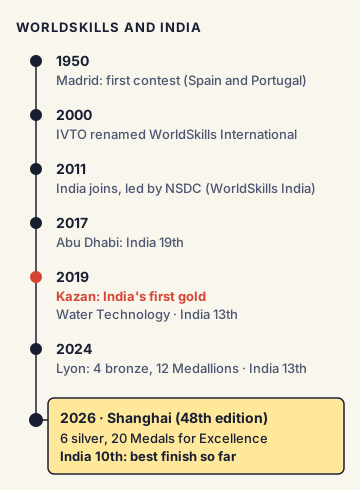
- The idea began in Spain. The first contest, the "Iberian Competition", was held in Madrid in 1950, with Portugal joining Spain.
- The organising body was first called the International Vocational Training Organization (IVTO). It was renamed WorldSkills International in 2000.
- Over time it spread across Europe and then the world. Past hosts include Tokyo, Sydney, Abu Dhabi (2017), Kazan in Russia (2019) and Lyon in France (2024).
- The 48th WorldSkills Competition was held in Shanghai, China, from 22 to 27 September 2026.
- WorldSkills International has its registered office in Amsterdam, the Netherlands. As of January 2026 it had 90 member countries and regions.
How does the competition work?
Think of it like an exam and a sports event at the same time:
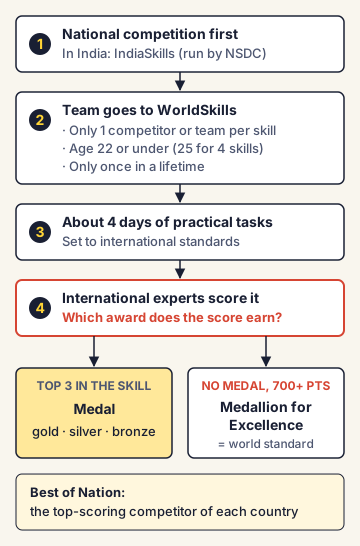
- Each member country first holds its own national competition to pick its best young workers. In India this is IndiaSkills.
- Each country can send only one competitor (or one team) per skill. A person can compete in only one WorldSkills Competition in their life.
- Most competitors must be 22 years or younger in the competition year. For a few advanced skills (Additive Manufacturing, Aircraft Maintenance, Manufacturing Team Challenge and Industry 4.0), the limit is 25 years.
- Over about four days, each competitor completes real practical tasks set to international standards. A welder welds actual joints; a chef cooks full menus.
- International experts score the work. The best get gold, silver and bronze medals. Competitors who do not win a medal but score 700 points or more get a Medallion (Medal) for Excellence, which means they reached the international standard.
- The best-scoring competitor of each country gets the "Best of Nation" award.
The skill groups
Skills are grouped into six sectors:
- Transportation and Logistics
- Construction and Building Technology
- Manufacturing and Engineering Technology
- Information and Communication Technology
- Creative Arts and Fashion
- Social and Personal Services
Shanghai 2026 had 64 skills, including seven new ones such as Dental Prosthetics, Retail Sales, Software Testing and Unmanned Aerial Systems (drones).
India's position and Indian examples
- India's participation is led by the National Skill Development Corporation (NSDC) under MSDE, through its WorldSkills India initiative, since 2011.
- Abu Dhabi 2017: India finished 19th.
- Kazan 2019: India won its first gold medal (S. Aswatha Narayana of Odisha in Water Technology), plus one silver, two bronze and 15 Medallions of Excellence. India ranked 13th out of 63.
- Lyon 2024: India won 4 bronze medals and 12 Medallions of Excellence (16 awards) in 52 skills, and finished 13th.
- Shanghai 2026: India sent its largest-ever team of 70 competitors in 63 skills. It won 6 silver medals and 20 Medals for Excellence and ranked 10th, its best finish so far. Smriti Nambiar (Bakery) was named Best of Nation.
- Schemes like PM-SETU now ask ITIs to add WorldSkills-aligned trades, so that ordinary ITI training slowly moves towards world standards.
Commonly confused concepts
- WorldSkills vs IndiaSkills: IndiaSkills is India's national competition, held by NSDC, to select the team. WorldSkills is the international competition.
- WorldSkills vs World Youth Skills Day: World Youth Skills Day is a UN day marked every year on 15 July, declared by the UN General Assembly in 2014. It is not a competition.
- Medal vs Medallion for Excellence: Medals (gold, silver, bronze) go to the top three in each skill. A Medallion for Excellence goes to any non-medal competitor who reaches 700 points, the "world standard" mark.
- WorldSkills vs Skill India Mission: Skill India (launched 2015) is India's national programme for skilling. WorldSkills is a global contest that India takes part in.
Issues, criticism and the way forward
- A showcase, not the system: A few dozen champions do not show the quality of training for millions. Critics say success at WorldSkills must be matched by better everyday ITI training.
- Unequal access: Many competitors come from well-funded private institutes or companies. Talented youth from rural ITIs may lack the equipment to train for world-level tasks.
- Low social status of trades: In India, many families still see vocational work as inferior to a college degree. WorldSkills success stories can help change this view.
- Way forward: Experts suggest using WorldSkills standards to update ITI courses, training more instructors to international levels, holding more state-level skill contests, and linking medal winners to good jobs and trainer roles.
Concepts to Know
- Vocational training: Practical training for a specific job or trade, such as electrician or nurse, rather than general academic study.
- National Skill Development Corporation (NSDC): A public-private partnership company set up in 2008 under the Ministry of Finance (now under MSDE) to promote skill development, mainly through private training partners.
- Additive manufacturing: Making objects layer by layer from a digital design, often called 3D printing.
- Industry 4.0: The use of smart machines, sensors, robots and data networks in factories, often called the "fourth industrial revolution".
- Organiser: WorldSkills International (earlier International Vocational Training Organization; renamed 2000); registered office Amsterdam
- First competition: Madrid, 1950 (Spain and Portugal)
- Held every two years; 90 member countries and regions (January 2026)
- Age limit: 22 for most skills; 25 for four advanced skills
- Medallion for Excellence: 700 points or more without a medal
- India: led by NSDC (WorldSkills India) since 2011; first gold at Kazan 2019 (Water Technology)
- Lyon 2024: India 13th (4 bronze, 12 Medallions); Shanghai 2026 (48th edition, 22-27 September): India 10th (6 silver, 20 Medals for Excellence), largest team of 70 in 63 skills
● Tracked since October 16, 2026 · last seen October 16, 2026 · updates as the daily brief publishes