World Economic Outlook (WEO)
The IMF's Flagship Forecast Report
The World Economic Outlook, or WEO, is a report by the International Monetary Fund (IMF) that tells the world how fast the global economy and each country's economy are likely to grow in the next few years. It also gives forecasts for inflation, trade balances and other key numbers, and it explains the main risks ahead.
It comes out in full twice a year, in April and October, with shorter updates in January and July. When newspapers say "IMF raises India's growth forecast", they are almost always quoting the WEO.
Why does the world need it?
Governments, central banks, companies and investors all make decisions based on what they expect the economy to do. A country planning its budget needs to guess how much tax it will collect, and that depends on growth. A company deciding whether to build a factory needs to guess future demand. The WEO gives everyone one common, carefully built set of forecasts for almost every country, made with the same method.
This lets people compare countries fairly. It is also the IMF's main tool for watching the health of the whole world economy, which is one of its core jobs.
Where did it come from?
The idea started inside the IMF in 1969, when Charles F. Schwartz of the IMF's Research Department began an internal exercise to forecast the world economy. For about ten years these forecasts were used only inside the IMF. The first public WEO came out in May 1980. It appeared once a year from 1980 to 1983, and twice a year since 1984. Later, the IMF added short "WEO Updates" in January and July, because people wanted fresh forecasts more often.
Who makes it?
The WEO is prepared by the IMF's Research Department. Its head carries the title Economic Counsellor, and newspapers usually call this person the IMF's Chief Economist. As of October 2026, this post is held by Silvana Tenreyro, a former external member of the Bank of England's Monetary Policy Committee, who took charge on 10 August 2026. She followed Pierre-Olivier Gourinchas. Gita Gopinath, an Indian-origin economist, held this post from 2019 to 2022 and was the first woman to do so.
How is a WEO forecast made?
It is a team effort spread across the IMF:
- Country teams (IMF staff who follow each country closely) prepare forecasts for their country. They use data from that country's own statistics office and central bank.
- The Research Department sets common assumptions for everyone. These include the expected price of oil, interest rates in big economies, and exchange rates. This keeps all country forecasts consistent with one another.
- The forecasts are checked against each other. For example, if every country expects to export more, someone must be importing more, so the numbers must add up.
- The final numbers are combined into world and regional totals and published with analysis.
A simple way to picture it: think of a cricket board asking each team's coach to predict their team's runs, but first telling all coaches the same pitch report and weather forecast. The final table is then fair and comparable.
What is inside a WEO?
A full April or October edition usually has:
- Chapter 1: Global prospects and policies. The headline forecasts for world growth, inflation and risks, along with policy advice.
- Analytical chapters. Deep studies on one topic each time, for example AI, debt, energy or trade.
- A statistical appendix and the WEO database. Detailed numbers for about 197 economies (as of October 2025), usually covering past years plus forecasts. The full database is released only with the April and October editions.
The January and July Updates are much shorter. They mainly give a revised headline table (Table 1) with growth forecasts for two years for the world and selected major economies. They do not come with the full database.
When is it released?
The April and October editions are usually released in the same week as the IMF and World Bank Spring Meetings (April) and Annual Meetings (October). The Annual Meetings are normally held in Washington, D.C. for two years in a row and in a member country every third year. The 2026 Annual Meetings were held in Bangkok, Thailand, from 12 to 18 October 2026.
How does the WEO measure world growth?
To find world growth, the IMF adds up countries' growth rates, giving bigger economies more weight. For growth rates, it measures each country's size using Purchasing Power Parity (PPP), not market exchange rates. PPP adjusts for the fact that the same money buys more in a cheaper country. This gives fast-growing developing countries like India and China a larger weight in world growth than they would get at market exchange rates.
The WEO's sister reports
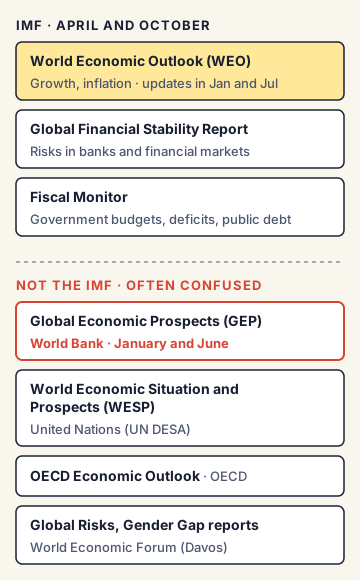
The IMF publishes three main reports together each April and October. Students often mix them up:
- World Economic Outlook (WEO): growth, inflation and the overall global economy.
- Global Financial Stability Report (GFSR): risks in banks, stock markets, bond markets and the wider financial system.
- Fiscal Monitor: government budgets, deficits and public debt around the world.
The IMF also publishes the External Sector Report, which looks at trade balances and exchange rates.
How does India appear in the WEO?
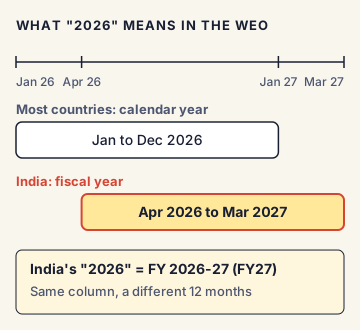
This is a classic exam trap. For most countries, the WEO uses calendar years (January to December). For India, it uses India's fiscal year (April to March), and places it in the column of the year in which it begins. So the "2026" figure for India means FY 2026-27, also written FY27. The same IMF report may also mention a calendar-year figure for India, which can differ slightly.
India is classified among the Emerging Market and Developing Economies (EMDEs), not the advanced economies. India's growth forecast in the WEO matters for India because rating agencies, foreign investors and policymakers watch it closely.
Commonly confused concepts
- WEO vs Global Economic Prospects (GEP): The WEO is the IMF's report. The GEP is the World Bank's growth forecast report, also published twice a year, in January and June.
- WEO vs OECD Economic Outlook: The OECD Economic Outlook comes from the Organisation for Economic Co-operation and Development, a club of mostly rich countries. It is a separate set of forecasts.
- WEO vs World Economic Situation and Prospects (WESP): The WESP is published by the United Nations (UN DESA).
- WEO vs World Economic Forum reports: The World Economic Forum (Davos) is a private Swiss foundation. It publishes reports like the Global Gender Gap Report and Global Risks Report, not the WEO.
- IMF forecast vs India's official estimate: The IMF projects India's future growth. India's official GDP numbers are measured and released by the National Statistics Office (NSO) under the Ministry of Statistics and Programme Implementation (MoSPI). The Reserve Bank of India (RBI) and the Economic Survey also give their own projections.
- Upgrade vs high growth: An "upgrade" only means the new forecast is higher than the old forecast. A country can get an upgrade and still be expected to grow slower than last year, as with India's 7% forecast for FY27 against 7.8% in FY26.
Issues, criticism and the way forward
- Accuracy in bad times: A 2014 study by the IMF's own Independent Evaluation Office (IEO) looked at WEO forecasts from 1990 to 2011. It found that forecasts were broadly as accurate as private forecasters, but they tended to be too optimistic during global or regional recessions and crises.
- Frequent revisions: Forecasts change every three months. Critics say headlines about "upgrades" and "downgrades" can create too much excitement over small changes, such as 0.1 or 0.2 percentage points.
- Dependence on assumptions: Every forecast rests on assumptions, like when a war ends or what oil will cost. If these turn out wrong, the forecast goes wrong too. This is why the WEO gives a baseline plus "downside" and "upside" scenarios.
- Data quality: The WEO depends on each country's own data. If a country's statistics are late, revised or weak, the forecast suffers.
- Way forward: The IEO advised the IMF to make better use of its own past errors, explain uncertainty more clearly and work more closely with country authorities. Readers should treat the WEO as a well-informed estimate, not a promise, and read the risks section along with the headline number.
Concepts to Know
- Forecast (projection): An estimate of what a number will be in the future, based on today's data and assumptions.
- GDP growth rate: How much bigger a country's total production of goods and services became compared with the previous year, after removing the effect of price rise.
- Percentage point: The simple difference between two percentages. A rise from 6.4% to 7% is a rise of 0.6 percentage points. 0.6 percentage points is also called 60 basis points.
- Purchasing Power Parity (PPP): A way of comparing economies by what money can actually buy in each country. ₹100 buys more food in India than its dollar value would buy in the US, and PPP adjusts for this.
- Fiscal year: The 12-month period a government uses for its accounts. India's fiscal year runs from 1 April to 31 March.
- Emerging Market and Developing Economies (EMDEs): The IMF's group for countries that are not yet classed as advanced. Classification depends mainly on income per person, how varied a country's exports are and how linked it is to world finance.
- Baseline: The "most likely" forecast, based on the main set of assumptions.
- Surveillance: The IMF's job of regularly checking the economic health and policies of its member countries and of the world economy as a whole.
- Published by: IMF Research Department; head = Economic Counsellor (Silvana Tenreyro since 10 August 2026)
- Full editions: April and October; WEO Updates: January and July
- First public WEO: May 1980; yearly 1980–1983; twice a year since 1984
- Internal forecasting exercise began in 1969 (Charles F. Schwartz)
- Covers about 197 economies (WEO database, October 2025)
- World growth aggregate uses PPP-based GDP weights
- India's data shown on a fiscal-year basis (the 2026 column = FY 2026-27)
- Sister IMF flagships: Global Financial Stability Report, Fiscal Monitor; also External Sector Report
- World Bank's equivalent: Global Economic Prospects (January and June)
- 2026 Annual Meetings: Bangkok, Thailand, 12–18 October 2026
● Tracked since July 08, 2026 · last seen October 13, 2026 · updates as the daily brief publishes