World Economic Forum (WEF)
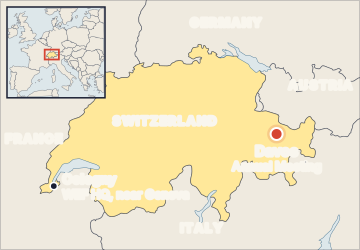
The World Economic Forum (WEF) is a Swiss not-for-profit foundation that brings together leaders from business, government, international organisations, universities and civil society to discuss global problems. It is best known for its Annual Meeting in Davos, a ski town in the Swiss Alps, held every January. It also publishes widely quoted reports and rankings, such as the Global Gender Gap Report and the Global Risks Report.
The WEF is not a UN body and not a government organisation; it is funded mainly by its member companies.
Why does it exist?
Many global problems, such as climate change, pandemics, new technologies and trade tensions, cannot be solved by governments alone or by companies alone. The WEF's idea is public-private cooperation: getting government leaders and business leaders in the same room so they can talk and plan together. Its stated mission is "improving the state of the world" through such cooperation.
Where did it come from?
- January 1971: German-born professor Klaus Schwab, then teaching at the University of Geneva, founded the European Management Forum, a non-profit foundation. Its first meeting was held in Davos for European business leaders.
- 1987: It was renamed the World Economic Forum, reflecting its global focus.
- January 2015: Switzerland formally recognised the WEF under its Host State Act. The Forum describes this status as an "international organization for public-private cooperation".
- April 2025: Klaus Schwab stepped down from the WEF board.
- February 2026: President and CEO Børge Brende stepped down, and Alois Zwinggi was named interim President and CEO. As of mid-2026, the Board of Trustees is co-chaired on an interim basis by Larry Fink and André Hoffmann.
Where is it based and how is it run?
The WEF's headquarters is in Cologny, near Geneva, Switzerland. It is guided by a Board of Trustees and run by a management team led by the President and CEO. Its money comes mostly from partner and member companies, which pay to take part in its meetings and initiatives.
What does it do?
The WEF works in three main ways:
- Meetings: The Davos Annual Meeting every January (the 56th was held on 19–23 January 2026 under the theme "A Spirit of Dialogue"), plus regional meetings.
- Reports and indices: Research reports that rank countries or map global risks.
- Initiatives and centres: Projects on topics like technology, climate and health, including a network of Centres for the Fourth Industrial Revolution (C4IR).
Important WEF reports for UPSC
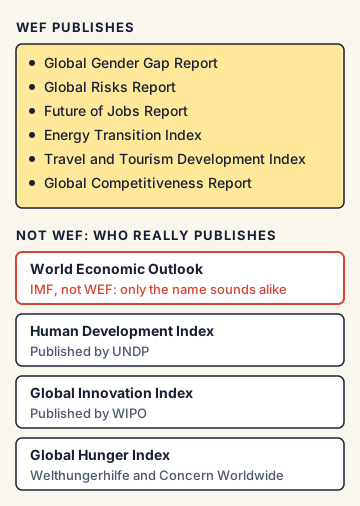
- Global Gender Gap Report: ranks countries on gaps between men and women in four areas: economic participation, education, health and survival, and political empowerment. India ranked 131st out of 148 in 2025 and 131st out of 145 in 2026.
- Global Risks Report: lists the biggest risks the world faces, based on a survey of experts. The 2026 edition (21st, released 14 January 2026) ranked geoeconomic confrontation (trade and economic rivalry between countries) as the top risk for 2026.
- Future of Jobs Report: studies how technology and other trends will change jobs and skills.
- Energy Transition Index and Travel and Tourism Development Index: rank countries on their energy systems and tourism.
- Global Competitiveness Report: a long-running ranking of country competitiveness; the last full ranking was published in 2019, and the ranking was paused in the 2020 special edition.
India and the WEF
Indian leaders and companies take part in Davos every year. In October 2018, the WEF opened its Centre for the Fourth Industrial Revolution India, the fourth such centre in the world after San Francisco, Tokyo and Beijing, with NITI Aayog coordinating on behalf of the government. It is based in the Mumbai area (Navi Mumbai), and its early focus areas were artificial intelligence, blockchain and drones. India also hosts a second C4IR centre in Telangana.
Commonly confused concepts
- WEF vs World Bank vs IMF: The World Bank and IMF are intergovernmental institutions owned by member countries; they lend money and set rules. The WEF is a private, non-profit foundation; it lends no money and makes no binding rules. It is a platform for discussion and research.
- WEF vs World Economic Outlook (WEO): The World Economic Outlook is the IMF's report on global growth forecasts. It is not a WEF report, though the names sound alike.
- WEF reports vs other indices: The Human Development Index is published by UNDP; the Global Innovation Index by WIPO; the Global Hunger Index by Welthungerhilfe and Concern Worldwide. Students often wrongly assign these to the WEF.
- Davos vs Geneva: Davos is where the famous annual meeting takes place; the WEF's headquarters is in Cologny, near Geneva.
Issues, criticism and the way forward
- "Elite club" criticism: Critics say Davos is a gathering of the rich and powerful, and that big corporations get too much say on public policy without being elected.
- Survey-based rankings: Some WEF indices rely partly on opinion surveys of business executives. Governments, including India's, have at times questioned the methods and data of rankings like the Gender Gap Index.
- Governance and trust: Leadership changes in 2025–26, including the founder's exit and the CEO's exit while an independent investigation was under way, have raised questions about the Forum's governance. The board says it is searching for permanent leaders.
- Way forward: Supporters argue that a neutral meeting place for business and governments is useful in a divided world. Reformers suggest more transparency in funding, clearer methods for rankings, and wider participation from developing countries and civil society.
Concepts to Know
- Foundation: A legal organisation set up to pursue a purpose (not to make profit for owners), funded by contributions.
- Public-private cooperation: Governments and private companies working together on a common goal.
- Fourth Industrial Revolution: The present wave of technological change, where digital, physical and biological technologies merge, for example AI, robotics, the Internet of Things and gene editing.
- Geoeconomic confrontation: When countries use trade, tariffs, sanctions, investment rules or control over resources as weapons against each other.
- Founded January 1971 by Klaus Schwab as the European Management Forum; renamed World Economic Forum in 1987
- Headquarters: Cologny, near Geneva, Switzerland; Swiss not-for-profit foundation
- Recognised under Switzerland's Host State Act in January 2015 ("international organization for public-private cooperation")
- Davos Annual Meeting every January; 56th meeting 19–23 January 2026, theme "A Spirit of Dialogue"
- Interim President and CEO: Alois Zwinggi (since February 2026)
- Global Gender Gap Report: India 131st of 148 (2025), 131st of 145 (2026)
- Global Risks Report 2026: geoeconomic confrontation ranked top risk for 2026
- C4IR India opened October 2018, with NITI Aayog as coordinating partner
● Tracked since June 29, 2026 · last seen November 10, 2026 · updates as the daily brief publishes