Wholesale Price Index (WPI)
Measuring Prices at the Wholesale Stage
The Wholesale Price Index (WPI) tracks how the prices of goods change when they are sold in bulk, that is, by producers and wholesalers, before they reach the shopkeeper and the consumer. It covers things like grains, vegetables, minerals, crude oil, electricity, steel, cement, chemicals and machinery. It does not cover services such as rent, haircuts, school fees or doctors' fees.
It is compiled every month by the Office of the Economic Adviser (OEA) in the Department for Promotion of Industry and Internal Trade (DPIIT), Ministry of Commerce and Industry.
Why does it exist?
Prices do not change at the same time at every stage. When crude oil or steel becomes costlier, factories feel it first. Shops and households feel it weeks or months later. The WPI catches price changes at this early stage. So it works like an early warning signal for retail inflation, and it tells the government and businesses how their input costs are moving.
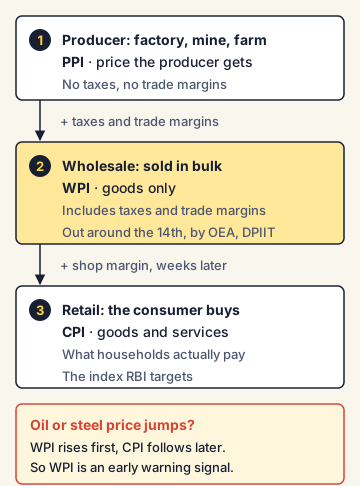
It is also used in daily business. Many long contracts (roads, buildings, defence supplies) have a price escalation clause. This clause says that the contract price will rise along with the WPI, so that a builder is not ruined if steel prices jump midway through a project.
Where did it come from?
The WPI is one of India's oldest price measures.
- Its base year has been revised many times: 1952-53, 1961-62, 1970-71, 1981-82, 1993-94, 2004-05 and 2011-12.
- For decades, the WPI was India's headline inflation measure. Newspapers and policymakers quoted it as "the" inflation rate.
- In January 2014, the Urjit Patel Committee recommended that the RBI target CPI inflation instead, because the CPI reflects prices people actually pay and includes services. Since the adoption of inflation targeting (formally from 2015-16), CPI has been the main inflation measure.
- On 15 June 2026, the OEA released a new WPI series with base year 2022-23, replacing the 2011-12 series. On the same day, India launched its first Producer Price Indices (PPI).
How is it calculated?
- Every month, the OEA collects prices of a fixed list of items from factories, mines, mandis and other sources across the country.
- Each item gets a weight, based on how important it is in the economy. In the new series, weights are based on the Gross Value of Output (the total value of what is produced). The old series used "net traded value" (output plus imports minus exports).
- The index for the base year is set to 100. If the index is 110.8, prices have risen about 10.8% since the base year.
- WPI inflation = the change in the index compared with the same month last year.
- Release: Provisional figures come out on the 14th of every month (or the next working day) for the previous month. They are revised later, when more price reports arrive, into final figures.
What is inside the basket?
The new 2022-23 series has 957 items, up from 697 in the old series. They are grouped into three major groups:
| Major group | Weight (2022-23 series) | Weight (2011-12 series) |
|---|---|---|
| Primary Articles (food grains, vegetables, fruits, milk, minerals) | 22.76% | 22.62% |
| Fuel and Power (coal, mineral oils, electricity, crude petroleum and natural gas) | 14.11% | 13.15% |
| Manufactured Products (food products, textiles, chemicals, metals, machinery) | 63.13% | 64.23% |
Main changes in the new series:
- Crude petroleum and natural gas moved from Primary Articles to Fuel and Power.
- Solar, wind and nuclear electricity were added to the electricity group.
- Missing prices are now filled using "targeted mean imputation" (an estimate from similar items), instead of simply repeating last month's price.
- WPI also publishes a separate WPI Food Index, which combines food items from Primary Articles and Manufactured Products.
The new Producer Price Index (PPI)
The WPI records prices that include taxes and trade margins (the profit of middlemen). A PPI measures the price the producer actually receives, without taxes and margins. This makes it a cleaner measure of production costs. India's new PPI family has three parts:
- Output PPI: prices of what producers sell (monthly).
- Input PPI: prices of what manufacturers buy as inputs (on a trial basis).
- Service PPI: for seven services: banking, securities transactions, insurance, pension fund management, railways, air passenger transport and telecom (quarterly).
The government plans to keep publishing the WPI for five more years alongside the PPI and then discontinue it. The gap gives time for contracts linked to the WPI to switch to the PPI. Most advanced economies and the IMF recommend PPIs over wholesale indices.
India's position: the WPI-CPI gap
WPI and CPI often move very differently.
- WPI has a big weight for fuel, metals and manufactured goods, which follow world prices of oil and commodities.
- CPI has a big weight for food and services.
- So when global oil prices jump, WPI inflation shoots up first. In August 2026, WPI inflation was 9.92% while CPI inflation was below 5%. A large gap like this means businesses are paying much more for inputs than they are yet charging consumers. Economists watch it because firms may pass these costs on later.
- When WPI is negative or very low for long, it can signal weak demand and pressure on factory profits.
Commonly confused concepts
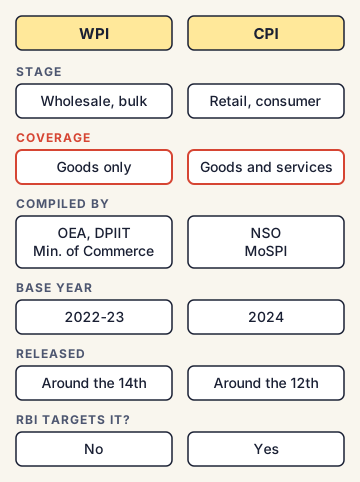
- WPI vs CPI:
- Stage: WPI = wholesale or bulk stage; CPI = retail stage (what consumers pay).
- Coverage: WPI = goods only; CPI = goods and services.
- Compiler: WPI = OEA, DPIIT (Ministry of Commerce and Industry); CPI = NSO, MoSPI.
- Base year: WPI = 2022-23; CPI = 2024.
- Release: WPI around the 14th; CPI around the 12th of the month.
- RBI target: CPI, not WPI.
- WPI vs PPI: WPI includes taxes and trade margins and covers only goods. PPI excludes taxes and margins and can cover services.
- WPI vs GDP deflator: The GDP deflator covers the price change of everything produced in the economy (goods and services), and is derived from GDP data every quarter. It is not a fixed basket index.
- Primary Articles vs Primary sector: "Primary Articles" in WPI includes food articles, non-food articles and minerals. Crude oil and gas now sit in Fuel and Power, not in Primary Articles.
Issues, criticism and the way forward
- No services: Services are over half of India's economy, but the WPI ignores them. The Service PPI is meant to fill this gap.
- Taxes and margins included: Because WPI includes taxes, a change in GST or excise duty can move it even if production costs did not change. The PPI avoids this.
- Large revisions: Provisional WPI numbers are based on incomplete price reports (for example, an 84.4% response rate for August 2026) and can change in final data.
- Old base years for too long: The 2011-12 series ran for over a decade. Regular base revisions keep the basket close to what the economy actually produces.
- Way forward: A smooth move to the PPI, updating contracts that use WPI escalation clauses, and regular base revisions in line with the CPI and GDP series.
Concepts to Know
- Wholesale: Selling goods in large quantities, usually to shops or factories, not to the final consumer.
- Index number: A number that shows change from a starting point set at 100. An index of 110 means a 10% rise from the base year.
- Base year: The reference year in which the index is set to 100.
- Weight: How important an item is in the index. Items with a larger share of the economy get a bigger weight.
- Price escalation clause: A condition in a contract that raises the contract price if an agreed price index rises.
- Trade margin: The extra amount a wholesaler or trader adds over the cost price, as their earning.
- GDP deflator: A broad price measure that compares GDP at current prices with GDP at constant prices.
- Compiled by the Office of the Economic Adviser, DPIIT, Ministry of Commerce and Industry
- New base year 2022-23 (released 15 June 2026), replacing 2011-12; items increased from 697 to 957
- Weights (2022-23): Primary Articles 22.76%, Fuel and Power 14.11%, Manufactured Products 63.13%
- Weights based on Gross Value of Output (earlier: net traded value)
- Covers goods only; includes taxes and trade margins
- Provisional release on the 14th of each month; revised later to final
- Producer Price Indices launched 15 June 2026: Output PPI, trial Input PPI, Service PPI (seven services)
- WPI to continue for five years alongside PPI, then be discontinued
- Urjit Patel Committee (January 2014) recommended CPI, not WPI, as the inflation anchor
● Tracked since February 16, 2026 · last seen October 12, 2026 · updates as the daily brief publishes