Veto Initiative (UNGA Resolution 76/262)
Making the Veto Answerable
The Veto Initiative is a decision of the UN General Assembly, adopted in April 2022, that makes the whole UN membership discuss every veto. Whenever a permanent member of the Security Council casts a veto, the General Assembly must meet within 10 working days to debate the issue. It does not take away or limit the veto.
It only makes the country that used the veto explain itself in front of all 193 member states. You can think of it like a school rule that does not stop the monitor from overruling the class, but makes the monitor stand up and explain the decision to everyone.
Why was it needed?
The Security Council acts on behalf of all UN members, yet one permanent member can block action that the other 14 members support. Before 2022, a veto often ended the matter quietly. Many smaller countries felt the veto was being used without any accountability. The Veto Initiative was designed to put a political cost on using the veto, through a public debate where every country can speak.
Where did it come from?
- The resolution was brought by Liechtenstein, a very small European country, with a core group of supporters. Media and UN reports counted about 83 co-sponsors.
- It was adopted on 26 April 2022 at the 69th plenary meeting of the General Assembly. It passed without a vote, which means no member asked for a recorded vote (often called adoption by consensus).
- It came two months after Russia vetoed a Council draft on its military action in Ukraine in February 2022, which had made the veto debate very sharp.
- Its official title is "Standing mandate for a General Assembly debate when a veto is cast in the Security Council". Here "standing mandate" means a permanent rule that applies automatically every time, without a new decision.
What does the resolution actually say?
It has five operative paragraphs. The main ones are:
- The President of the General Assembly must call a formal meeting within 10 working days of a veto by one or more permanent members, to debate the situation on which the veto was cast. This does not apply if the Assembly is already meeting in an emergency special session on the same situation.
- On an exceptional basis, the permanent member or members who cast the veto get to speak first in that debate.
- The Security Council is invited to send a special report on the use of the veto to the General Assembly at least 72 hours before the debate. This uses Article 24(3) of the UN Charter, which says the Council shall submit annual and, when necessary, special reports to the Assembly.
- A permanent item titled "Use of the veto" was added to the General Assembly's agenda from its 77th session onwards.
How does it work in practice?
Here is the simple sequence:
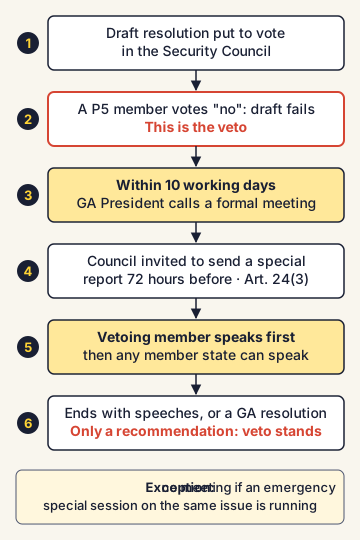
- A draft resolution is put to vote in the Council, and a permanent member votes "no", so the draft fails.
- Within 10 working days, the General Assembly President calls a meeting.
- The vetoing country speaks first and gives its reasons. Then any member state can speak.
- The debate can end with only speeches, or members can choose to adopt a General Assembly resolution on the issue.
The first debate under this rule was held on 8 June 2022. It followed the veto by China and Russia on 26 May 2022 of a draft that would have tightened sanctions on North Korea (the DPRK). The other 13 Council members had voted for that draft.
What powers does the General Assembly really have here?
The General Assembly can discuss any matter of peace and security under Articles 10 and 11 of the Charter. But its resolutions are only recommendations, not binding orders. Also, under Article 12, it should not make a recommendation on a dispute while the Council is still dealing with it. So the Veto Initiative creates talk and pressure, not a power to override the Council.
India's position
India did not oppose adoption, but raised serious objections during the April 2022 debate:
- India called it a "piecemeal" initiative. It argued that countries which reject piecemeal reform inside the IGN were backing a piecemeal step here.
- India regretted that the text was presented as a "take it or leave it" proposal without enough inclusive discussion.
- India said the General Assembly can do very little, because the P5 effectively hold a "veto over the veto": no Charter change can happen without them.
- India restated its core view: the veto should be abolished in principle, but as long as it exists, it should be given to new permanent members too.
- India has since pointed out that vetoes have kept coming after the resolution was adopted. In April 2026 it said 24 vetoes had been cast on 20 draft resolutions since 2022.
Commonly confused concepts
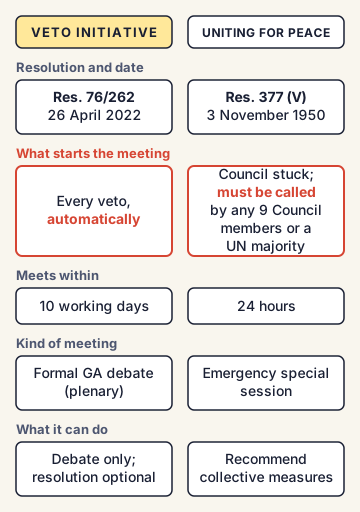
- Veto Initiative (Resolution 76/262, 2022) vs Uniting for Peace (Resolution 377 (V), 1950): Uniting for Peace was adopted on 3 November 1950. It allows the General Assembly to meet in an emergency special session within 24 hours when the Council fails to act because the permanent members do not agree. Such a session can be called by any nine Council members (seven when the Council had 11 members) or by a majority of UN members, and it can recommend collective measures. The Veto Initiative is automatic after every veto and only requires a debate. If an emergency special session on the same issue is already running, the Veto Initiative meeting is not held.
- Veto Initiative vs French-Mexican initiative (2015): France and Mexico asked the P5 to voluntarily not use the veto in cases of mass atrocities (genocide, crimes against humanity, large-scale war crimes). It is a political declaration, not a General Assembly rule.
- Veto Initiative vs ACT Code of Conduct (2015): The ACT group (Accountability, Coherence and Transparency) asked all Council members, permanent and elected, to pledge not to vote against credible action to stop mass atrocities. It too is voluntary.
- Veto vs "de facto veto": The formal veto exists only for the P5 under Article 27(3). A "de facto veto" means any one of the 15 members blocking a consensus-based product, such as a press statement or a terrorist listing in a sanctions committee.
- Veto vs abstention: A permanent member that abstains does not block a decision. Only a negative vote does.
Issues, criticism and the way forward
- No change in behaviour: Permanent members have kept using the veto. Many debates under the initiative have ended with speeches and no General Assembly resolution.
- Only a cost, not a check: The Assembly cannot override a veto, so the initiative depends on public pressure, which major powers can ignore.
- Silent blocking escapes it: If a draft is never put to vote because a veto is expected, there is no veto and no debate. Informal holds in sanctions committees are also outside its reach.
- The reform angle: Supporters see it as a useful step that makes the veto more transparent. Countries like India see it as a side-track that should not replace real reform of membership and the veto through the IGN.
- Way forward suggested in debates: wider support for voluntary restraint in mass-atrocity cases, better use of the special reports, and a negotiating text on veto reform within the IGN.
Concepts to Know
- Veto: A "no" vote by a permanent member of the Security Council that blocks a decision on an important matter, even if all other members vote yes.
- P5: The five permanent members of the Security Council: China, France, Russia, the United Kingdom and the United States.
- General Assembly (UNGA): The main body of the UN where all 193 member states sit with one vote each. Its resolutions are mostly recommendations, not binding orders.
- Plenary meeting: A full meeting of the General Assembly where all members can take part, not a smaller committee.
- Draft resolution: A proposed decision that members vote on. If it passes, it becomes a resolution.
- Emergency special session: A special, short-notice meeting of the General Assembly called under the Uniting for Peace resolution when the Council cannot act.
- Piecemeal reform: Changing one small part of a system at a time, instead of agreeing on a complete package.
- UNGA Resolution 76/262, adopted on 26 April 2022, without a vote; brought by Liechtenstein; about 83 co-sponsors
- General Assembly must meet within 10 working days of any veto by a permanent member
- The vetoing member gets first place on the list of speakers
- Council invited to send a special report at least 72 hours before the debate, under Article 24(3) of the Charter
- Permanent agenda item "Use of the veto" from the 77th session of the General Assembly
- First debate under it: 8 June 2022, after the China and Russia veto of 26 May 2022 on North Korea sanctions
- Uniting for Peace: Resolution 377 (V), 3 November 1950; emergency special session within 24 hours
- India's view: veto should be abolished in principle; while it exists, it must extend to new permanent members
● Tracked since October 28, 2026 · last seen October 28, 2026 · updates as the daily brief publishes