Vedanthangal Bird Sanctuary
Vedanthangal Bird Sanctuary is a small lake sanctuary in the Madurantakam taluk of Chengalpattu district, Tamil Nadu, south-west of Chennai. It is often described as one of the oldest water bird sanctuaries in India. Every year, tens of thousands of water birds come here to nest and spend the winter. It is protected under the Wildlife (Protection) Act, 1972, and is also a Ramsar site.
Why does it exist?
The lake at Vedanthangal is an irrigation tank. Birds nest in the trees standing in the water, and their droppings (called guano) fall into the lake. This makes the water rich in nutrients. When farmers use this water on their fields, crops grow better. So the local villagers protected the birds for generations because the birds helped their farms. This is a classic Indian example of community-based conservation: people protect nature because they see a direct benefit.
Where did it come from?
The area was used for bird hunting in the past. Near the end of the 18th century, local villagers got a written order from the District Collector to stop British soldiers from shooting birds there. This early record is why the site is called one of India's oldest protected bird areas. The main steps after that:
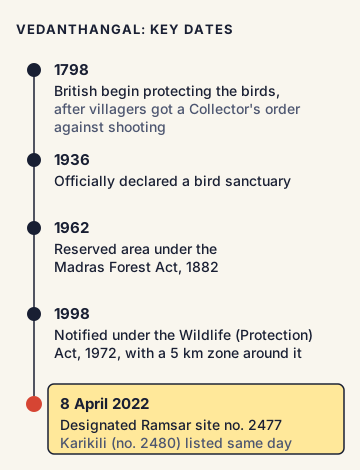
- 1798: the British administration began steps to protect the area for birds.
- 1936: it was officially declared a bird sanctuary.
- 4 June 1962: the wetland was declared a reserved area under the Madras Forest Act, 1882.
- 1998: final notification as a wildlife sanctuary under the Wildlife (Protection) Act, 1972, with the surrounding 5 km zone included (8 July 1998).
- 8 April 2022: designated a Ramsar site (site no. 2477).
How does the sanctuary work?
The lake is small, about 30 hectares (the Ramsar listing gives about 40 ha). It is up to 5 m deep. It fills mainly with rain from the north-east monsoon (October to December), when Tamil Nadu gets most of its rain. The area gets about 140 cm of rain a year. The lake also waters nearly 250 acres of farmland.
Birds arrive soon after the lake fills, build nests on the trees in the water, raise their young, and leave by about March as the water dries.
Which birds live here?
- Nesting birds: spot-billed pelican, Asian openbill stork, painted stork, Indian and little cormorants, black-crowned night heron, little, intermediate and great egrets, glossy and black-headed ibises, Eurasian spoonbill and Indian pond heron.
- Winter migrants: northern pintail, garganey, northern shoveler, black-winged stilt and whiskered tern. Many of these breed far north in Central Asia and Siberia.
- Numbers: more than 40,000 birds each migratory season, and over 70,000 in a good monsoon year.
India's position and the neighbourhood
Vedanthangal is part of a cluster of wetlands. The nearby Karikili Bird Sanctuary (a sanctuary since 1988 and a Ramsar site since 2022) is another small lake sanctuary. Birds move between these sanctuaries and the hundreds of village irrigation tanks (locally called eris) around them to feed. So the health of the sanctuary depends not only on its own small lake but on the whole landscape around it.
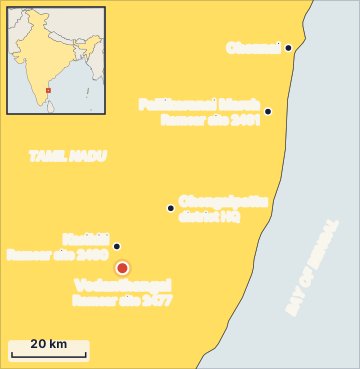
Tamil Nadu has more Ramsar sites (20) than any other state, and many of them, like Vedanthangal, Karikili and Pallikaranai Marsh, are close to Chennai.
Commonly confused concepts
- Wildlife sanctuary vs national park: Both are declared under the Wildlife (Protection) Act, 1972. A sanctuary (Section 18) may allow some human activities, like grazing, if permitted. A national park (Section 35) has stricter rules, and no grazing or private rights are allowed. Vedanthangal is a sanctuary.
- Ramsar site vs wildlife sanctuary: A sanctuary is a legal protected area under Indian law. A Ramsar site is an international listing. A place can be both, as Vedanthangal is.
- Vedanthangal vs Vettangudi vs Vedaranyam: All are in Tamil Nadu. Vettangudi is a bird sanctuary in Sivaganga district. Vedaranyam is the coastal area near Point Calimere (Kodiakkarai). Vedanthangal is the one in Chengalpattu district.
- Bird sanctuary vs Important Bird Area (IBA): An IBA is a site identified by BirdLife International as important for birds. It is a scientific label, not a legal protection. Vedanthangal and Karikili together are listed as an IBA.
Issues, criticism and the way forward
- Urban growth around Chennai: Roads, industry, housing and airports are spreading into the wetland belt south and west of Chennai. Building on feeding grounds can harm the birds even if the sanctuary itself is untouched.
- Water supply: The lake depends on rain and on inflow channels. Blocked or broken channels, encroachment and silt can leave the lake dry in a weak monsoon. In 2013, the Public Works Department de-silted the lake and built new channels.
- Buffer zone pressure: Development in the 5 km zone around the sanctuary has led to conflicts with landowners and builders.
- Tourism: Many visitors come in the season; noise and crowding must be managed so they do not disturb nesting birds.
- The way forward suggested by experts: protect the whole landscape of village tanks and not only the sanctuary lake, keep inflow channels clean, involve local villagers who have protected the birds for centuries, and run strict environmental checks before big projects in the area.
Concepts to Know
- Wetland: Land covered with water for all or part of the year, like a lake, marsh, swamp, mangrove or paddy field. Wetlands store water, clean it and support many birds and fish.
- Irrigation tank (eri): A man-made lake that stores rainwater to water fields. South India has thousands of them, many built centuries ago.
- Guano: Bird droppings. They are rich in nitrogen and phosphorus, which act like natural fertiliser.
- North-east monsoon: The rain that Tamil Nadu gets from October to December, when the winds blow from the north-east.
- Habitat fragmentation: When a large natural area is broken into small, separated pieces by roads, buildings or farms. Animals then find it harder to feed, move and breed.
- Spot-billed pelican: A large water bird that nests at Vedanthangal. It is listed as Near Threatened on the IUCN Red List.
- Location: Madurantakam taluk, Chengalpattu district, Tamil Nadu
- One of India's oldest water bird sanctuaries; Collector's protection order in the late 18th century; declared a bird sanctuary in 1936
- Reserved area under the Madras Forest Act, 1882 (1962); notified under the Wildlife (Protection) Act, 1972 with a 5 km zone (1998)
- Area: about 30 ha (Ramsar listing about 40 ha); fed by the north-east monsoon
- Ramsar site no. 2477, designated 8 April 2022; nearby Karikili (Ramsar no. 2480) designated the same day
- More than 40,000 birds every season; key nesting species include the spot-billed pelican and Asian openbill
● Tracked since November 11, 2026 · last seen November 11, 2026 · updates as the daily brief publishes