United Nations Population Fund (UNFPA) and the State of World Population Report
The United Nations Population Fund, or UNFPA, is the United Nations agency that works on population, sexual and reproductive health, and the rights of women and young people. In simple words, it helps countries make sure that every pregnancy is wanted, every childbirth is safe, and every young person can reach their full potential. Every year it publishes the State of World Population (SWOP) Report, its main report on what is happening to the world's people. India has worked with UNFPA since 1974.
Why does UNFPA exist?
In the 1960s, the world's population was growing very fast. Many poor countries worried that their schools, hospitals and food supply could not keep up. At the same time, millions of women had no way to plan when to have children, and many died during pregnancy or childbirth. Countries needed money, data and expert help to deal with these problems.
UNFPA was created to give that help. Without such an agency, poorer countries would struggle to run population censuses, train midwives or supply family planning methods.
Where did it come from?
UNFPA started as a small fund and slowly grew into a full agency:
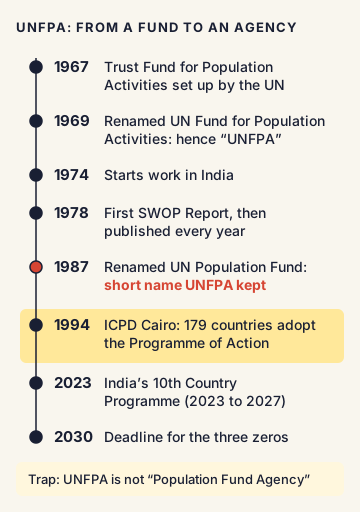
- 1967: The UN set up a special Trust Fund for Population Activities.
- 1969: It was renamed the United Nations Fund for Population Activities and began work. This is where the short name "UNFPA" comes from. At first, its work was run by the United Nations Development Programme (UNDP).
- Early 1970s: The UN General Assembly placed the fund under its own authority, making it a body of the General Assembly.
- 1987: It was renamed the United Nations Population Fund. The old short form UNFPA was kept, even though the new name has no "A" for "Activities".
The big turning point: Cairo, 1994
The International Conference on Population and Development (ICPD) was held in Cairo, Egypt, from 5 to 13 September 1994. Delegations from 179 countries took part. They adopted the ICPD Programme of Action on 13 September 1994. This changed the whole way the world thinks about population. Before Cairo, many governments focused on numbers: how to cut the birth rate, sometimes with targets.
After Cairo, the focus moved to people: a woman's right to decide freely whether, when and how many children to have. UNFPA's work is still guided by this Programme of Action.
How does UNFPA work?
UNFPA is not a lender like the World Bank. It gives grants, supplies and expert help. Its work happens in four main ways:
- Country programmes: It signs a programme with each country's government, usually for five years. The programme lists what UNFPA will help with in that country.
- Supplies: It is one of the world's biggest buyers of contraceptives (methods to prevent pregnancy) and maternal health medicines for poorer countries.
- Data: It helps countries run censuses and surveys, so governments know how many people they have and what they need.
- Advocacy: It pushes governments to fight child marriage, female genital mutilation and violence against women.
The three "zeros"
UNFPA's mission today is summed up as three transformative results, to be reached by 2030:
- Zero unmet need for family planning: every woman who wants to avoid or delay pregnancy can get a method to do so.
- Zero preventable maternal deaths: no woman dies of a pregnancy or childbirth problem that could have been prevented.
- Zero gender-based violence and harmful practices: an end to violence against women and to practices like child marriage.
UNFPA's own reports admit that the world is off track for these goals. Progress on unmet need and maternal deaths has slowed since about 2015.
Who runs it and who pays for it?
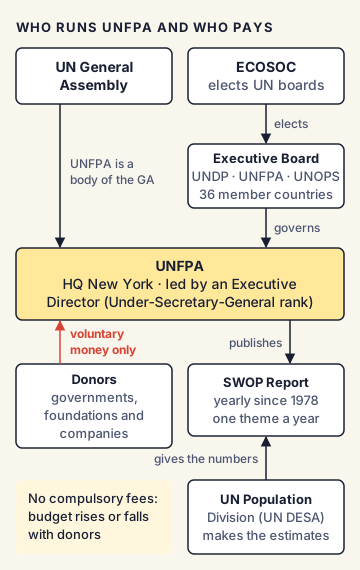
- Headquarters: New York, USA.
- Governing body: UNFPA reports to the Executive Board of UNDP, UNFPA and UNOPS, which has 36 member countries elected by the UN Economic and Social Council (ECOSOC). UNFPA is a body of the UN General Assembly.
- Head: An Executive Director, who holds the rank of Under-Secretary-General of the UN.
- Money: UNFPA has no compulsory fees. All its money comes from voluntary contributions by governments, foundations and companies. So its budget can rise or fall depending on what donors decide.
What is the State of World Population (SWOP) Report?
The SWOP Report is UNFPA's flagship report, published every year since 1978. Each edition picks one theme and gives the latest population numbers for every country. Those numbers are not counted by UNFPA itself. They mostly come from the UN Population Division's World Population Prospects. Recent editions show how the theme changes each year:
- 2023: 8 Billion Lives, Infinite Possibilities. It came out in the year India's population passed China's.
- 2025: The Real Fertility Crisis. It argued that the real crisis is not "too many" or "too few" people. It is that many people cannot have the number of children they want, because of cost, jobs, housing or health. It put India's population at about 1,463.9 million in 2025 and its fertility rate below the replacement level (about 2.1 children per woman, the level at which each generation just replaces the one before it).
- 2026: Succeeding Generations: Empowering young people to chart the future. It focuses on young people's hopes and on what governments must do to support them.
India's position and Indian examples
UNFPA has worked in India since 1974, and India is one of its largest country programmes. The current 10th Country Programme runs from 2023 to 2027. It is aligned with the UN's wider cooperation framework for India for the same years, and it works on the same three zeros. UNFPA India supports:
- The Ministry of Health and Family Welfare on maternal health, family planning and adolescent health.
- Programmes on adolescent health (for example, the Rashtriya Kishor Swasthya Karyakram, the national programme for the health of 10 to 19 year olds).
- Work against child marriage and gender-biased sex selection (choosing to give birth to boys over girls).
- Studies on population ageing and on the youth population, state by state.
India's own policy matches the Cairo approach. The National Population Policy, 2000 aims for voluntary choice and better services, not forced targets. India also observes World Population Day on 11 July every year. The UNDP Governing Council started this day in 1989. The date marks 11 July 1987, the day the world's population was estimated to reach five billion.
Commonly confused concepts
- UNFPA vs UNICEF: UNFPA works on population, reproductive health and gender. UNICEF (United Nations Children's Fund) works on children's health, nutrition and education. Both are UN funds based in New York, so students mix them up.
- UNFPA vs UN Population Division (UN DESA): The Population Division, part of the UN Department of Economic and Social Affairs, produces the official population estimates and projections (World Population Prospects). UNFPA mostly uses those numbers in the SWOP Report and works on the ground in countries.
- "UN Population Fund" vs "Fund for Population Activities": These are the same body. The full name changed in 1987, but the short name UNFPA stayed. An option saying "UNFPA stands for United Nations Population Fund Agency" is a trap.
- SWOP Report vs World Population Prospects: SWOP is a yearly, theme-based UNFPA report. World Population Prospects is the UN Population Division's large data set, usually revised every two years.
- Population figures vs the Census: UN figures for India are estimates and projections, not a head count. India's own count is the Census, done by the Registrar General and Census Commissioner of India under the Ministry of Home Affairs.
Issues, criticism and the way forward
- Funding cuts: Because its money is voluntary, UNFPA is hit hard when big donors pull out. The United States has cut UNFPA funding several times under the Kemp-Kasten Amendment (1985). This US law bars US funds to any group that the US President decides supports or helps run forced abortion or forced sterilisation. In 2025, the US cut 48 grants and later denied future funding. UNFPA rejected the claims as unfounded and said the cuts would hurt women in crisis areas.
- Political disputes: Some governments object to UNFPA's work on sexual and reproductive rights, saying it goes against their values. Others say this work saves women's lives.
- Off-track goals: Progress on the three zeros has slowed, so the 2030 targets look hard to meet.
- Survey limits: Online surveys, like the Demographic Futures Survey (the online survey UNFPA used for its 2025 SWOP Report), reach only people with internet access. They show trends in thinking but cannot speak for a whole country.
- The way forward: Experts call for steady, long-term funding, better data at the district level, and putting women's choices, not numbers, at the centre of population policy.
Concepts to Know
- Reproductive health: Good health in everything linked to having children, including safe pregnancy, safe childbirth, and the freedom and means to decide when to have children.
- Unmet need for family planning: Among women of reproductive age (15 to 49 years) who can get pregnant, the share who want to stop or delay having children but are not using any method to prevent pregnancy.
- Maternal mortality ratio (MMR): The number of women who die from pregnancy or childbirth problems (during pregnancy or within 42 days after it ends) for every 1,00,000 live births in the same period. Do not confuse it with the maternal mortality rate, which counts the same deaths per 1,00,000 women of reproductive age.
- Population projection: A careful estimate of how many people there will be in a future year, based on today's birth rates, death rates and migration. It is not a guarantee.
- ECOSOC (Economic and Social Council): One of the six main bodies of the UN. It handles economic, social and development work, and it elects the members of many UN boards.
- Gender-based violence: Harm done to a person because of their gender, such as domestic violence, sexual violence or forced marriage.
- Trust Fund set up 1967; renamed United Nations Fund for Population Activities in 1969; renamed United Nations Population Fund in 1987 (acronym UNFPA kept)
- Headquarters: New York; a body of the UN General Assembly
- Governed by the Executive Board of UNDP, UNFPA and UNOPS (36 members elected by ECOSOC)
- Funded only by voluntary contributions
- ICPD Cairo, 5-13 September 1994; 179 countries; Programme of Action adopted 13 September 1994
- Three transformative results by 2030: zero unmet need for family planning, zero preventable maternal deaths, zero gender-based violence and harmful practices
- SWOP Report: flagship annual report since 1978
- UNFPA in India since 1974; 10th Country Programme 2023-2027
- World Population Day: 11 July (set up by the UNDP Governing Council in 1989; marks the "Day of Five Billion", 11 July 1987)
● Tracked since November 19, 2026 · last seen November 19, 2026 · updates as the daily brief publishes