UN Watercourses Convention, 1997
The Global Rules for Sharing Rivers
The UN Watercourses Convention is a global treaty that sets out basic rules for how countries should share rivers, lakes and underground water that cross their borders. Its full name is the Convention on the Law of the Non-Navigational Uses of International Watercourses. The UN General Assembly adopted it on 21 May 1997, and it came into force on 17 August 2014.
Its two most important rules are simple: each country must use a shared river in a fair and reasonable way, and must try not to cause significant harm to the other countries on that river.
Why does it exist?
The world has about 310 river basins shared by two or more countries, and many of them have no sharing agreement at all. A river does not stop at a border, so what one country does affects the next. If an upstream country builds a dam or takes out too much water, the downstream country may get less water, more pollution or sudden floods.
Without common rules, every such problem becomes a fight between two governments. The Convention gives all countries one shared rulebook, so that disputes can be settled by talking and fair principles instead of by power.
You can think of it like a building where many flats share one water tank on the roof. The flat closest to the tank could take all the water. Building rules say every flat gets a fair share, nobody wastes or dirties the water, and everyone must tell the others before changing the pipes.
Where did it come from?
Countries have argued about shared rivers for a long time. The rules grew in stages:
- 1895, the Harmon Doctrine: In a river dispute with Mexico over the Rio Grande, US Attorney General Judson Harmon argued that a country has absolute sovereignty (complete control) over the water inside its territory, whatever the effect downstream. This extreme upstream view was later given up.
- 1966, the Helsinki Rules: The International Law Association (a private body of international lawyers, not a UN body) wrote the Helsinki Rules on the Uses of the Waters of International Rivers. They put forward the idea of equitable utilisation: every country in a river basin has a right to a fair share.
- 1970 onwards: The UN General Assembly asked its expert body, the International Law Commission (ILC), to draft rules on shared rivers. The ILC worked on this for over two decades and finished its draft articles in 1994.
- 21 May 1997: The General Assembly adopted the Convention by a vote of 103 in favour, 3 against (Burundi, China and Turkey) and 27 abstentions. India and Pakistan abstained. Bangladesh and Nepal voted in favour.
- 2004, the Berlin Rules: The International Law Association updated the Helsinki Rules into the Berlin Rules on Water Resources.
- 17 August 2014: The Convention came into force, 90 days after Vietnam became the 35th country to join (on 19 May 2014). Article 36 says it enters into force on the 90th day after the 35th country joins.
The core rules: what does it say?
- Article 5, equitable and reasonable utilisation: Each country must use the shared river in a fair and reasonable way and must also take part in protecting and developing it. "Equitable" means fair, not necessarily equal. A country with a bigger population depending on the river may get more.
- Article 6, how "fair" is decided: It lists factors to weigh together, with no fixed ranking. These include geography and climate, the social and economic needs of each country, the population depending on the river, the effect of one country's use on others, existing and possible uses, conservation and cost, and whether other water sources are available.
- Article 7, no significant harm: Each country must take all suitable steps to avoid causing significant harm to other countries on the river. If harm still happens, it must consult the affected country to remove or reduce it and, where suitable, discuss compensation (payment for the loss).
- Article 8, duty to cooperate: Countries must cooperate in good faith. They may set up joint commissions to do this.
- Article 9, sharing data: Countries must regularly share data on water levels, weather, groundwater, water quality and forecasts.
- Article 10, no use comes first automatically: Drinking, farming, power or industry have no built-in priority. In a conflict, special attention goes to vital human needs (enough water to survive, including for drinking and growing basic food).
- Articles 11 to 19, planned projects: Before building a big project like a dam that may harm others, a country must notify the other countries and share the technical data. Under Article 13, the other countries get six months to study it, which can be extended by six more months if the study is difficult.
- Articles 20 and 21, environment: Countries must protect river ecosystems (the living system of plants, fish and animals) and prevent, reduce and control pollution that could cause significant harm.
How are disputes settled? (Article 33)
The Convention sets up a step-by-step ladder:
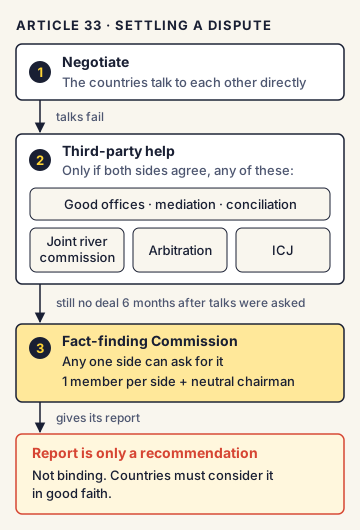
- First, the countries negotiate with each other.
- If that fails, they may jointly use good offices, mediation or conciliation by a third party, use their joint river commission, or agree to go to arbitration or the International Court of Justice (ICJ).
- If there is still no settlement six months after talks were requested, any side can ask for an impartial Fact-finding Commission. It has one member from each side plus a neutral chairman. Its report is a recommendation that the countries must consider in good faith; it is not binding.
What do courts say?
The ideas in the Convention are also used by the world's top court:
- Gabčíkovo-Nagymaros Project (Hungary v. Slovakia), ICJ, 25 September 1997: The case was about a joint dam project on the Danube. The ICJ said Czechoslovakia (later Slovakia) had wrongly taken control of a shared river and denied Hungary its equitable and reasonable share of the Danube's resources.
- Pulp Mills on the River Uruguay (Argentina v. Uruguay), ICJ, 20 April 2010: The ICJ said that under general international law, a country planning a project that may cause serious harm across a border must carry out an Environmental Impact Assessment (EIA).
Who has joined?
Only a few dozen countries are parties, mostly from Europe and Africa. Many large upstream countries, such as China and Turkey, have stayed out. India, Pakistan, Bangladesh, Nepal and China are not parties. So the Convention does not bind South Asian countries directly. Even so, many of its core ideas, especially fair use and no significant harm, are widely seen as part of customary international law (rules that bind countries because almost all countries follow them in practice).
India's position and Indian examples
India is an upper riparian (upstream country) for Pakistan and Bangladesh, but a lower riparian (downstream country) for China on the Brahmaputra and Sutlej. This double position makes India cautious about global river rules. India prefers to manage each river through bilateral treaties (agreements between two countries) suited to local conditions:
- Indus Waters Treaty, 1960 with Pakistan (brokered by the World Bank).
- Ganges Water Treaty, 1996 with Bangladesh. Its Article IX says sharing of other common rivers will be guided by equity, fairness and no harm, the same ideas as the UN Convention.
- Mahakali Treaty, 1996 with Nepal, on joint development of the Mahakali river.
- With China, India has no water treaty. It has only Memorandums of Understanding (MoUs) under which China agreed to share flood-season data on the Brahmaputra (first signed in 2002) and the Sutlej (2005), and an Expert Level Mechanism set up in 2006 to discuss data sharing.
Commonly confused concepts
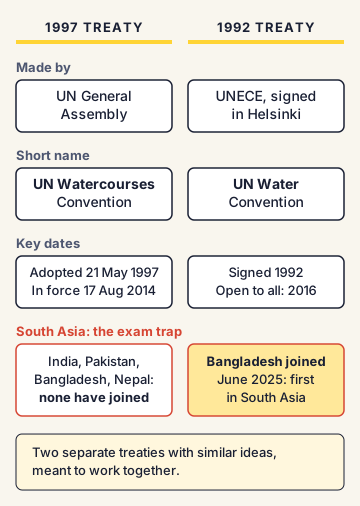
- UN Watercourses Convention (1997) vs UN Water Convention (1992): The 1992 treaty, the Convention on the Protection and Use of Transboundary Watercourses and International Lakes, was made under the UN Economic Commission for Europe (UNECE) in Helsinki. It was opened to all UN members from 1 March 2016. Bangladesh acceded to the 1992 Convention in June 2025, becoming the first South Asian country to join it. The 1997 Convention is a separate treaty adopted by the UN General Assembly. The two have similar ideas and are meant to work together.
- Helsinki Rules (1966) vs Helsinki Convention (1992): The Helsinki Rules were written by the International Law Association, a private body, and are not a treaty. The 1992 Water Convention was signed in Helsinki and is a binding treaty for its parties.
- Non-navigational vs navigational uses: The 1997 Convention covers uses other than shipping, such as drinking, irrigation, power and fishing. Rules on ships using rivers are separate.
- Equitable vs equal: Equitable means fair after weighing all factors. It does not mean a 50:50 split.
- Harmon Doctrine vs equitable utilisation: The Harmon Doctrine gave the upstream country full control. Equitable utilisation says every country on the river has a right to a fair share.
Issues, criticism and the way forward
- Upstream vs downstream tension: Upstream countries say the "no harm" rule lets downstream countries block their dams. Downstream countries say "fair use" lets upstream countries take too much. The Convention does not clearly say which rule wins when they clash. This was a main reason why China and Turkey voted against it.
- Low membership: Few countries have joined, and most of the world's big upstream countries stay out. So its rules bind few of the rivers where disputes are most serious.
- Weak dispute settlement: The Fact-finding Commission can only recommend. There is no court ruling that a country must obey unless it has separately agreed to arbitration or the ICJ.
- Climate change: Treaties based on old flow records may not match rivers whose flow is changing because of melting glaciers, irregular rain and sedimentation. Experts suggest flexible treaties with regular reviews and shared data.
- Way forward: Experts suggest basin-wide cooperation (all countries on a river working together), real-time data sharing, joint environmental studies and treaties that adjust shares to actual flows rather than fixed averages.
Concepts to Know
- Riparian: A country or state through which a river flows. The upper riparian is upstream (closer to the source); the lower riparian is downstream.
- International watercourse: A system of rivers, lakes and connected underground water that lies partly in two or more countries.
- Cusec: One cubic foot of water flowing past a point every second. It is a common unit for measuring river flow.
- Customary international law: Rules that bind countries not because they signed a treaty, but because countries generally follow them and accept them as law.
- Arbitration: Settling a dispute by giving it to a small panel of neutral judges (arbitrators) chosen by the two sides, whose decision both sides agree to accept.
- Environmental Impact Assessment (EIA): A study done before a project starts, to find out how it may harm nature and people, and how to reduce that harm.
- Accede / ratify: Ways a country formally agrees to be bound by a treaty. Ratifying usually follows signing; acceding means joining a treaty without having signed it earlier.
- Full name: Convention on the Law of the Non-Navigational Uses of International Watercourses
- Adopted by the UN General Assembly (Resolution 51/229) on 21 May 1997: 103 for, 3 against (Burundi, China, Turkey), 27 abstentions (including India and Pakistan)
- In force: 17 August 2014, 90 days after the 35th instrument (Vietnam, 19 May 2014) (Article 36)
- Article 5: equitable and reasonable utilisation; Article 6: factors; Article 7: no significant harm; Article 8: cooperation; Article 9: data exchange; Article 10: vital human needs
- Article 13: six months to reply to a notified project, extendable by six months
- Article 33: negotiation, then mediation, joint institutions, arbitration or ICJ; Fact-finding Commission after six months (recommendatory)
- Helsinki Rules: International Law Association, 1966; Berlin Rules: 2004
- Harmon Doctrine: 1895, absolute territorial sovereignty (Rio Grande dispute)
- ICJ cases: Gabčíkovo-Nagymaros (1997), Pulp Mills (2010)
- India, Pakistan, Bangladesh, Nepal and China are not parties; Bangladesh acceded to the separate 1992 UNECE Water Convention in June 2025
● Tracked since November 15, 2026 · last seen November 15, 2026 · updates as the daily brief publishes