UN Security Council Resolution 1540 (2004)
Keeping WMDs Away from Non-State Actors
UN Security Council Resolution 1540 is a binding decision of the UN Security Council that orders every country in the world to stop terrorists and other non-state groups from getting weapons of mass destruction (WMDs). WMDs here mean nuclear, chemical and biological weapons, along with the missiles and other systems that carry them. Countries must pass laws, set up controls and report to the UN on what they have done.
Why does it exist?
Older treaties like the Nuclear Non-Proliferation Treaty (NPT), the Chemical Weapons Convention and the Biological Weapons Convention deal with what countries do. They say little about non-state actors, such as terror groups or smuggling networks. After the 11 September 2001 attacks in the United States, the world feared that a terror group might one day get a nuclear or chemical weapon. There was a gap: no global rule forced every country to make it a crime for private groups to make, buy or move WMDs.
Where did it come from?
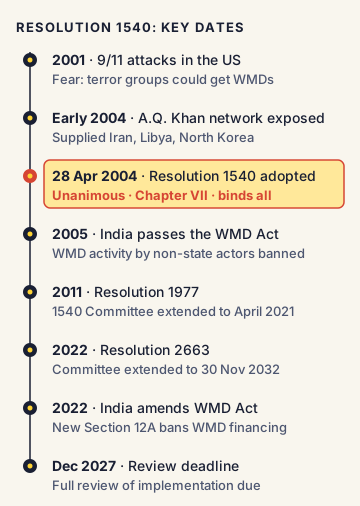
In early 2004, the world learned about the A.Q. Khan network. Abdul Qadeer Khan, a top Pakistani nuclear scientist, confessed that a network linked to him had secretly supplied nuclear technology to Iran, Libya and North Korea over almost two decades. It spanned three continents and slipped past national export controls. This showed how private networks could spread nuclear technology. Soon after, on 28 April 2004, the Security Council unanimously adopted Resolution 1540.
What makes it binding?
The resolution was adopted under Chapter VII of the UN Charter. Chapter VII deals with threats to international peace. Decisions taken under it are legally binding on all 193 UN member states, not just on Security Council members. So 1540 is not a treaty that countries can choose to sign; every country must follow it.
What does it require?
Resolution 1540 puts three main duties on every country:
- Do not help: States must not give any support to non-state actors that try to develop, acquire, make, possess, transport, transfer or use nuclear, chemical or biological weapons and their delivery systems.
- Make it a crime: States must adopt and enforce effective laws that ban non-state actors from doing any of these things, including trying, helping or paying for them.
- Control the materials: States must set up effective domestic controls: account for and secure sensitive materials, protect them physically, police borders, and control exports and trans-shipment (goods passing through a country on the way to another).
How is it monitored?
The resolution set up the 1540 Committee, a subsidiary body of the Security Council made up of its 15 members, supported by a Group of Experts (now up to nine). Countries send national reports explaining how they have put the resolution into practice. The committee does not punish; it checks, helps and offers technical assistance.
How has it changed over time?
The committee's mandate has been extended several times. Resolution 1977 (2011) extended it for 10 years to April 2021. Resolution 2663 (2022), adopted unanimously under Chapter VII, extended it again for 10 years, until 30 November 2032. Resolution 2663 also asks for a comprehensive review of implementation before December 2027, and another before the mandate is renewed.
India's position and Indian examples
India supports Resolution 1540 and submits national reports to the committee. To meet its duties, Parliament passed the Weapons of Mass Destruction and their Delivery Systems (Prohibition of Unlawful Activities) Act, 2005 (often called the WMD Act, 2005). It bans unlawful activity related to WMDs and controls the export of sensitive goods and technology. In 2022, Parliament amended it.
The WMD Amendment Act, 2022 (assent on 6 August 2022) added Section 12A, which bans financing of WMD-related activities and lets the Centre freeze, seize or attach funds linked to them. India often points to the A.Q. Khan network to argue that proliferation by and from its neighbourhood remains a real risk.
Commonly confused concepts
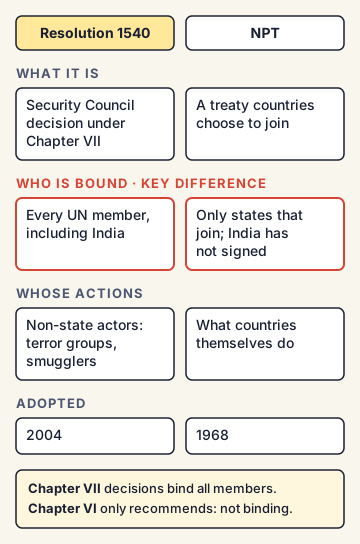
- Resolution 1540 vs the NPT: The NPT (1968) is a treaty that countries choose to join, and India has not signed it. Resolution 1540 is a Security Council decision that binds every UN member, including India, and focuses on non-state actors.
- Resolution 1540 vs Resolution 2231: Resolution 2231 (2015) endorsed the Iran nuclear deal (JCPOA). Resolution 1540 is general and applies to all countries.
- 1540 Committee vs IAEA: The International Atomic Energy Agency (IAEA) inspects nuclear facilities and promotes peaceful nuclear use. The 1540 Committee only tracks how countries implement Resolution 1540 and does not inspect sites.
- Chapter VI vs Chapter VII: Chapter VI of the UN Charter is about peaceful settlement and its recommendations are not binding. Chapter VII decisions are binding and can lead to sanctions or force.
Issues, criticism and the way forward
- Uneven implementation: Many countries, especially small and poor ones, lack the money and skills to build export controls and border checks. The committee depends on aid and voluntary reports.
- No enforcement teeth: The resolution has no penalty for countries that do not comply. Critics say it relies too much on goodwill.
- Legitimacy debate: Some countries argued that the Security Council was acting like a world lawmaker by creating duties for all states without a treaty negotiation.
- New risks: Threats now include 3D printing, drones, synthetic biology and cyber attacks on nuclear plants, which the 2004 text did not foresee.
- Way forward: Experts suggest more capacity-building help, regular peer reviews, stronger action against proliferation financing, and closer work with bodies like the Financial Action Task Force (FATF).
Concepts to Know
- Weapons of mass destruction (WMDs): Weapons that can kill very large numbers of people at once: nuclear, chemical and biological weapons.
- Non-state actor: Any group or person that is not a government, such as a terrorist group, a criminal gang or a smuggling network.
- Proliferation: The spread of weapons, or of the materials and know-how to make them, to more countries or groups.
- Delivery system ("means of delivery"): Anything that carries a weapon to its target, such as a missile, rocket or drone.
- Export control: Government rules that require a licence before sensitive goods or technology can be sent out of the country.
- Proliferation financing: Giving money or financial services that help someone make or obtain WMDs.
- Adopted unanimously on 28 April 2004, under Chapter VII of the UN Charter (binding on all UN members)
- Covers nuclear, chemical and biological weapons and their means of delivery, focusing on non-state actors
- Three duties: do not support non-state actors; criminalise their WMD activities by law; set up domestic controls (accounting, physical protection, border and export controls)
- 1540 Committee: made up of the 15 Security Council members, helped by a Group of Experts (up to 9)
- Mandate extended by Resolution 1977 (2011) to 2021 and by Resolution 2663 (2022) to 30 November 2032
- India's law: WMD Act, 2005; amended in 2022 (new Section 12A bans financing of WMD activities)
- Background trigger: exposure of the A.Q. Khan network in 2004 (supplied Iran, Libya, North Korea)
● Tracked since October 10, 2026 · last seen October 10, 2026 · updates as the daily brief publishes