Turtle Excluder Device (TED)
Shrimp Trade and Sea Turtle Protection
A Turtle Excluder Device (TED) is a simple metal grid fitted inside a fishing trawl net. Small shrimp pass through the gaps in the grid and are caught. Big animals like sea turtles hit the grid and are pushed out through an opening in the net. So the fisher keeps the shrimp, and the turtle swims away alive.
Why does it exist?
Shrimp trawlers drag nets through the water for long periods. Sea turtles swimming in the same area get pulled into the net. Turtles breathe air, so when they are trapped underwater for a long time, they drown. Around the world, shrimp trawling has been one of the biggest killers of sea turtles. The TED was invented to fix this problem without stopping fishing.
How does a TED work?
Picture a sieve placed at an angle inside a funnel.
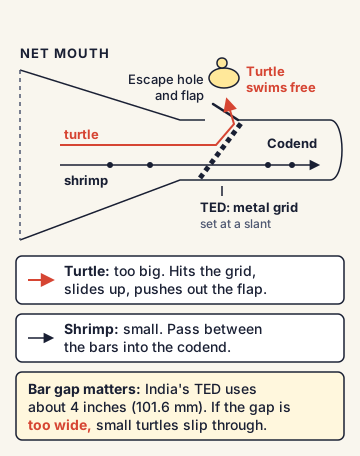
- A trawl net is shaped like a long funnel. At its narrow end is a bag (called the codend) where the catch collects.
- The TED is fitted in the "neck" of the net, just before the codend. It is a frame with metal bars spaced a few inches apart.
- The grid is set at a slant. Shrimp and small fish are small enough to pass between the bars into the codend.
- A turtle is too big. It hits the slanted grid and slides along it towards an escape hole, either at the top or the bottom of the net.
- A flap covers the hole so the shrimp do not escape, but a turtle can push through it and swim free.
The gap between the bars is very important. If it is too wide, small turtles slip through into the codend and drown. If the grid angle is wrong, animals get stuck or the net collapses.
Where did it come from?
The United States developed TEDs in the late 1970s and 1980s. It made TEDs compulsory for its own shrimp trawlers from 1987. In 1989, the US passed a law, Section 609 of Public Law 101-162. It says shrimp caught in the wild cannot be imported into the US unless the exporting country is certified. To be certified, a country must show it has a turtle protection programme as good as the US one (in practice, TEDs used across its trawler fleet), or that its fishing does not threaten turtles. The US National Oceanic and Atmospheric Administration (NOAA) sets the TED design standards.
The WTO Shrimp-Turtle case
This is one of the most famous trade-versus-environment cases in the world. It is a favourite for UPSC.
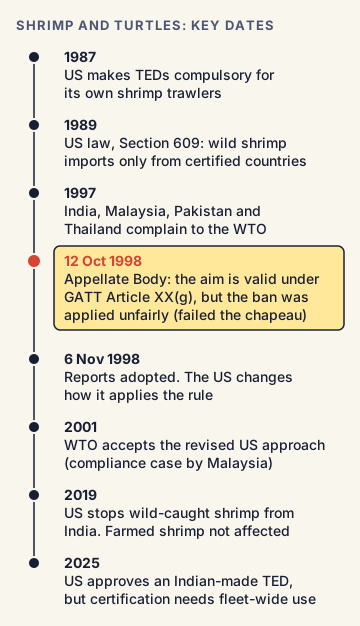
- In 1997, India, Malaysia, Pakistan and Thailand jointly complained to the World Trade Organization (WTO) against the US shrimp import ban.
- The Panel (the first-level WTO court) ruled against the US.
- The Appellate Body (the WTO's appeal court) gave its report on 12 October 1998. It said protecting sea turtles is a valid aim under Article XX(g) of GATT, which allows trade rules "relating to the conservation of exhaustible natural resources". So the US goal was fine.
- But the US lost on the way it applied the ban. The ban treated countries unfairly, so it failed the chapeau (opening paragraph) of Article XX. For example, the US gave some countries more time and technical help than others, and it judged countries without proper hearings.
- The reports were adopted on 6 November 1998. The US then changed how it applied the rule. In a later compliance case brought by Malaysia, the WTO accepted the revised US approach in 2001.
The big lesson: under WTO rules, a country can restrict trade to protect the environment, but it must do so fairly and without discrimination.
India and TEDs
In India, the ICAR-Central Institute of Fisheries Technology (CIFT), Kochi, designed Indian versions of the TED. Odisha has also used TED rules in its turtle zones. But TED use was never universal across India's trawler fleet.
- In 2019, the US stopped imports of wild-caught shrimp from India under Section 609, citing turtle bycatch. Farmed (aquaculture) shrimp is not affected, and it makes up most of India's shrimp exports.
- There was a design dispute. CIFT at one stage widened the bar gap to about 145 mm to let larger fish through, but NOAA pushed back. CIFT went back to a bar gap of about 4 inches (101.6 mm).
- Reports in early 2025 said the US had approved an Indian-made TED design. But to get certified again, India must show TEDs are actually used across its trawl fleet.
- MPEDA (the Marine Products Export Development Authority) has led the effort to distribute TEDs, train fishers and run demonstrations.
What has the ban cost India?
- India's wild-caught shrimp exports fell from 153,286 tonnes (2018-19) to 65,882 tonnes (2023-24).
- In 2018-19, about 33,497 tonnes (about 22%) went to the US.
- Wild-caught shrimp fetched about $9.87/kg in the US market in 2018-19, compared with $6.93/kg elsewhere. The average fell to $5.26/kg by 2023-24 because exporters lost the high-paying US market.
- MPEDA estimates the total loss at about ₹4,500 crore (about US$550 million).
Commonly confused concepts
- Wild-caught shrimp vs farmed shrimp: Wild-caught shrimp is caught from the sea by trawlers. Farmed shrimp is grown in ponds (aquaculture). The US ban covers only wild-caught shrimp from India.
- TED vs BRD: A TED keeps out turtles and other large animals. A Bycatch Reduction Device (BRD) is a wider term for any gear change (like square-mesh panels) that lets unwanted small fish escape. A TED is one type of bycatch-reducing tool.
- WTO Panel vs Appellate Body: The Panel hears the case first. The Appellate Body hears appeals on legal points. (Since December 2019 the Appellate Body has not been working because no new members have been appointed.)
- Article XX(g) vs Article XX(b) of GATT: XX(g) covers the conservation of exhaustible natural resources. XX(b) covers measures needed to protect human, animal or plant life or health. The US mainly won the Shrimp-Turtle argument under XX(g).
Issues, criticism and the way forward
- Fishers' fears: Fishers worry TEDs will let some shrimp and fish escape and cut their income. They fear losses of 10–20%. MPEDA's studies and demonstrations found the real loss is about 1–5%.
- Cost and upkeep: Each TED costs about ₹28,000. Small trawler owners find this hard without government support, which is why schemes like PMMSY now fund them.
- Enforcement: A TED only helps if it is fitted correctly and not removed at sea. Checking thousands of boats is difficult.
- Trade fairness debate: Some argue that rich countries use environmental rules as hidden trade barriers. Others argue such rules push all countries to protect shared wildlife like migratory turtles.
- Way forward: Make TEDs universal in all coastal states, give them free or subsidised, train fishers, inspect boats regularly and keep data on turtle deaths. This protects turtles and can also bring back the US shrimp market.
Concepts to Know
- Codend: The closed bag at the narrow end of a trawl net where the catch collects.
- Certification (under Section 609): Official approval from the US government saying a country's turtle protection is good enough. Without it, that country's wild-caught shrimp cannot enter the US.
- NOAA: The National Oceanic and Atmospheric Administration, the US government agency for oceans, weather and fisheries. It sets the TED standards.
- WTO and GATT: The World Trade Organization sets global trade rules. GATT (General Agreement on Tariffs and Trade) is the main WTO rulebook for trade in goods.
- Chapeau: The opening paragraph of Article XX of GATT. It says that even an allowed exception must not be used in an unfair or discriminatory way, or as a hidden trade barrier.
- MPEDA: Marine Products Export Development Authority, a body under the Ministry of Commerce and Industry, set up in 1972 to promote India's seafood exports.
- PMMSY: Pradhan Mantri Matsya Sampada Yojana, the central government's scheme to develop the fisheries sector, launched in 2020.
- TED: a metal grid in a trawl net that lets shrimp pass and pushes turtles out through an escape opening
- US made TEDs compulsory for its own shrimp trawlers in 1987
- US law: Section 609 of Public Law 101-162 (1989); countries must be certified to export wild-caught shrimp to the US
- WTO Shrimp-Turtle case: complaint by India, Malaysia, Pakistan, Thailand (1997); Appellate Body report 12 October 1998; adopted 6 November 1998
- Ruling: valid aim under GATT Article XX(g), but applied in a discriminatory way (failed the chapeau)
- US restriction on Indian wild-caught shrimp since 2019; farmed shrimp not affected
- India's wild-caught shrimp exports: 153,286 tonnes (2018-19) to 65,882 tonnes (2023-24)
- Estimated loss: about ₹4,500 crore (US$550 million)
- Indian TED designed by ICAR-CIFT, Kochi; bar gap about 4 inches (101.6 mm)
● Tracked since November 01, 2026 · last seen November 01, 2026 · updates as the daily brief publishes