Tropical Forest Forever Facility (TFFF)
The Tropical Forest Forever Facility, or TFFF, is a large global fund that pays tropical countries every year for keeping their forests standing. It works like an investment fund. It borrows money from governments, charities and private investors, invests it in bonds, and uses the extra profit to pay forest countries up to about US$4 per year for every hectare of tropical forest they keep standing. It was launched by Brazil at the COP30 leaders' summit in Belém on 6 November 2025.
Why does it exist?
Tropical forests store huge amounts of carbon and hold most of the world's land species. But a standing forest earns a poor country nothing, while cutting it for cattle, soy or timber earns money today. This is the basic problem: the forest is worth more to the planet alive, but worth more to its owner dead. The TFFF tries to fix this by making a living forest pay every year, like rent paid to a landlord for keeping a property in good shape.
Where did it come from?
- Brazil first presented the idea at COP28 in Dubai, UAE, in December 2023.
- A steering committee of 12 countries worked on the design: six tropical forest countries (including Brazil) and six possible investor countries.
- In October 2025, the World Bank's board agreed to act as the fund's trustee (the body that holds and looks after the money) and its interim host.
- The fund was launched at the COP30 Leaders' Summit in Belém on 6 November 2025. At the launch, 53 countries endorsed the TFFF launch declaration, and over US$5.5 billion was announced.
- By November 2026, more than 65 countries had endorsed it, but only eight had pledged money, about US$7.8 billion in total. The pledgers reported were Brazil, Indonesia, Norway, Germany, France, Luxembourg, the UK and the Netherlands.
How is the money raised?
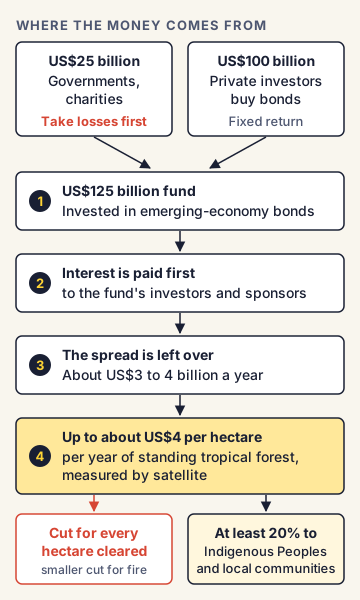
The plan is a two-layer fund of US$125 billion:
- Sponsor capital, about US$25 billion: long-term loans from governments and charities (philanthropies). These sponsors agree to take any losses first. This is called a "first-loss" or junior position.
- Private money, about US$100 billion: raised by selling bonds to private investors at a fixed return. Investors feel safe because the sponsors' money absorbs losses before theirs.
So every US$1 of sponsor money (from governments and charities) aims to bring in about US$4 of private money. This mix of sponsor money and private money is called blended finance.
How are payments made, step by step?
- The whole US$125 billion is invested in bonds, mainly government and company bonds of emerging economies. Fossil fuel and other harmful sectors are excluded.
- The fund pays its own investors and sponsors their agreed interest.
- The spread (the extra return left over after paying interest and costs) is the money paid to forest countries. If fully funded, this is expected to be about US$3 to 4 billion a year.
- Each eligible country gets up to about US$4 per hectare per year of standing tropical forest, measured by satellite.
- Money is cut for forest lost. Each hectare cleared cancels the payment for many standing hectares. As of late 2026, reported design figures put the cut at about US$400 to 800 for every hectare cleared, which equals the yearly payment (about US$4 each) for 100 to 200 standing hectares. Land damaged by fire gets smaller cuts. [Unverified: final penalty figures are still being set.]
- At least 20% of each country's payment must go to Indigenous Peoples and local communities.
The fund was expected to start operating in 2027, with the first payments not expected before 2028.
Who can get money?
- Developing countries with tropical and subtropical moist forests, covering over 1 billion hectares in about 70 to 76 countries (estimates differ by source). The main regions are the Amazon, the Congo Basin and Southeast Asia.
- A country's yearly deforestation rate must stay at or below 0.5% of its forest area, with a falling trend.
- It must have a working satellite-based forest monitoring system, and must publish how it spends the money.
- Countries decide for themselves how to spend payments.
India's position and Indian examples
India joined the TFFF as an observer at its launch in Belém in November 2025, not as a funder or full participant. An observer can follow and shape the discussions but has made no money pledge. India has tropical moist forests in the Western Ghats, the North-East and the Andaman and Nicobar Islands. At home, India uses a different idea for paying states to keep forests: since the 14th Finance Commission (2015-20), forest cover has been one of the factors used to share central tax money among states, so a state with more forest gets a slightly bigger share.
Commonly confused concepts
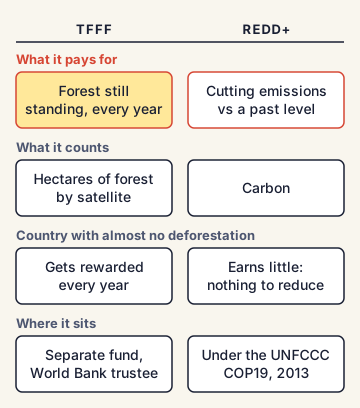
- TFFF vs REDD+: REDD+ (agreed under the UNFCCC, rulebook finalised at COP19 in Warsaw, 2013) pays a country for cutting emissions compared with a past level. A country that already has almost no deforestation earns little, because it has nothing left to "reduce". The TFFF pays for forest that is still standing, every year, so forest-rich countries with low deforestation also get rewarded. REDD+ counts carbon; the TFFF counts hectares by satellite.
- TFFF vs Green Climate Fund (GCF): The GCF (set up at COP16, Cancún, 2010) gives grants and loans for many kinds of climate projects. The TFFF only pays for standing tropical forests, and its payments come from investment returns. The GCF instead spends money that countries give it in pledging rounds.
- TFFF vs Glasgow Leaders' Declaration on Forests and Land Use (COP26, 2021): The Glasgow Declaration was a political promise to halt and reverse forest loss by 2030, and India did not sign it. The TFFF is a money mechanism, not a promise.
- TFFF is not a UNFCCC body. It was launched at a COP but is a separate fund, with the World Bank as trustee. COP texts can only "welcome" or "note" it.
Issues, criticism and the way forward
- Funding gap: About US$7.8 billion pledged against a US$25 billion sponsor target. Without the sponsor layer, private money will not come in.
- Market risk: Payments depend on bond returns. If markets fall or interest rates change, the spread shrinks and forest countries could get less.
- Degradation is hard to see: Satellites easily spot cleared land, but not selective logging, roads or mining under a closed canopy. So a forest can be badly damaged and still be paid for.
- Leakage: Clearing could move to forests not covered, such as Brazil's Cerrado grassland-savanna or Africa's Miombo woodlands.
- Indigenous rights: Indigenous representatives have only an advisory role, without board votes, and rules on how they get their share (at least 20%) are still being worked out.
- Way forward suggested by experts: more sponsor pledges, better satellite tools that can detect degradation, clear direct-access rules for Indigenous Peoples, and links with REDD+ and national forest plans.
Concepts to Know
- Hectare: A unit of area equal to 10,000 square metres, about the size of a large football ground. 100 hectares make 1 square kilometre.
- Deforestation rate: The share of a country's forest cleared in a year. A 0.5% rate means losing 5 hectares out of every 1,000 hectares of forest each year.
- Bond: A paper an investor buys when lending money to a government or company. The borrower pays back the amount later, with interest.
- Trustee: A trusted body that holds and manages money on behalf of others, following agreed rules.
- Forest degradation: When a forest still stands but becomes thinner and weaker, because of fires, logging or roads. It is different from deforestation, where the forest is fully cleared.
- Leakage: When protecting one area simply pushes the damage to another area that is not protected.
- Indigenous Peoples and local communities (IPLCs): Groups who have lived in and depended on forests for generations and often protect them best.
- Proposed by Brazil at COP28, Dubai (December 2023); launched at the COP30 Leaders' Summit, Belém, on 6 November 2025
- Target: US$125 billion (about US$25 billion sponsor capital + about US$100 billion private money)
- Payment: up to about US$4 per hectare per year of standing tropical forest
- Eligibility: yearly deforestation at or below 0.5% of forest area, with a falling trend, and satellite monitoring
- At least 20% of payments to Indigenous Peoples and local communities
- World Bank: trustee and interim host (board approval October 2025); investments managed by the Tropical Forest Investment Fund (TFIF), the fund's investment arm, based in Luxembourg
- As of November 2026: 65+ endorsing countries; 8 funders; about US$7.8 billion pledged
- India: observer since November 2025; no money pledged
● Tracked since November 20, 2026 · last seen November 20, 2026 · updates as the daily brief publishes