Trade Creation and Trade Diversion
Who Really Gains From a Trade Deal
When two countries sign a free trade agreement (FTA), they cut tariffs (import taxes) only for each other. This can change who buys what from whom in two very different ways. Trade creation happens when the deal lets a country replace costly goods with cheaper goods from the partner, which is good for everyone. Trade diversion happens when the deal makes a country switch from a cheaper outside supplier to a costlier partner, only because the partner now pays no tariff. Whether a trade deal is truly beneficial depends on which of the two effects is bigger.
Why does this idea matter?
Many people assume that any trade deal is good because it "frees" trade. But an FTA is free trade only between members. It still discriminates against outsiders. Think of a school canteen that gives a discount only to students of one section. Some students now buy cheaper snacks (good), but others switch from a better, cheaper shop outside the gate just to use the discount (wasteful).
Economists use trade creation and trade diversion to judge a deal's real gains. Policymakers also use them to understand the flip side: how a deal between two other countries can take business away from you.
Where did it come from?
- 1950: The Canadian-born economist Jacob Viner introduced the two terms in his book The Customs Union Issue, published by the Carnegie Endowment for International Peace. Before him, most economists assumed that any step towards freer trade was good. Viner showed that a customs union (or FTA) can make members worse off if diversion outweighs creation.
- 1956: Richard Lipsey and Kelvin Lancaster gave the general "theory of the second best". It says that when one distortion (such as tariffs on outsiders) remains, removing some other distortions does not always make things better. Preferential deals are a "second best", not true free trade.
- 1995: The Indian-American economist Jagdish Bhagwati coined the term "spaghetti bowl" for the tangle of overlapping FTAs, each with its own rules. He warned that too many preferential deals make trade complex and discriminatory.
How does it work? A simple example
Suppose India imports a machine. Germany sells it for ₹100. Switzerland sells it for ₹105. India charges a 10% tariff on both.
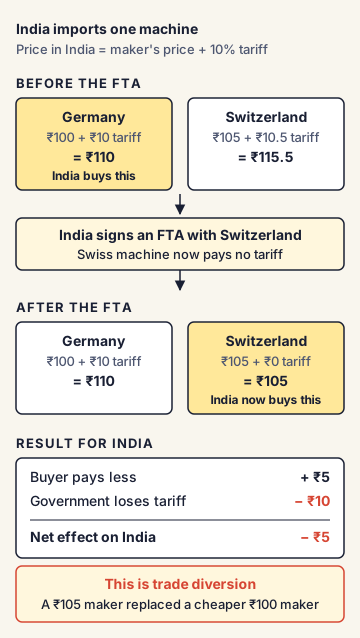
- Before any deal: Germany's machine costs ₹110 in India, Switzerland's costs ₹115.5. India buys from Germany, the cheapest producer. The government collects ₹10 in tariff.
- After an India-Switzerland FTA: Switzerland's machine now enters tariff-free at ₹105. Germany's still costs ₹110. Indian buyers switch to Switzerland.
- Who gains and loses? The buyer saves ₹5. But the government loses ₹10 of tariff revenue. And the world now uses a producer that is ₹5 costlier to make the machine. This is trade diversion: a net loss for India.
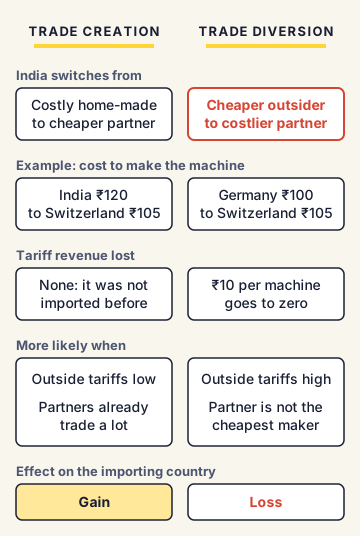
Now suppose India used to make the machine at home for ₹120, protected by the tariff. After the FTA, India imports it from Switzerland at ₹105. India stops wasting resources on costly local production and buyers save ₹15. This is trade creation: a real gain.
The key parts and facts
- Trade creation = new trade that replaces higher-cost production (at home or elsewhere) with lower-cost production by a partner.
- Trade diversion = imports shift from a low-cost non-member to a higher-cost member only because of the tariff preference.
- Diversion is more likely when the country's tariffs on outsiders are high, and when the partner is not the world's most efficient producer.
- Creation is more likely when the partners are already big trading partners, when they make similar goods at different costs, and when outside tariffs are low.
- Dynamic effects: Beyond these one-time (static) effects, FTAs can bring longer-term gains such as bigger markets (economies of scale), more competition and new investment.
- Preference erosion: If your partner signs similar deals with your competitors, your special access becomes less special. This is the outsider's view of trade diversion.
- WTO rule: GATT Article XXIV allows FTAs only if they cover "substantially all the trade" between members and do not raise barriers against outsiders. This is meant to limit diversion.
India's position and Indian examples
- India's goods deal with ASEAN (in force 1 January 2010) is often cited in debates on who gained. India's imports from ASEAN grew faster than its exports, and India's trade deficit with the bloc widened. India has sought a review of the agreement.
- Rules of origin in India's FTAs prevent trade deflection: goods from a non-member being routed through a partner country to enjoy the lower tariff.
- In India-EFTA TEPA, Switzerland had already removed tariffs on all industrial goods for every country from 1 January 2024. So for Indian factory goods entering Switzerland, there is little preference left to create or divert trade.
- From India's side, deals signed between its competitors and its markets matter as much as India's own deals. When Vietnam or Bangladesh gets better access to a market than India, Indian exporters face diversion against them.
Commonly confused concepts
- Trade creation vs trade expansion: Trade expansion simply means more trade. Trade creation specifically means more trade that also moves production to a cheaper source. More trade can still be diversion.
- Trade diversion vs trade deflection: Diversion is a real switch of supplier because of the preference. Deflection is cheating the deal by routing a third country's goods through a member; rules of origin stop it.
- FTA vs customs union: In an FTA, each member keeps its own tariffs on outsiders. In a customs union (like the EU), members share a common external tariff, so routing goods through the low-tariff member is not a problem.
- Trade diversion vs dumping: Dumping means a firm sells abroad below its home price or cost. Diversion has nothing to do with unfair pricing; it comes only from unequal tariffs.
Issues, criticism and the way forward
- Hard to measure: It is difficult to separate the effect of a trade deal from other changes such as exchange rates, new technology or global demand.
- Lost tariff revenue: Diversion costs the government money while giving a smaller saving to consumers.
- The spaghetti bowl: Many overlapping deals, each with its own rules of origin, raise paperwork costs, which hurts small exporters most.
- Competitive pressure on India: As rivals such as Vietnam sign deals with the EU, the UK and EFTA, Indian exporters risk losing ground unless India signs comparable deals and improves its competitiveness.
- Way forward: Economists suggest keeping outside tariffs low (so diversion stays small), using simple and clear rules of origin, choosing partners who are efficient producers, and pairing trade deals with steps that improve domestic competitiveness, such as better logistics and quality standards.
Concepts to Know
- Tariff: A tax charged on imported goods at the border. It makes foreign goods costlier.
- Customs union: A group of countries that remove tariffs among themselves and also charge the same tariff on goods from outside.
- Preferential trade: Trade terms that are better for some countries than for others, as in an FTA.
- Rules of origin: Rules that decide which country a product "comes from", so that only goods truly made in a member country get the low FTA tariff.
- Economies of scale: The fall in cost per unit when a firm produces more, for example because fixed costs are spread over more units.
- Jacob Viner, The Customs Union Issue, 1950: introduced trade creation and trade diversion
- Lipsey and Lancaster, 1956: general theory of the second best
- Jagdish Bhagwati, 1995: coined the term "spaghetti bowl" for overlapping FTAs
- GATT Article XXIV: FTAs must cover "substantially all the trade" and must not raise barriers against outsiders
- Trade creation = shift to a cheaper source (gain); trade diversion = shift from a cheaper outsider to a costlier partner (loss)
- ASEAN-India goods agreement in force 1 January 2010; Switzerland abolished industrial tariffs for all countries from 1 January 2024
● Tracked since October 21, 2026 · last seen October 21, 2026 · updates as the daily brief publishes