Technology Readiness Level (TRL)
Measuring How Close an Idea Is to the Market
Technology Readiness Level, or TRL, is a simple 1-to-9 scale that tells us how "ready" a new technology is for real use. TRL 1 means scientists have only seen a basic principle on paper or in a lab. TRL 9 means the full product is working successfully in the real world. Governments, space agencies, armies and investors use this scale to decide what kind of money and support a project needs at each step.
Why does it exist?
Imagine a student who says, "I have built a new type of battery." That sentence could mean many things. It could be a drawing in a notebook, a small cell that works on a lab table, or a battery already running a car. Funders need a common language to know which one it is. TRL gives that language. It helps them:
- judge how risky a project still is (lower TRL means more risk);
- pick the right type of money (grants for early research, loans or equity for later stages);
- avoid putting an immature technology into a big, costly programme too early, where failure is expensive.
Where did it come from?
- The idea was started at the US space agency NASA in 1974 by a researcher named Stan Sadin.
- NASA formally defined an early seven-level scale in 1989.
- In the 1990s NASA moved to the nine-level scale used today. John C. Mankins of NASA wrote a well-known 1995 paper that gave expanded descriptions of each level.
- In 1999, a US government audit report found that the US Department of Defense (DoD) was taking big risks by using immature technologies. From 2001, the DoD began using TRLs for major new programmes.
- The European Commission advised EU-funded projects to use TRLs from 2010, and its big research programme Horizon 2020 used them formally from 2014.
- In 2013, the International Organization for Standardization published ISO 16290:2013, which made the scale an international standard, mainly for space systems.
The nine levels, in plain words
The levels fall into three broad stages: research, development and deployment.
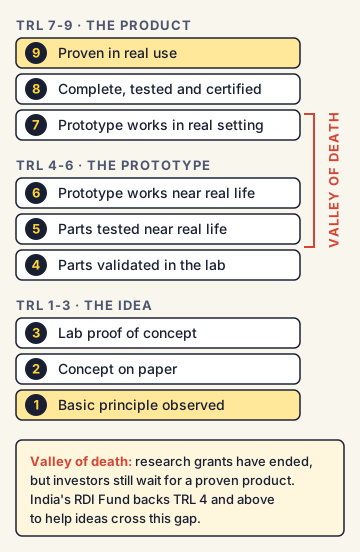
- TRL 1: Basic principles observed. Scientists notice a new effect. Example: a material conducts electricity in an unusual way.
- TRL 2: Technology concept formulated. They imagine a practical use for it, still on paper.
- TRL 3: Experimental proof of concept. A simple lab experiment shows the idea can work.
- TRL 4: Technology validated in the lab. Basic parts are put together and tested in a laboratory.
- TRL 5: Technology validated in a relevant environment. The parts are tested in conditions close to real life (for example, real temperature or pressure).
- TRL 6: Technology demonstrated in a relevant environment. A working model or prototype of the system is shown to work in near-real conditions.
- TRL 7: System prototype demonstrated in an operational environment. A near-final prototype works in the actual setting (in space, on a real farm, in a real hospital).
- TRL 8: System complete and qualified. The final product has passed all tests and certifications.
- TRL 9: Actual system proven in an operational environment. The product is in real use and working successfully.
A simple way to remember it: TRL 1-3 is "the idea", TRL 4-6 is "the prototype" and TRL 7-9 is "the product".
What is the "valley of death"?
Many technologies get stuck between the lab and the market, roughly between TRL 4-5 and TRL 7. At this stage, research grants have usually ended, because the work is no longer "pure science". But private investors are still nervous, because the product is not yet proven or selling. So promising ideas often die here for lack of money. Experts call this gap the "valley of death". It is like a bridge with its middle part missing: both ends are strong, but nothing connects them.
How is TRL used in India?
Indian funding schemes now use TRL to decide who gets what:
- ANRF grants (Anusandhan National Research Foundation) mostly support early research in universities and labs, roughly up to TRL 4.
- The RDI Fund supports projects at TRL 4 and above, to carry them across the valley of death towards the market.
- The Technology Development Fund (TDF) of the Ministry of Defence, run by DRDO, supports start-ups and MSMEs (micro, small and medium enterprises) in upgrading defence technologies from TRL 3 onwards.
- Space and defence agencies such as ISRO and DRDO use TRL-style reviews to decide when a technology is ready to fly or to be inducted.
Commonly confused concepts
- TRL vs MRL: TRL measures whether a technology works. Manufacturing Readiness Level (MRL) measures whether it can be made reliably in large numbers at a sensible cost. A product can be at TRL 9 but still struggle with mass production.
- TRL vs Commercial Readiness Level (CRL): CRL is a separate scale that measures how ready a product is for the market: customers, prices, supply chains and business model.
- R&D vs innovation: Research and development (R&D) creates new knowledge and prototypes. Innovation means turning that knowledge into something people actually use and pay for.
- Grant vs loan vs equity: A grant is free money, usually for low-TRL research. A loan must be repaid. Equity means the investor buys part-ownership of the company. Higher-TRL projects usually get loans or equity.
Issues, criticism and the way forward
- Not every field fits neatly: The scale was built for hardware like rockets. Software, medicines and biotech often move in loops, not straight lines, so their TRL can be hard to judge.
- Readiness is not the same as usefulness: A highly "ready" technology may still be the wrong choice for a particular system. TRL says nothing about cost, demand or whether the technology may soon become out of date.
- Gaming the scale: Applicants may over-state their TRL to qualify for funds. Independent technical checks are needed.
- Way forward: Experts suggest using TRL together with manufacturing and market readiness scales, clear sector-specific definitions, and dedicated funding for the "valley of death" stage, which is exactly where India's RDI Fund aims to act.
Concepts to Know
- Deep tech: Technology based on major scientific or engineering advances (such as gene editing, quantum computing or new materials). It takes many years and a lot of money to develop.
- Prototype: An early working model of a product, built to test whether the design works.
- Operational environment: The real place and conditions where the product will finally be used.
- Venture capital (VC): Money that investors put into young, high-risk companies in exchange for a share of ownership, hoping for big returns if the company succeeds.
- Patient capital: Long-term investment where the investor is willing to wait many years for returns.
- Scale: 9 levels (TRL 1 = basic principles observed; TRL 9 = actual system proven in an operational environment)
- Origin: NASA, 1974 (Stan Sadin); seven-level scale defined 1989; nine-level scale in the 1990s (John C. Mankins, 1995 paper)
- US Department of Defense adopted TRLs for major programmes from 2001
- European Commission: advised from 2010; used in Horizon 2020 from 2014
- International standard: ISO 16290:2013
- "Valley of death": gap roughly between TRL 4-5 and TRL 7
- India: RDI Fund backs TRL 4+; DRDO's Technology Development Fund backs TRL 3 onwards
● Tracked since October 16, 2026 · last seen October 16, 2026 · updates as the daily brief publishes