Systematic Withdrawal Plan (SWP)
A Systematic Withdrawal Plan (SWP) is a way of taking money out of a savings or investment pot in fixed amounts at regular intervals (every month, every quarter, and so on), instead of taking everything at once. The rest of the money stays invested and keeps earning. It is the mirror image of a SIP (Systematic Investment Plan), where you put in a fixed amount regularly.
SWPs began in mutual funds, and in November 2026 the EPFO (Employees' Provident Fund Organisation) approved an SWP option for retiring PF members.
Why does it exist?
At retirement, a person often receives a large lump sum, for example their entire PF balance. This creates three problems. First, the money may be spent too fast, on a wedding, a house repair or a loan to a relative, leaving little for later years. Second, the person must find a new safe place to invest it, often at lower interest; this is called reinvestment risk.
Third, a retired person no longer has a monthly salary but still has monthly bills. An SWP solves all three: it turns a big pot into a "salary after retirement" while the remaining money keeps growing.
A simple example
Suppose Ramesh retires with ₹30 lakh in his PF. Under the old system, he would take all ₹30 lakh, and the EPFO's high interest would stop for him. Under an SWP, he could choose to receive, say, ₹25,000 a month. Each month ₹25,000 is paid out, and the remaining balance keeps earning EPF interest (8.25% for 2025-26).
Because interest keeps being added, his savings last far longer than if he kept the cash at home or in a savings account. Think of it like a water tank with a tap: you open the tap a little each month, while rain (interest) keeps adding to the tank.
Where did it come from?
SWPs were first offered by mutual funds, regulated in India by SEBI (Securities and Exchange Board of India). Mutual funds commonly offer three "systematic" tools:
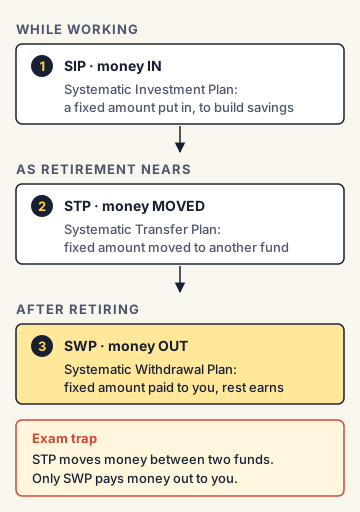
- SIP (Systematic Investment Plan): put in a fixed amount regularly, to build savings.
- STP (Systematic Transfer Plan): move a fixed amount regularly from one fund to another, for example from a safe debt fund into an equity fund.
- SWP (Systematic Withdrawal Plan): take out a fixed amount regularly, to create income.
Many investors use them in a life cycle: SIP while working, STP to shift risk as retirement nears, and SWP after retiring. The EPFO's SWP brings this idea to the country's largest retirement fund.
How does an SWP work? (step by step)
- The member chooses an SWP at retirement (it is optional).
- The member picks the frequency: monthly, quarterly or half-yearly, and the amount (the exact options will be set out in the amended EPF Scheme).
- On each due date, the chosen amount is paid into the member's bank account.
- The balance left in the account continues to earn the yearly EPF interest.
- The plan continues until the money runs out or the member stops it. The member keeps ownership of the whole corpus; it is not handed over to anyone else.
- Under the decision of the CBT (Central Board of Trustees), the EPFO's top decision-making body, the option may also extend to eligible family members or beneficiaries, for example after the member's death.
In a mutual fund SWP, each payout is done by selling (redeeming) some fund units at that day's NAV (Net Asset Value, the price of one unit). So the number of units falls with each withdrawal, and the value of what remains rises or falls with the market.
How is an SWP taxed?
In a mutual fund SWP, only the profit part of each withdrawal is taxed as capital gains, not the original money put in. As of 2026, for equity funds, gains on units held for more than 12 months are long-term. They are taxed at 12.5%, but only on the part above ₹1.25 lakh of such gains in a financial year.
Gains on units held for 12 months or less are short-term and taxed at 20%. EPF money follows different rules: withdrawals are generally tax-free after five years of continuous service. Because the law was written for one-time withdrawals, the EPFO has asked the Finance Ministry for a matching change in the Income Tax Act so that SWP payouts are treated clearly.
India's position and Indian examples
India's retirement system has several pillars, and the SWP fits into them as follows:
- EPF (Employees' Provident Fund): a lump-sum savings scheme; the new SWP adds a regular-income option.
- EPS-95 (Employees' Pension Scheme): a separate defined pension paid monthly, with a minimum pension of ₹1,000 a month (since 2014). SWP payouts come on top of this pension, from the member's own PF savings.
- National Pension System (NPS): at exit, a part of the corpus must be used to buy an annuity (a product that pays a fixed income for life), and the rest can be withdrawn.
- Senior Citizens' Savings Scheme (SCSS): a government small-savings scheme that pays quarterly interest to people aged 60 and above.
- Gig and platform workers: the Code on Social Security, 2020 brought them into the social security net for the first time. The Labour Ministry says the SWP can help extend social security coverage to them.
Commonly confused concepts
- SWP vs SIP: SIP puts money in regularly; SWP takes money out regularly. They are opposites.
- SWP vs STP: STP moves money between two funds; the money stays invested. SWP pays money out to you.
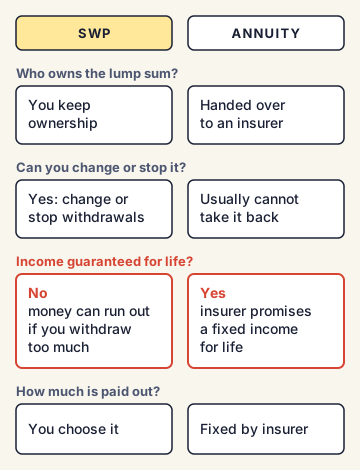
- SWP vs annuity: In an annuity, you hand your lump sum to an insurer, which promises a fixed income for life; usually you cannot take the lump sum back. In an SWP, you keep ownership of the corpus, can change or stop withdrawals, and what is left goes to your family. But an SWP has no guarantee of lasting for life: if you withdraw too much, the money can run out.
- SWP vs pension (EPS-95): EPS pays a defined pension worked out by formula from salary and service. An SWP pays out your own savings, at the rate you choose.
- Equity fund holding period: Gains are long-term only if the units are held for more than 12 months. Units sold after exactly 12 months still give short-term gains.
- SWP vs partial withdrawal (advance): A partial withdrawal is a one-time amount for a need like illness, education or a house, taken while still working. An SWP is a regular payout, usually after retirement.
Issues, criticism and the way forward
- Longevity risk: People are living longer. If withdrawals are too large, the savings may run out while the person is still alive. Members need guidance on safe withdrawal rates.
- Tax clarity: Until the Income Tax Act is amended, members may be unsure how SWP payouts will be taxed.
- Fund sustainability: The EPFO must keep paying interest on larger balances held longer. Supporters say keeping money inside the fund longer actually strengthens it; critics worry about pressure to maintain high interest rates.
- Balancing access and saving: The same meeting made it easier to withdraw early. The minimum balance that must always stay in the PF account was cut from 25% to 10%, and the wait for final PF settlement was cut from 12 months to two months. Critics say easy early withdrawals can empty retirement savings before old age; supporters say workers have a right to their own money, especially during job loss.
- Awareness and design: Many workers do not understand financial products. Simple defaults, clear statements and digital tools will be needed so members choose sensible amounts.
- Way forward: Experts suggest clear tax treatment, default options based on age and balance, financial literacy campaigns, and better links between EPF, EPS and NPS so that workers get one complete retirement picture.
Concepts to Know
- Corpus: The total amount of money saved in an account or fund.
- Lump sum: A large single payment made at one time, instead of in parts.
- Reinvestment risk: The risk that when you receive money back, you can only invest it again at a lower interest rate than before.
- Mutual fund: A pool of money collected from many investors and invested by professional managers in shares, bonds or other assets.
- NAV (Net Asset Value): The value of one unit of a mutual fund on a given day.
- Capital gains: The profit made when you sell an investment for more than you paid for it.
- Annuity: A financial product, usually from an insurance company, that pays a fixed income at regular intervals, often for life, in return for a lump sum.
- Longevity risk: The risk of living longer than your savings last.
- SWP = fixed withdrawals at regular intervals; the rest stays invested and keeps earning
- EPFO SWP approved by the CBT (Central Board of Trustees of the EPFO) on 19 November 2026; frequencies: monthly, quarterly or half-yearly; voluntary; may extend to eligible family members
- Needs amendment of the EPF Scheme (after Ministry approval) and a matching Income Tax Act change (with the Finance Ministry)
- EPF interest rate 8.25% for 2025-26
- Mutual fund tools: SIP (in), STP (transfer), SWP (out); regulator: SEBI
- Equity mutual fund gains (as of 2026): long-term (held more than 12 months) taxed at 12.5% on gains above ₹1.25 lakh in a financial year; short-term (held 12 months or less) at 20%
- EPF withdrawals generally tax-free after 5 years of continuous service
- EPS-95 minimum pension: ₹1,000 a month (since 2014)
● Tracked since November 19, 2026 · last seen November 19, 2026 · updates as the daily brief publishes