Swachh Vayu Sarvekshan
Swachh Vayu Sarvekshan (SVS), meaning "clean air survey", is an annual ranking of Indian cities based on how much they do to control air pollution. It is run by the Ministry of Environment, Forest and Climate Change as part of the National Clean Air Programme (NCAP). Cities are given marks for actions such as controlling road dust, stopping waste burning and managing traffic. The best cities are awarded every year on 7 September, the International Day of Clean Air for Blue Skies.
Why was it started?
Under NCAP, about 130 cities got money and targets to clean their air. But there was no simple way to compare cities or push them to act faster. A ranking creates healthy competition, like the Swachh Survekshan did for cleanliness and sanitation. It also makes city governments report what they are doing, so the public and the Centre can see who is acting and who is not.
Where did it come from?
In September 2022, MoEFCC released the "Guidelines for Ranking of Cities" under NCAP, called Swachh Vayu Sarvekshan. The guidelines were meant for four years, from 2022-23 to 2025-26. The first results came out in 2022, when only the top three cities in each category were announced. By 2026 the survey had completed five rounds, and in 2026 it was extended to the ward level (parts of a city).
How are cities grouped?
Cities are divided by population (2011 Census), so that a small town does not compete with a mega city:
- Category 1: above 10 lakh population (47 cities in the original guidelines)
- Category 2: 3 to 10 lakh population (44 cities)
- Category 3: below 3 lakh population (40 cities)
What is measured?
Category 1 cities are marked out of 200. The main areas and their weights are:
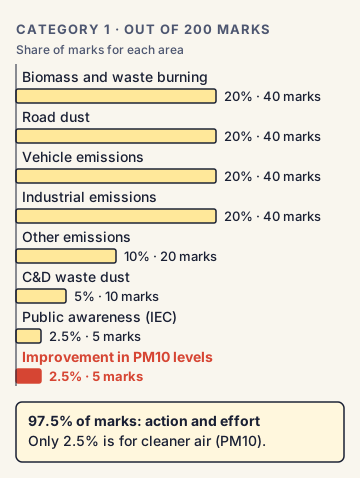
- Measures against biomass and municipal solid waste burning: 20%
- Measures against road dust: 20%
- Measures against construction and demolition (C&D) waste dust: 5%
- Measures against vehicle emissions: 20%
- Measures against industrial emissions: 20%
- Measures against other emissions: 10%
- Public awareness (information, education and communication): 2.5%
- Improvement in PM10 levels: 2.5%
The weights change slightly for smaller cities. For example, in smaller cities road dust gets a higher weight and industry a lower one.
So SVS mostly scores action and effort, such as how much solid waste is collected and processed, how many roads are paved or swept by machines, and how many electric buses run. Actual air quality improvement is only a small part of the score.
How does the process work?
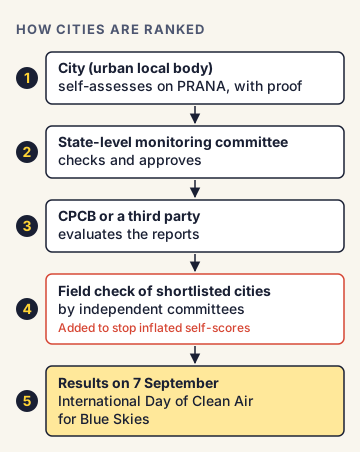
- Each city's urban local body (municipal corporation) fills in a self-assessment on the PRANA portal, with documents as proof.
- A state-level monitoring committee checks and approves it.
- The Central Pollution Control Board (CPCB) or a third party evaluates the reports.
- Since recent rounds, shortlisted cities are also checked on the ground by independent committees, after concerns that some self-reported scores were too high.
- Results are announced on 7 September.
What do winners get?
The top three cities in each category get a cash prize, a trophy and a certificate with the title "National Clean Air City". Under the guidelines, ₹21 crore was set aside for prizes over four years. In Category 1, the cash prize is ₹1.5 crore for first, ₹1 crore for second and ₹50 lakh for third place.
Who has won?
Category 1 toppers have been: Indore in 2023 and 2025, Surat in 2024, and Lucknow in 2022 and 2026.
Commonly confused concepts
- Swachh Vayu Sarvekshan vs Swachh Survekshan: Swachh Survekshan (since 2016) is run by the Ministry of Housing and Urban Affairs and ranks cities on cleanliness and sanitation under the Swachh Bharat Mission (Urban). Swachh Vayu Sarvekshan is run by the Ministry of Environment and ranks cities on air pollution control under NCAP.
- SVS rank vs air quality: A top SVS rank means a city is doing a lot of work to control pollution. It does not mean the city has the cleanest air. A city can rank first and still be above the national standard.
- SVS vs AQI: AQI is a daily reading of how polluted the air is. SVS is a yearly score for a city's actions.
- International Day of Clean Air for Blue Skies (7 September) vs World Environment Day (5 June): Both are UN days, but 7 September is the one linked to SVS awards.
Issues, criticism and the way forward
- Effort vs outcome: Only 2.5% of the score is for actual PM10 improvement. Critics say this rewards paperwork and projects even when the air stays bad.
- Self-assessment risks: Since cities grade themselves first, there have been concerns about inflated scores. Field checks have been added to reduce this.
- Big swings in ranks: Some cities move from top ranks to the 20s and back within a few years. For example, Lucknow went from 1st (2022) to 24th (2023), then 4th, 15th and back to 1st (2026). This suggests that ranks can be sensitive to small scoring differences.
- Way forward suggested by experts: Read SVS scores together with real air quality data, give more weight to measured improvements, use the survey for sharing best practices and peer learning instead of only competition, and include PM2.5. MoEFCC has also published a Compendium of Best Management Practices under NCAP for cities to learn from each other.
Concepts to Know
- Urban local body (ULB): The local government of a town or city, such as a municipal corporation or municipality.
- Biomass burning: Burning of plant material such as crop stubble, leaves or wood, which releases smoke and fine particles.
- Construction and demolition (C&D) waste: Debris like broken concrete, bricks and dust from building or breaking structures.
- Information, Education and Communication (IEC): Public awareness work such as campaigns, posters and school programmes.
- Ward: A small area of a city that elects one councillor to the municipal body.
- Run by MoEFCC under NCAP; guidelines released September 2022 for 2022-23 to 2025-26
- Three categories: above 10 lakh, 3-10 lakh, below 3 lakh (2011 Census)
- Category 1 marked out of 200; PM10 improvement weight only 2.5%
- Self-assessment on PRANA → state committee → CPCB evaluation → field verification
- Awards on 7 September, International Day of Clean Air for Blue Skies; title "National Clean Air City"
- Prize pool: ₹21 crore over four years; Category 1 winner gets ₹1.5 crore
- 2026 (5th edition): Lucknow (198/200) first, Indore (197) second, Jabalpur (195) third in Category 1; Rourkela tops Category 2; Kalinga Nagar tops Category 3
- 2026: first year with ward-level assessment (over 7,400 wards)
● Tracked since October 31, 2026 · last seen October 31, 2026 · updates as the daily brief publishes