Stand-Up India Scheme
Stand-Up India is a central government scheme that helps women, Scheduled Caste (SC) and Scheduled Tribe (ST) people start their own new business with a bank loan. Under it, banks give loans of above ₹10 lakh and up to ₹1 crore for a greenfield (brand new) enterprise. Every bank branch is expected to give at least one such loan to a woman and at least one to an SC or ST borrower. The government backs these loans with a credit guarantee, so banks feel safer lending to first-time business owners.
Why was it needed?
Starting a business needs money, and banks usually ask for property as security (collateral) and a past track record. Many women and SC/ST people do not own land or property in their name and have no business history. So banks often turned them away, even when their business idea was good. Small loan schemes like Mudra help with tiny businesses, but there was a gap for the next level: a proper small factory, a service centre or a trading unit needing ₹10 lakh to ₹1 crore. Stand-Up India was designed to fill this "missing middle" for groups that are under-represented among business owners.
Where did it come from?
The idea was announced in the Independence Day speech of 15 August 2015 under the slogan "Start-up India, Stand-up India".
- The Union Cabinet approved the scheme on 6 January 2016.
- It was formally launched on 5 April 2016 at Noida.
- At launch, the government created a refinance window of ₹10,000 crore through SIDBI (Small Industries Development Bank of India) and a credit guarantee fund run by the National Credit Guarantee Trustee Company (NCGTC).
- The scheme was first meant to run till 2020. It was later extended to 2025, in line with the period of the 15th Finance Commission.
- In Budget 2021-22, the margin money needed was cut from up to 25% to up to 15% of project cost, and agriculture-allied activities (like dairy, poultry and fisheries) were made eligible.
- In November 2026, the Cabinet extended it again till 31 March 2031, with a fresh guarantee corpus of ₹4,111 crore.
Who can borrow?
- An SC or ST person, or a woman, who is above 18 years of age.
- The project must be greenfield, meaning the borrower's first venture in that line of work. Expanding an old business does not qualify.
- If the borrower is a company or firm (not a single person), at least 51% of the shares and controlling stake must be held by an SC/ST person or a woman.
- The borrower must not be a defaulter to any bank or financial institution.
How does the loan work, step by step?
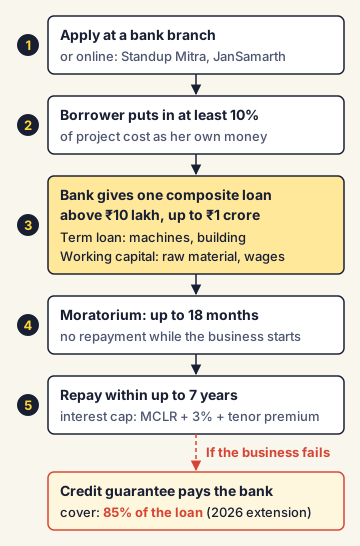
- The entrepreneur prepares a project idea, for example a small garment unit costing ₹50 lakh.
- She applies to a scheduled commercial bank branch, directly or through the online portal Standup Mitra (standupmitra.in) or the JanSamarth portal.
- The bank gives a composite loan: a term loan for machines and buildings, plus working capital for raw materials and wages. The loan can be up to ₹1 crore.
- The borrower brings a small share of the cost herself. She must put in at least 10% of the project cost as her own money. The rest of the "margin money" can come from other central or state schemes.
- The loan is repaid over up to 7 years, with a moratorium (a no-repayment break at the start) of up to 18 months, so the business has time to start earning.
- The bank charges interest at its lowest rate for that risk category, capped at its base rate (MCLR) + 3% + tenor premium.
- The loan is covered by a government-backed credit guarantee. If the business fails and cannot repay, the guarantee fund pays the bank most of its loss.
Handholding support
Many first-time entrepreneurs need guidance more than money. The scheme connects borrowers to training, help with preparing project reports, mentoring, and links to other schemes, through the Standup Mitra portal and agencies such as SIDBI and NABARD.
What changed in the 2026 extension?
- Period: up to 31 March 2031.
- Guarantee corpus: ₹4,111 crore.
- Guarantee cover: 85% of the loan amount.
- Guarantee fee: standardised at 0.5%, with no additional risk premium.
- Loan can cover up to 85% of project cost (earlier guidelines expected the loan to cover about 75%).
- Target: at least 2.5 lakh additional entrepreneurs in five years.
How has it performed?
As of 28 February 2025, about 2.67 lakh loan accounts had been sanctioned for ₹60,504 crore, of which about 1.99 lakh went to women. By late 2026, the government put the total number of beneficiaries at more than 2.75 lakh. The original target, however, was at least 2.5 lakh loans from about 1.25 lakh branches, and that target was meant to be reached within about three years. So the scheme took far longer than planned.
Commonly confused concepts
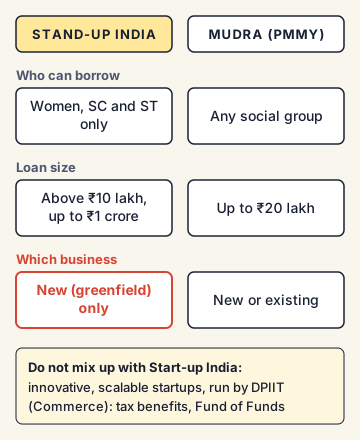
- Stand-Up India vs Start-up India: Both were launched in 2016, but they are different. Start-up India (DPIIT, Ministry of Commerce) supports innovative, scalable companies through tax benefits, easier rules and a Fund of Funds. Stand-Up India (Department of Financial Services, Ministry of Finance) gives bank loans to women and SC/ST people for any new business, innovative or not.
- Stand-Up India vs Mudra (PMMY): Mudra gives small loans up to ₹20 lakh to micro enterprises of any social group, and can fund existing businesses too. Stand-Up India gives larger loans of ₹10 lakh to ₹1 crore, only to women and SC/ST borrowers, and only for new ventures.
- Stand-Up India vs PMEGP: The Prime Minister's Employment Generation Programme gives a capital subsidy (a part of the cost is not repaid) through KVIC. Stand-Up India gives a loan that must be fully repaid; it only reduces the bank's risk through a guarantee.
- Greenfield vs brownfield: Greenfield means building something new from scratch. Brownfield means expanding or upgrading something that already exists.
Issues, criticism and the way forward
- Slow progress: The scheme reached its 2.5 lakh target only after many years, far slower than the "two loans per branch" plan suggested.
- Uneven reach: Most loans have gone to women. SC and ST borrowers got a much smaller share. Experts point to weaker collateral, lower awareness and fewer business networks in these groups.
- Risk aversion of bank branches: Many branch managers see first-time borrowers as risky and prefer existing customers. A strong guarantee (now 85%) is meant to reduce this fear.
- Proxy ownership: There have been concerns that some businesses are put in a woman's name while a male relative actually runs them.
- Survival of businesses: A loan alone does not ensure success. Market access, skills and mentoring decide whether a new unit survives.
- Way forward: Experts suggest better handholding, use of digital credit data instead of collateral, special focus on SC/ST borrowers, tracking of business survival (not just loan numbers), and linking with procurement rules, such as the public procurement policy that reserves a share of government purchases from MSMEs owned by SC/ST and women entrepreneurs.
Concepts to Know
- Collateral: Property or valuables a borrower pledges to a bank. If the loan is not repaid, the bank can sell it.
- Credit guarantee: A promise by a guarantee fund to pay the bank a fixed share of its loss if a borrower defaults. It works like insurance for the bank.
- Composite loan: One loan package that covers both long-term needs (machines, building) and day-to-day running costs (working capital).
- Working capital: Money needed to run a business daily: buying raw material, paying wages and bills.
- Margin money: The part of the project cost that the borrower must arrange, because the bank does not fund 100% of it.
- Moratorium: A starting period during which the borrower does not have to repay the loan.
- MCLR (Marginal Cost of Funds based Lending Rate): The basic minimum interest rate a bank uses as a reference for pricing its loans.
- SIDBI: Small Industries Development Bank of India, set up in 1990, the main development bank for small businesses.
- Cabinet approval: 6 January 2016; launch: 5 April 2016, Noida
- Nodal department: Department of Financial Services, Ministry of Finance
- Beneficiaries: women, SC and ST entrepreneurs, aged above 18
- Loan size: above ₹10 lakh and up to ₹1 crore; greenfield enterprises only
- Sectors: manufacturing, services, trading and (since 2021) agriculture-allied activities
- Firms: at least 51% shareholding and control with SC/ST or woman entrepreneur
- Target: at least one woman and one SC/ST borrower per bank branch
- Borrower's own contribution: at least 10% of project cost; margin money cut from 25% to 15% in Budget 2021-22
- Repayment: up to 7 years with up to 18 months moratorium
- Initial support: ₹10,000 crore refinance via SIDBI; guarantee via NCGTC
- 2026 extension: till 31 March 2031; guarantee corpus ₹4,111 crore; cover 85%; fee 0.5%
- Progress: 2.67 lakh accounts, ₹60,504 crore sanctioned (Feb 2025); over 2.75 lakh beneficiaries (2026)
- Portals: Standup Mitra and JanSamarth
● Tracked since March 16, 2026 · last seen November 11, 2026 · updates as the daily brief publishes