Small Industries Development Bank of India (SIDBI)
The Small Industries Development Bank of India (SIDBI) is a government-backed financial institution whose main job is to help MSMEs get money. It mostly does not lend to small firms directly. Instead, it gives money to banks, non-bank lenders and microfinance institutions so that they can lend to small businesses. It also runs support funds, credit guarantee and digital platforms for MSMEs. Its headquarters is in Lucknow, Uttar Pradesh.
Why does it exist?
Small businesses find it very hard to borrow. A big company has property to pledge, audited accounts and a long track record. A small factory owner often has none of these. Banks see such loans as risky and costly to handle, because many small loans need as much paperwork as one big loan. So small firms either get no loan, or they borrow from moneylenders at high interest.
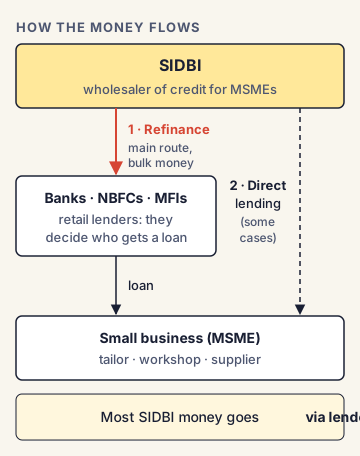
SIDBI was created to fix this gap. It works like a "wholesaler" of credit for small businesses: it gives bulk money to the "retail shops" (banks and lenders) that reach the small borrower.
Where did it come from?
India built special banks for important sectors after Independence. These are called Development Financial Institutions (DFIs): lenders that fund long-term development, not just short-term profit.
- The Industrial Development Bank of India (IDBI) was set up in 1964 to finance industry. It had a separate unit for small industries.
- Parliament passed the Small Industries Development Bank of India Act, 1989. Under it, SIDBI started work on 2 April 1990 as a wholly owned subsidiary of IDBI.
- With effect from 27 March 2000, SIDBI was delinked from IDBI and became an independent institution, owned by several public sector bodies.
- Over time it grew from a pure refinancing agency into a broader body that also gives direct loans, runs venture capital and manages government funds.
How does it work? The main channels
- Refinance (indirect lending): a bank gives a loan to a small business. SIDBI then gives that bank money at a fair rate so it can lend again. This is SIDBI's biggest activity. It is like a ration shop being restocked by a wholesaler so it never runs out.
- Direct lending: in some cases, SIDBI lends directly to MSMEs for projects, machinery, working capital and receivables, through its branches in industrial clusters.
- Fund of funds and venture capital: SIDBI puts money into private investment funds (AIFs) that buy shares in startups and small firms. It manages the Fund of Funds for Startups.
- Promotion and development: it supports skill training, cluster development, credit information and digital lending platforms.
The key parts and facts (the SIDBI family)
UPSC likes questions on which body belongs to whom.
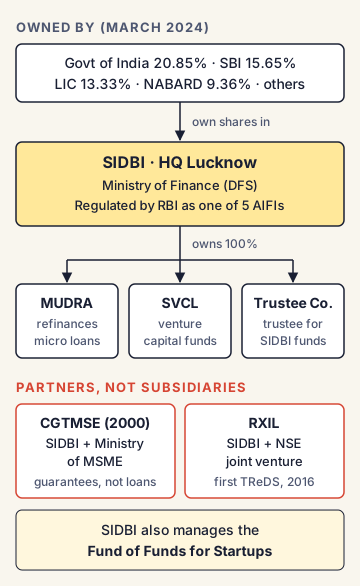
- Ownership: SIDBI is owned by public sector institutions. As of March 2024, the main shareholders were the Government of India (20.85%), State Bank of India (15.65%), LIC (13.33%) and NABARD (9.36%), with the rest held by other public sector banks and institutions.
- Administrative ministry: the Department of Financial Services, Ministry of Finance.
- Regulator: the RBI. SIDBI is one of the five All India Financial Institutions (AIFIs) regulated by the RBI, along with EXIM Bank, NABARD, National Housing Bank (NHB) and NaBFID.
- Wholly owned subsidiaries:
- MUDRA (Micro Units Development & Refinance Agency Ltd): refinances lenders that give small loans to micro units under the Pradhan Mantri MUDRA Yojana (launched 8 April 2015). Loan categories are Shishu (up to ₹50,000), Kishore (₹50,000 to ₹5 lakh), Tarun (₹5 lakh to ₹10 lakh) and Tarun Plus (₹10 lakh to ₹20 lakh, from 24 October 2024, for those who have repaid a Tarun loan).
- SIDBI Venture Capital Ltd (SVCL): manages venture capital funds.
- SIDBI Trustee Company Ltd: acts as trustee for SIDBI-linked funds.
- CGTMSE (Credit Guarantee Fund Trust for Micro and Small Enterprises): set up jointly by the Ministry of MSME and SIDBI in 2000. It promises banks that it will cover a large part of the loss if a collateral-free loan to a micro or small firm goes bad. The ceiling for such guarantees was raised from ₹5 crore to ₹10 crore from 1 April 2025.
- RXIL (Receivables Exchange of India Ltd): a joint venture promoted by SIDBI and the National Stock Exchange (NSE). It launched India's first working TReDS platform on 1 December 2016, under RBI guidelines of 3 December 2014. TReDS lets an MSME sell its unpaid bills to lenders and get cash quickly.
- Capital support: in January 2026 the Union Cabinet approved ₹5,000 crore of equity support to SIDBI, to be given in three parts: ₹3,000 crore in 2025-26 and ₹1,000 crore in each of the next two years. The aim is to raise the number of MSMEs it supports from about 76.26 lakh (end of 2024-25) to about 102 lakh by the end of 2027-28.
India's position and Indian examples
SIDBI sits at the centre of India's MSME finance system.
- A tailor who gets a ₹40,000 Shishu loan from a bank under MUDRA is indirectly supported by SIDBI, because MUDRA refinances that bank.
- A small machine-parts maker who gets a collateral-free bank loan is protected through CGTMSE.
- A supplier to a public sector company who sells an invoice on TReDS to get cash in two days uses a platform SIDBI helped build.
- A startup that gets money from a venture fund may be using money that came from the Fund of Funds for Startups managed by SIDBI.
Commonly confused concepts
- SIDBI vs NABARD: SIDBI serves MSMEs (small industry and services). NABARD (set up in 1982) serves agriculture and rural development. Both are AIFIs and both mainly refinance other lenders.
- SIDBI vs MUDRA: MUDRA is SIDBI's subsidiary. MUDRA refinances loans to micro units (up to ₹20 lakh). SIDBI covers the wider MSME sector. MUDRA itself does not lend directly to borrowers; banks, NBFCs and MFIs do.
- SIDBI vs CGTMSE: SIDBI provides money. CGTMSE provides a guarantee (a promise to cover losses), not the loan itself.
- SIDBI vs NSIC: NSIC (National Small Industries Corporation) is a public sector company under the Ministry of MSME that helps with marketing, raw materials and technology. Its arm, NSIC Venture Capital Fund Ltd, is the mother fund of the Self-Reliant India Fund. SIDBI is a financial institution under the Ministry of Finance.
- Refinance vs direct lending: in refinance, SIDBI lends to a bank which then lends to the business. In direct lending, SIDBI lends to the business itself.
- AIFI vs commercial bank: an AIFI like SIDBI does not take savings deposits from the public like a normal bank. It raises money from markets, the government and institutions.
Issues, criticism and the way forward
- Credit still does not reach the smallest firms: many micro units remain outside formal credit and depend on moneylenders, because they lack collateral and records.
- Dependence on banks: since SIDBI mostly refinances, the final decision to lend is made by banks, which may still avoid risky small borrowers.
- Loans are not enough: debt must be repaid even in bad years. Growing firms often need equity (risk capital) instead. Experts point out that SME equity in India is thin, and promoters often do not want to give up ownership.
- Delayed payments: large buyers paying late remains a key problem, which is why TReDS and payment rules matter.
- Way forward: expert groups such as the U.K. Sinha Committee (2019) set up by the RBI on MSMEs recommended better credit flow, stronger digital lending and a single market platform for MSMEs. Suggested steps include data-based (cash-flow) lending, wider use of TReDS, stronger guarantees and more equity funds for growing firms.
Concepts to Know
- Refinance: when a bigger institution gives money to a lender against loans it has already made, so the lender can lend again.
- Collateral: property or assets a borrower pledges to the lender. If the loan is not repaid, the lender can take them.
- Credit guarantee: a promise by a third party to repay a large share of a loan if the borrower fails to repay. It makes banks more willing to lend without collateral.
- Equity: money given to a business in return for a share of its ownership. It has no fixed repayment; the investor gains only if the business grows.
- NBFC (Non-Banking Financial Company): a company that lends money like a bank but does not have a full banking licence and cannot take ordinary savings deposits from the public in the same way.
- MFI (Microfinance Institution): a lender that gives very small loans, mostly to poor households and women's groups.
- Development Financial Institution (DFI): a lender set up to fund long-term development needs of a sector (industry, farming, housing, infrastructure) that normal banks under-serve.
- Set up under the Small Industries Development Bank of India Act, 1989; started work on 2 April 1990 as a wholly owned subsidiary of IDBI
- Delinked from IDBI with effect from 27 March 2000
- Headquarters: Lucknow; administrative ministry: Department of Financial Services, Ministry of Finance; regulated by the RBI as one of five AIFIs (with EXIM Bank, NABARD, NHB, NaBFID)
- Main shareholders (as of March 2024): Government of India 20.85%, SBI 15.65%, LIC 13.33%, NABARD 9.36%
- Subsidiaries: MUDRA, SIDBI Venture Capital Ltd, SIDBI Trustee Company Ltd
- CGTMSE: set up in 2000 by the Ministry of MSME and SIDBI; guarantee ceiling ₹10 crore from 1 April 2025
- RXIL: promoted by SIDBI and NSE; first TReDS platform, launched 1 December 2016
- Manages the Fund of Funds for Startups (2016, ₹10,000 crore)
- January 2026: Cabinet approved ₹5,000 crore equity support for SIDBI (₹3,000 crore in 2025-26, then ₹1,000 crore in each of the next two years)
● Tracked since October 06, 2026 · last seen October 06, 2026 · updates as the daily brief publishes