Samarth
Scheme for Capacity Building in Textile Sector
Samarth is a Government of India scheme that trains people to work in the textile and garment industry. It teaches new workers the basic skills they need to get a factory job, and it helps existing workers learn newer, better skills. It is run by the Ministry of Textiles. Its full official name is the Scheme for Capacity Building in Textile Sector (SCBTS), and "Samarth" (a Hindi word meaning "capable") is its short name.
Why does India need it?
The textile sector gives jobs to millions of people, but many workers learn on the job with no proper training. This leads to low productivity: an Indian worker often produces less per hour than a worker in Bangladesh or Vietnam. Factories also complain that they cannot find trained machine operators and tailors when they need them. Samarth tries to fix both problems at once: give poor and rural youth a job-ready skill, and give factories a trained workforce.
Where did it come from?
Before Samarth, the Ministry of Textiles ran the Integrated Skill Development Scheme (ISDS) during the 12th Five Year Plan (2012-17). In 2017, the Cabinet Committee on Economic Affairs (CCEA) approved Samarth as the next step after ISDS.
- First phase: 2017-18 to 2019-20, with an outlay of ₹1,300 crore and a target of training 10 lakh people (9 lakh in the organised sector and 1 lakh in traditional sectors).
- Extensions: The scheme was extended up to 2023-24, and then again for 2024-25 and 2025-26 (up to March 2026), with about ₹495 crore to train 3 lakh more people.
- Samarth 2.0: Announced in the Union Budget 2026-27 as part of a larger textile programme.
What does it cover?
Samarth covers almost the whole textile value chain (all the steps from fibre to finished clothes). It has one important exclusion:
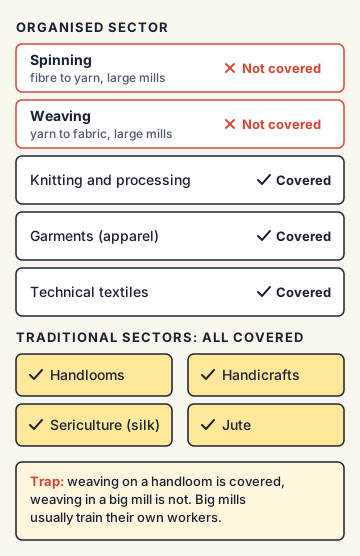
- Covered: garment making (apparel), knitting, processing, technical textiles and other organised segments.
- Covered: traditional sectors such as handlooms, handicrafts, sericulture (silk farming) and jute.
- Not covered: spinning and weaving in the organised sector (large mills). These are left out because big mills usually train their own workers.
How does it work, step by step?
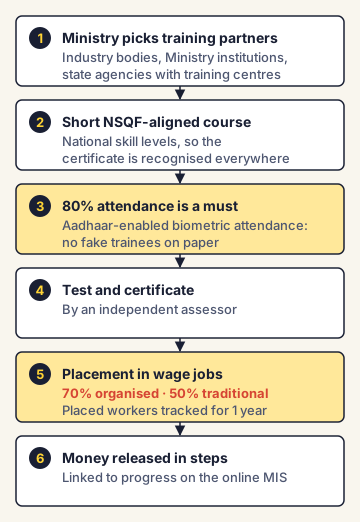
- The Ministry chooses implementing partners. These can be textile industry bodies and companies, institutions under the Ministry of Textiles, and state government agencies that have training centres.
- The partner runs short training courses. The courses are NSQF-aligned, which means they follow India's national standard for skill levels, so the certificate is recognised everywhere.
- Trainees must attend at least 80% of classes. Attendance is marked with an Aadhaar-enabled biometric system (fingerprint or face scan), so fake trainees cannot be shown on paper.
- At the end, trainees are tested and certified by an independent assessor.
- The partner must help them get jobs. The scheme requires 70% placement in wage jobs for organised-sector courses and 50% for traditional-sector courses. Placed workers are tracked for one year.
- Money is released to the partner in steps, linked to progress recorded on a central online system (an MIS, or management information system).
People who want to start their own small unit instead of taking a job can get loans at lower interest through the Pradhan Mantri MUDRA Yojana.
Two types of training
- Entry-level training: for new people with no experience, so they can get their first job.
- Upskilling and reskilling: for people already working, so they can learn new machines or methods and earn more.
As of 16 October 2026, the official Samarth dashboard showed about 7.38 lakh workers trained under entry-level programmes across 4,614 training centres, and about 26,786 more under upskilling and reskilling.
What is new in Samarth 2.0?
The Union Budget 2026-27 announced an integrated programme for the textile sector with five parts. Samarth 2.0 is one of them:
- National Fibre Scheme: self-reliance in fibres such as silk, wool, jute, man-made fibres and new-age fibres.
- Textile Expansion and Employment Scheme: modernising traditional clusters with machinery and technology support.
- National Handloom and Handicraft Programme: support for weavers and artisans.
- Tex-Eco Initiative: making Indian textiles environmentally sustainable and globally competitive.
- Samarth 2.0: an upgraded skilling system built on closer links between industry and academic institutions.
The proposed ₹25,000 crore over five years for Samarth 2.0 is many times the ₹740 crore spent in the previous five years.
Commonly confused concepts
- Samarth vs PMKVY: The Pradhan Mantri Kaushal Vikas Yojana (PMKVY) is the flagship skilling scheme of the Ministry of Skill Development and Entrepreneurship and covers all sectors. Samarth is run by the Ministry of Textiles and covers only textiles. Both follow the same national standards (NSQF) and common cost norms.
- Samarth vs PM MITRA: PM MITRA builds mega textile parks (infrastructure). Samarth trains workers (people). One builds the factory space, the other prepares the workforce for it.
- Samarth vs the PLI scheme for textiles: The Production Linked Incentive scheme pays companies a reward for producing more man-made fibre and technical textiles. Samarth spends money on training workers.
- Samarth (textiles) vs SAMARTH (other ministries): Other programmes also use the name "Samarth", for example a disability-related scheme and an SME scheme. In UPSC questions, "Samarth" with "capacity building" refers to the textile scheme.
Issues, criticism and the way forward
- Quantity vs quality: Skilling schemes often chase training numbers. Industry leaders say the focus should be on productivity and real jobs, not just certificates.
- Placement quality: A job may last only a few months or pay very little. Tracking beyond the first year is weak.
- Women workers: Most garment workers are women. Safe transport, hostels and childcare decide whether they stay in jobs after training.
- Gap with technology: Factories now use automated machines and must meet strict quality and environmental rules set by foreign buyers. Courses must keep updating.
- Way forward: closer partnership between exporters and training institutes, training on the shop floor (apprenticeship style), and linking skilling with the new mega textile parks.
Concepts to Know
- NSQF (National Skills Qualifications Framework): India's common ladder of skill levels (levels 1 to 10). A course is mapped to a level, so employers anywhere in India know what the certificate means.
- Placement-linked training: Training where the trainer is paid fully only if a set share of trainees actually get jobs.
- Organised sector: Registered businesses that follow labour laws, such as factories with formal contracts and wages.
- Value chain: All the steps a product passes through, from raw material to the final buyer. For textiles: fibre, yarn, fabric, processing, garment, export.
- Cabinet Committee on Economic Affairs (CCEA): A committee of senior Union ministers, chaired by the Prime Minister, that approves major economic decisions and schemes.
- Sericulture: Rearing silkworms to produce raw silk.
- Full name: Scheme for Capacity Building in Textile Sector (SCBTS); Ministry of Textiles
- Approved by CCEA in 2017 as the continuation of the Integrated Skill Development Scheme (ISDS)
- First phase: 2017-18 to 2019-20; outlay ₹1,300 crore; target 10 lakh (9 lakh organised + 1 lakh traditional)
- Extended up to 2023-24, then for 2024-25 and 2025-26 (about ₹495 crore, 3 lakh trainees)
- Excludes spinning and weaving in the organised sector; includes handloom, handicraft, sericulture and jute
- Mandatory placement: 70% (organised sector), 50% (traditional sector); 80% attendance with Aadhaar-enabled biometric attendance
- NSQF-aligned courses; self-employed trainees can get MUDRA loans
- Samarth 2.0 announced in the Union Budget 2026-27; proposed ₹25,000 crore over five years
● Tracked since October 19, 2026 · last seen October 19, 2026 · updates as the daily brief publishes