Regional Comprehensive Economic Partnership (RCEP)
The Regional Comprehensive Economic Partnership, or RCEP, is a free trade agreement among 15 countries of the Asia-Pacific: the ten ASEAN members plus China, Japan, South Korea, Australia and New Zealand. Its members agree to remove import taxes on most goods traded among them and to follow common trade rules. Together, these countries make up about 30% of the world's GDP and about 30% of its population, so it is often called the world's largest trade bloc by these measures.
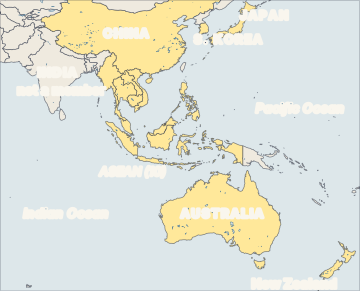
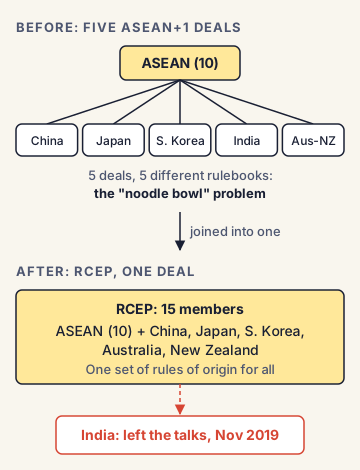
India took part in the talks for seven years but pulled out in November 2019 and is not a member.
Why was RCEP created?
By the early 2010s, ASEAN had five separate "ASEAN+1" free trade deals, one each with China, Japan, South Korea, India, and Australia-New Zealand together. Each had different rules, so a factory using parts from several countries had to deal with a confusing mix of paperwork. This is often called the "noodle bowl" problem. RCEP was designed to join these deals into one, with a single set of rules. It also keeps ASEAN at the centre of regional economic cooperation, instead of letting a big power lead it.
Where did it come from?
- November 2012: Leaders of ASEAN and its six FTA partners (China, Japan, South Korea, India, Australia and New Zealand) launched the negotiations on 20 November 2012 at the 21st ASEAN Summit in Phnom Penh, Cambodia. So the talks began with 16 countries.
- 2013-2019: Many rounds of talks followed. The original target of finishing by end-2015 was missed.
- 4 November 2019: At the RCEP summit in Bangkok, India announced it would not join, saying "significant outstanding issues" were unresolved.
- 11 November 2020: RCEP ministers adopted a special declaration on India, keeping the door open for it.
- 15 November 2020: The remaining 15 countries signed the agreement at a virtual summit.
- 1 January 2022: RCEP entered into force for ten members, after at least six ASEAN and three non-ASEAN signatories ratified it. Others joined later: South Korea (1 February 2022), Malaysia (18 March 2022), Indonesia (2 January 2023) and the Philippines (2 June 2023).
How does it work?
Think of RCEP as one big shared rulebook for a group of shops in a market. Earlier, each pair of shops had its own small deal. Now one rulebook covers everyone.
- Tariff cuts: Members aim to remove tariffs on about 90% of the goods traded among them, some at once and others gradually over about 20 years. Many sensitive farm products are protected and never reach zero.
- One set of rules of origin: Rules of origin decide whether a product truly "comes from" a member country, and so qualifies for the low tariff. Under RCEP the same rules apply in all 15 members. Parts and materials from any member can count towards a product's local content. This encourages regional supply chains, for example a phone assembled in Vietnam using Japanese and Korean parts.
- Beyond goods: The agreement also covers services, investment, intellectual property, e-commerce, competition, government procurement and dispute settlement.
The key parts and facts
- The legal text has 20 chapters, 17 annexes and 54 market access schedules.
- Members (15): Brunei, Cambodia, Indonesia, Laos, Malaysia, Myanmar, the Philippines, Singapore, Thailand, Vietnam (ASEAN), plus China, Japan, South Korea, Australia and New Zealand.
- RCEP created the first free trade link between China, Japan and South Korea, three of Asia's largest economies.
- It does not have strong chapters on labour rights or the environment, unlike some newer trade deals.
- New applicants: Hong Kong (January 2022), Sri Lanka (June 2023), Chile (June 2024) and Bangladesh (October 2024) have applied to join. Procedures for new members were adopted in Vientiane on 22 September 2024. In September 2026, RCEP ministers agreed to set up a working group to examine these applications.
India's position: why did India stay out?
India's reasons, as stated at the time and later, were mainly these:
- Trade deficit with China: India already imported far more from China than it exported. Opening up further could have flooded Indian markets with cheap Chinese goods. The gap has kept growing: India's trade deficit with China reached a record $99.2 billion in 2024-25.
- Weak protection against import surges: India asked for an auto-trigger mechanism, which would automatically raise tariffs on a product when its imports crossed a set limit. This was not accepted in the form India wanted.
- Rules of origin and routing: India feared that goods from non-members could be routed through member countries to enter India at low tariffs.
- Farmers and dairy: India's dairy sector is made up of millions of small producers. Cheap dairy products from New Zealand and Australia, and farm goods from elsewhere, could have hurt them.
- Past FTA experience: India's trade deficit with its FTA partners had roughly doubled, from about $54 billion in 2013-14 to about $105 billion in 2018-19.
- Not enough gain in services: India wanted easier movement of its professionals and better access for its services, where it is strong. It felt the offers were not enough.
The door is still open. The Ministers' Declaration of 11 November 2020 says the agreement is open for India to join from the date it entered into force, under Article 20.9 (Accession). India can start talks any time by writing to the Depositary, and can attend RCEP meetings as an observer before joining. Since leaving RCEP, India has signed bilateral deals with richer economies instead, such as the UAE, Australia, the EFTA countries and the UK, and is reviewing AITIGA.
Commonly confused concepts
- RCEP vs CPTPP: The Comprehensive and Progressive Agreement for Trans-Pacific Partnership (CPTPP) is a separate, stricter trade deal around the Pacific, with stronger rules on labour, environment and state-owned companies. The UK became its 12th member on 15 December 2024. China is in RCEP but not in CPTPP (it applied in 2021). India is in neither.
- RCEP vs AITIGA: AITIGA is India's own deal with the ten ASEAN countries only. RCEP is ASEAN's deal with five partners, without India.
- RCEP vs IPEF: The Indo-Pacific Economic Framework for Prosperity (IPEF), launched by the US in May 2022, is not a tariff-cutting deal. It covers supply chains, clean economy and fair economy. India is a member of IPEF but stayed out of its trade pillar.
- RCEP vs "ASEAN+3": ASEAN+3 is a cooperation forum of ASEAN with China, Japan and South Korea. It is not a free trade agreement.
Issues, criticism and the way forward
- For India, both sides of the debate: Supporters of India's exit say it protected farmers, dairy and small industry from a surge of Chinese imports. Critics say India lost a chance to become part of East Asian supply chains, which are central to manufacturing electronics, cars and machinery.
- China's weight: Many experts note that RCEP increases China's economic influence in the region, since it is by far the largest economy in the bloc.
- Shallow rules: Compared with CPTPP, RCEP has weaker rules on labour, environment and many farm products. Some see this as a weakness. Others see it as the reason so many different countries could agree.
- Way forward for India: Experts suggest India should strengthen its manufacturing competitiveness, use bilateral FTAs with key partners, complete the AITIGA review, and keep the RCEP option open if its concerns on safeguards and rules of origin can be met.
Concepts to Know
- Free trade agreement (FTA): A deal between countries to remove or cut tariffs on most goods traded between them.
- Tariff: A tax charged on goods when they are imported.
- Trade deficit: When a country imports more than it exports with a partner.
- Rules of origin: Rules that decide which country a product "comes from", so that only goods truly made in member countries get the low tariff.
- Supply chain: The full path a product takes, from raw materials and parts to the finished item, often across many countries.
- Safeguard: A temporary higher tariff that a country is allowed to put on a product when a sudden rise in imports hurts its own industry.
- Depositary: The official keeper of a treaty, who receives documents like ratifications or requests to join. For RCEP, it is the ASEAN Secretary-General.
- Observer: A country that can attend meetings of a group but has no voting rights.
- 15 members: 10 ASEAN + China, Japan, South Korea, Australia, New Zealand
- About 30% of world GDP and about 30% of world population (about 2.3 billion people)
- Talks launched: 20 November 2012, 21st ASEAN Summit, Phnom Penh (16 countries, including India)
- India's exit: 4 November 2019, Bangkok
- Ministers' Declaration on India: 11 November 2020; open to India under Article 20.9; India may join meetings as an observer
- Signed: 15 November 2020; in force: 1 January 2022
- 20 chapters, 17 annexes, 54 schedules; tariffs removed on about 90% of goods over about 20 years
- Accession procedures adopted: 22 September 2024, Vientiane; applicants: Hong Kong, Sri Lanka, Chile, Bangladesh
- India-China trade deficit: record $99.2 billion in 2024-25
● Tracked since October 16, 2026 · last seen October 16, 2026 · updates as the daily brief publishes