Purana Qila
Delhi's Old Fort
Purana Qila, which means "Old Fort", is a 16th-century fort in the heart of Delhi. The Mughal emperor Humayun began building it as the inner fort (citadel) of his new city, Dinpanah, and the Afghan ruler Sher Shah Suri added to it after defeating Humayun. The mound it stands on has been lived on for more than 2,500 years, and tradition links it to Indraprastha, the city of the Pandavas in the Mahabharata. Today it is a protected monument looked after by the Archaeological Survey of India (ASI).
Where is it?
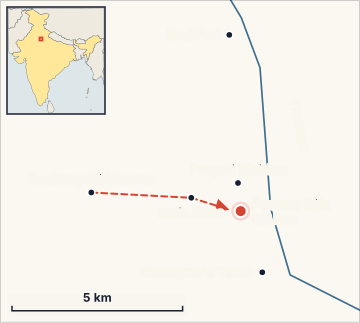
Purana Qila stands on a raised mound near Pragati Maidan, next to the National Zoological Park (Delhi Zoo). It was built on the bank of the Yamuna River; the river has since shifted east, away from the fort. When the British planned New Delhi in the 1920s, the architect Edwin Lutyens lined up the central avenue (Rajpath, now Kartavya Path) towards Purana Qila.
Who built it? The Humayun and Sher Shah story
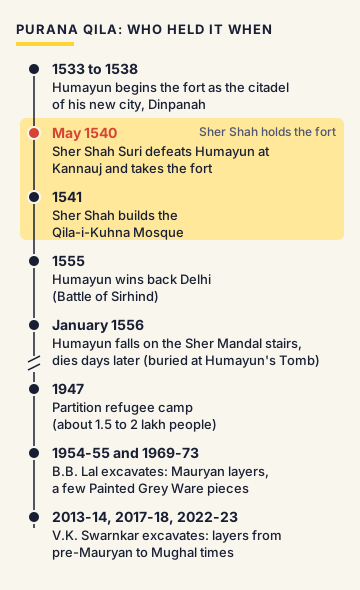
- Humayun (the second Mughal emperor, son of Babur) began building a new city called Dinpanah ("refuge of the faith") in the 1530s. Purana Qila was meant to be its citadel. Sources do not agree on the year work started: they give different years between 1533 and 1538.
- In May 1540, Sher Shah Suri defeated Humayun at the Battle of Kannauj (also called the Battle of Bilgram). Humayun lost his empire and fled to Persia (Iran).
- Sher Shah took over the fort and added buildings, including the Qila-i-Kuhna Mosque (1541). Some historians link the fort to Sher Shah's own city, sometimes called Shergarh, but this link is debated because the evidence is thin.
- In 1555, Humayun won back Delhi after the Battle of Sirhind. In January 1556, he fell down the steep stairs of the Sher Mandal inside the fort and died a few days later.
Because of this back-and-forth, historians are still not fully sure which buildings Humayun built and which Sher Shah (or his son Islam Shah) built.
What does the fort look like? The key parts
- Walls: About 18 metres high, running about 1.5 km around the fort.
- Three main gates:
- Bara Darwaza ("Big Gate"), facing west: the main entrance used today.
- Humayun Darwaza, the south gate, visible from the Delhi Zoo.
- Talaqi Darwaza, the north gate, popularly called the "forbidden gate".
- Qila-i-Kuhna Mosque ("mosque of the old fort"): Built by Sher Shah in 1541. It is a single-domed prayer hall with five arched openings, made of red sandstone with white marble and coloured stone decoration. It is the best-preserved building inside the fort.
- Sher Mandal: A two-storey octagonal (eight-sided) tower of red sandstone. Humayun used it as a library. Who began it is uncertain: older accounts credit Sher Shah, others credit Humayun.
Why does the architecture matter?
Purana Qila sits at a turning point in Indian architecture. The earlier Delhi Sultanate buildings (like those of the Lodis) were heavy and plain. The later Mughal style (Humayun's Tomb, the Red Fort) was grand and richly decorated. The Qila-i-Kuhna Mosque, with its pointed arches, fine stone inlay and balanced front, shows this change happening. That is why it is often described as a link between Sultanate (Afghan) and Mughal architecture.
The Indraprastha connection and the excavations
For centuries, people have believed that the mound of Purana Qila is the site of Indraprastha, the capital of the Pandavas in the Mahabharata. A village called Indrapat stood inside the fort walls until the early 20th century. The British archaeologist Alexander Cunningham also linked the site to Indraprastha. To test this, the ASI has dug here many times:
- 1954-55 and 1969-73: Excavations led by B.B. Lal. He found a continuous record of settlement from the Mauryan period onwards, and a few pieces of Painted Grey Ware (PGW) pottery.
- 2013-14, 2017-18 and 2022-23 (the 2022-23 season began in January 2023): Excavations led by Vasant Kumar Swarnkar of the ASI. They found layers from the pre-Mauryan period through the Mauryan, Shunga, Kushan, Gupta, Rajput, Sultanate and Mughal periods, along with PGW pieces.
Painted Grey Ware is a type of fine grey pottery with black painted designs. It is found mainly in the Ganga-Yamuna doab (the land between the two rivers) and is usually dated to about 1200 to 600 BCE, the time often linked with the later Vedic age. Finding PGW at Purana Qila shows that people lived here very early.
But there is no conclusive proof that this was Indraprastha. The Mahabharata is an epic, and archaeologists treat the link as a tradition, not a proven fact.
What else happened here?
In 1947, during Partition, Purana Qila and the nearby Humayun's Tomb became refugee camps for Muslims waiting to leave for Pakistan. About 1.5 to 2 lakh people stayed in and around the fort until the camp closed in early 1948. Today the fort hosts a museum of excavated objects and cultural events, and in November 2026 it was the venue of the first SCO Civilisational Dialogue Forum.
How is it protected?
Purana Qila is a Monument of National Importance, protected under the Ancient Monuments and Archaeological Sites and Remains (AMASR) Act, 1958, and looked after by the ASI (under the Ministry of Culture). It is not a UNESCO World Heritage Site.
The "seven cities of Delhi"
Historians often say Delhi was built and rebuilt as many "cities" by different rulers. A commonly used list is: Lal Kot / Qila Rai Pithora (Tomars and Chauhans), Siri (Alauddin Khalji), Tughlaqabad (Ghiyasuddin Tughlaq), Jahanpanah (Muhammad bin Tughlaq), Firozabad (Firoz Shah Tughlaq), Dinpanah / Shergarh (Humayun and Sher Shah, with Purana Qila as its citadel) and Shahjahanabad (Shah Jahan).
Different books give slightly different lists. In this common list, the sixth city is Dinpanah / Shergarh, and Purana Qila is that city's citadel, not a city by itself.
Commonly confused concepts
- Purana Qila vs Red Fort (Lal Qila): Purana Qila is 16th century (Humayun and Sher Shah). The Red Fort was built by Shah Jahan (1639-1648) as the citadel of Shahjahanabad, and became a UNESCO World Heritage Site in 2007.
- Sher Mandal vs Humayun's Tomb: Humayun died after falling at the Sher Mandal. He is buried at Humayun's Tomb, built later by his widow Bega Begum and a UNESCO World Heritage Site since 1993.
- Dinpanah vs Jahanpanah: Dinpanah was Humayun's city (16th century). Jahanpanah was Muhammad bin Tughlaq's city (14th century). The names sound alike.
- "Built by Sher Shah" vs "built by Humayun": Both are partly true. Humayun started the citadel; Sher Shah completed and added major buildings. The mosque (1541) is firmly Sher Shah's.
- Indraprastha "found": Excavations found very old settlement layers and PGW pottery, but have not proved that the site is the Mahabharata's Indraprastha.
Issues, criticism and the way forward
- Proof vs belief: Some see the excavations as a search to confirm the epic. Archaeologists stress that conclusions must rest on dated evidence, and that the oldest layer will be known only when digging reaches natural soil (the untouched ground below all layers left by people).
- Conservation pressure: Traffic, pollution, crowds and the surrounding city put stress on old stone walls and buildings.
- Telling the full story: Heritage experts suggest the fort's many layers, from early settlements to the Partition camp, should all be presented to visitors, not just one period.
- Way forward: Publishing full excavation reports, using scientific dating, better site museums, and using events like the SCO forum to raise public interest in heritage.
Concepts to Know
- Citadel: A strong inner fort that protects the ruler, usually built inside or beside a larger city.
- Excavation: Careful digging by archaeologists to find and study remains from the past, layer by layer. Deeper layers are usually older.
- Mauryan period: The time of the Maurya Empire, about 322 to 185 BCE (Chandragupta Maurya, Ashoka). "Pre-Mauryan" means older than this.
- Doab: The land between two rivers that join. The Ganga-Yamuna doab covers much of western and central Uttar Pradesh. It ends at Prayagraj, where the two rivers meet.
- Monument of National Importance: A monument that the Central Government declares important under the AMASR Act, 1958. The ASI protects it, and building near it is controlled.
- Location: Delhi, near Pragati Maidan, next to the Delhi Zoo; originally on the bank of the Yamuna
- Begun by Humayun as the citadel of Dinpanah (start of work dated to different years between 1533 and 1538)
- Sher Shah Suri defeated Humayun at Kannauj (May 1540); built the Qila-i-Kuhna Mosque (1541)
- Humayun regained Delhi in 1555; died after a fall at the Sher Mandal, January 1556
- Walls about 18 m high, about 1.5 km around; gates: Bara Darwaza (west), Humayun Darwaza (south), Talaqi Darwaza (north)
- Excavations: B.B. Lal (1954-55, 1969-73); Vasant Kumar Swarnkar (2013-14, 2017-18, 2022-23)
- Painted Grey Ware: about 1200 to 600 BCE; link to Indraprastha not proven
- 1947: Partition refugee camp (about 1.5 to 2 lakh people)
- Status: Monument of National Importance (AMASR Act, 1958), maintained by ASI; not a UNESCO site
● Tracked since November 20, 2026 · last seen November 20, 2026 · updates as the daily brief publishes