Pulse Polio Programme and Polio Eradication in India
The Pulse Polio Programme is India's mass campaign to wipe out polio by giving oral polio drops to every child under five years of age, all on the same days across the country. It began in 1995 and is famous for its slogan "Do Boond Zindagi Ki" ("Two drops of life"). Through this campaign and routine vaccination, India went from being one of the worst-hit countries in the world to being free of wild polio. India's last case of wild polio was recorded on 13 January 2011.
What is polio?
Polio (poliomyelitis) is a disease caused by the poliovirus. The virus spreads mainly through dirty hands, water or food contaminated with an infected person's stool (this is called the faecal-oral route). It mostly affects children under five. In a small share of infections, the virus attacks the nerves in the spinal cord and causes paralysis (permanent weakness of the legs or arms) that cannot be cured. There is no cure for polio; it can only be prevented by vaccines.
Why was a special campaign needed?
Routine vaccination alone was not enough in India. In the 1990s, routine coverage in large states was low. In parts of Uttar Pradesh and Bihar, fewer than 40% of children had received all three routine oral polio doses even in the late 2000s. Crowding, poor sanitation and high birth rates helped the virus spread fast.
To stop it, India needed to immunise every child under five at the same time, again and again, so the virus had nobody left to infect. That is the idea of a "pulse": a short, powerful burst of vaccination across the whole country.
Where did it come from?
The story has three layers:
- Global level: In 1988, the Global Polio Eradication Initiative (GPEI) was set up, led by the World Health Organization (WHO) with partners such as UNICEF, Rotary International and the US CDC, to wipe out polio worldwide.
- India's routine programme: Oral polio vaccine was already part of India's routine immunisation, and the Universal Immunisation Programme began in 1985.
- Pulse Polio: India launched the Pulse Polio Programme in December 1995. On National Immunisation Days, every child under five got polio drops, whether or not they had been vaccinated before.
How does a Pulse Polio round work?
It runs like a military operation:
- Booth day: On a fixed Sunday, often called "Polio Sunday", lakhs of booths open at schools, health centres and anganwadis. Parents bring every child under five for two drops.
- House-to-house visits: For the next few days, teams of health workers go door to door to find children who were missed.
- Transit teams: Teams stand at railway stations, bus stands, markets and construction sites to catch children who are travelling or living in temporary homes.
- Marking: Each vaccinated child's little finger is marked with ink, and houses are marked with chalk, so workers know who has been covered.
- Repeat: Rounds are held across the whole country (National Immunisation Days, NIDs) or only in high-risk areas (Sub-National Immunisation Days, SNIDs).
How did India track the virus?
Two kinds of watching (surveillance) were key:
- AFP surveillance: Every case of acute flaccid paralysis (sudden floppy weakness of a limb) in children under 15 is reported and its stool samples are tested in labs. This finds real polio cases.
- Environmental surveillance: Sewage water is tested for poliovirus. This finds the virus even when no child is yet paralysed. India began this in Mumbai in 2001, and later expanded it to many cities.
India's journey to polio-free status
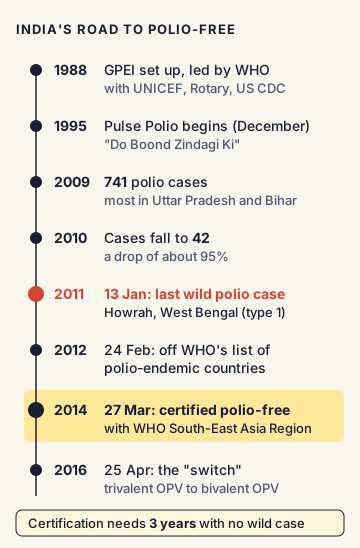
- 2009: India reported 741 polio cases, most of them in Uttar Pradesh and Bihar.
- 2010: Cases fell to 42, a drop of about 95%.
- 13 January 2011: The last case of wild polio in India, a child in Howrah, West Bengal (wild poliovirus type 1).
- 24 February 2012: WHO removed India from the list of polio-endemic countries (countries where the virus is still spreading naturally).
- 27 March 2014: WHO certified the whole South-East Asia Region, including India, as polio-free. Certification needs at least three years with no wild polio cases.
The two types of polio vaccine
Students must know the difference:
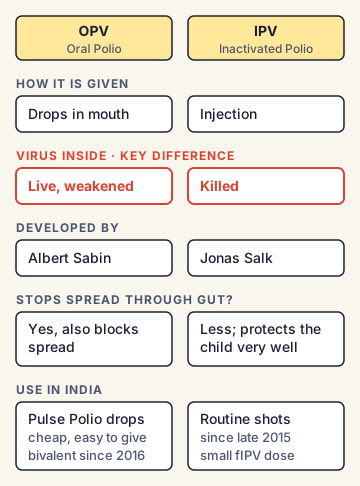
- OPV (Oral Polio Vaccine, developed by Albert Sabin): given as drops in the mouth. It contains a live but weakened virus. It is cheap, easy to give and also stops the virus from spreading through the gut. This is what Pulse Polio uses.
- IPV (Inactivated Polio Vaccine, developed by Jonas Salk): given as an injection. It contains a killed virus. It protects the child very well but does less to stop spread through the gut.
Changes after polio was eliminated
- IPV added (2015): India added IPV to routine immunisation in late 2015.
- The "switch" (25 April 2016): India moved from trivalent OPV (protecting against types 1, 2 and 3) to bivalent OPV (types 1 and 3), because wild type 2 had already been wiped out. All old trivalent stock was withdrawn and destroyed.
- Fractional IPV (fIPV): Because IPV was in short supply, India began giving a smaller one-fifth dose (0.1 ml) into the skin at 6 and 14 weeks. A third fIPV dose at 9 months was added from 1 January 2023.
The world today
Of the three types of wild poliovirus, type 2 was declared eradicated in 2015 and type 3 in 2019. Only wild type 1 still spreads naturally, in just two countries: Pakistan and Afghanistan. They reported 99 cases together in 2024. This is why India still runs Pulse Polio rounds and keeps transit teams at border crossings.
India's position and wider immunisation milestones
Polio is one of several victories for India's vaccination system. India stopped smallpox transmission in the 1970s, and WHO declared smallpox eradicated from the world in 1980. India was validated as having eliminated maternal and neonatal tetanus in 2015. The huge network built for Pulse Polio (micro-plans for every village, trained vaccinators, cold chains and surveillance) was later used for Mission Indradhanush and COVID-19 vaccination.
Commonly confused concepts
- Elimination vs eradication: Elimination means a disease no longer spreads in one country or region (India eliminated polio). Eradication means the germ is wiped out from the whole world permanently (only smallpox has been eradicated among human diseases; wild polio types 2 and 3 have also been eradicated).
- Wild poliovirus vs vaccine-derived poliovirus (VDPV): The wild virus is the natural one. A VDPV is a rare form that comes from the weakened virus in OPV, which can change over time and, in places with low vaccination or in children with weak immunity, cause paralysis. In 2024, a child with weak immunity in Meghalaya's West Garo Hills was found to have vaccine-derived polio. The health ministry said this did not affect India's polio-free status.
- NID vs SNID: A National Immunisation Day covers the whole country; a Sub-National Immunisation Day covers only high-risk states or districts.
- Pulse Polio vs Mission Indradhanush: Pulse Polio targets only polio, for all children under five, on fixed days. Mission Indradhanush is a catch-up drive for all UIP vaccines, aimed at children and pregnant women who missed doses.
Issues, criticism and the way forward
- Risk of imported cases: As long as wild polio spreads in Pakistan and Afghanistan, it can enter India. High immunity and border vaccination must continue.
- Vaccine-derived cases: The rare VDPV cases have led some experts to argue that India should rely more on IPV injections and phase out OPV, as the global plan intends after wild polio is gone.
- Cost and fatigue: Repeated rounds for a disease no one sees any more cost a lot of money and can make parents and workers lose interest.
- Missed groups: Migrant families, urban slums and remote areas remain the hardest to reach, both for polio drops and for routine vaccines.
- Way forward: Keep strong AFP and sewage surveillance, maintain high routine coverage, use digital records like U-WIN to track mobile children, and follow the GPEI plan to stop using OPV once wild polio is eradicated globally.
Concepts to Know
- Endemic: A disease is endemic in a country when it keeps spreading there naturally all the time, without being brought in from outside.
- Herd immunity: When enough people in a community are immune, the germ cannot find new people to infect, so even unvaccinated people are protected indirectly.
- Acute flaccid paralysis (AFP): A sudden weakness or floppiness in an arm or leg. Polio is one cause, so every AFP case is tested.
- Trivalent and bivalent: "Trivalent" means a vaccine protects against three types of a germ; "bivalent" means two types.
- Cold chain: The system of fridges, freezers and cool boxes that keeps vaccines at the right temperature from the factory to the child.
- Certification: An official declaration by an expert commission that a region has been free of a disease for a required number of years.
- GPEI launched in 1988 (led by WHO, with UNICEF, Rotary International, US CDC and others)
- Pulse Polio Programme launched in December 1995; slogan "Do Boond Zindagi Ki"; covers all children under 5
- India's polio cases: 741 (2009) → 42 (2010)
- Last wild polio case: 13 January 2011, Howrah, West Bengal (type 1)
- Removed from WHO's endemic list: February 2012
- WHO South-East Asia Region certified polio-free: 27 March 2014 (needs 3 years with no wild case)
- tOPV to bOPV switch: 25 April 2016; IPV added in 2015; third fIPV dose at 9 months from 1 January 2023
- Wild poliovirus type 2 eradicated 2015; type 3 eradicated 2019; type 1 endemic only in Pakistan and Afghanistan
- Maternal and neonatal tetanus elimination validated in India in 2015
● Tracked since November 10, 2026 · last seen November 10, 2026 · updates as the daily brief publishes