Project Seabird
The Karwar Naval Base
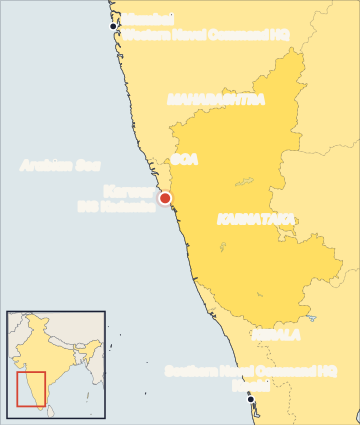
Project Seabird is the Indian Navy's plan to build a large, modern naval base at Karwar on the coast of northern Karnataka. The base built under it is called INS Kadamba, or Naval Base Karwar. It sits on the Arabian Sea in Uttara Kannada district, a short distance south of the Goa border. When all its phases are complete, it is expected to be one of the largest naval bases in Asia.
Why does India need it?
For decades, the Navy's western fleet was based mainly at Mumbai. Mumbai's harbour is shared with a busy commercial port, merchant ships and fishing boats. That made it crowded, hard to expand and easy to watch. A big naval base needs deep water, a sheltered bay, space on land and room to grow. Karwar offers a deep natural harbour, protection from hills behind it and islands in front of it.
It also gives the Navy a second strong base on the west coast, so the whole fleet is not in one place. A single crowded base is risky in a war, because one attack could hit many ships at once.
Where did it come from?
The project moved slowly at first, mainly because of money:
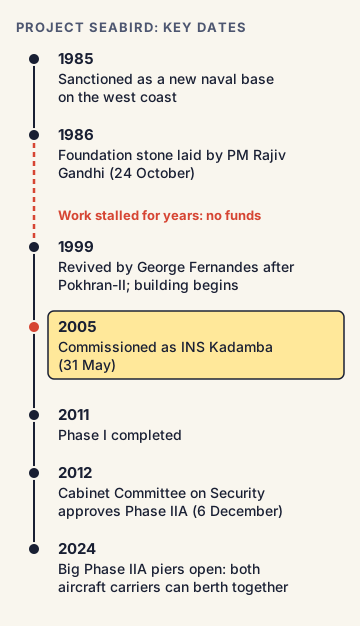
- 1985: The government sanctioned a new naval base on the west coast for strategic reasons.
- 24 October 1986: Prime Minister Rajiv Gandhi laid the foundation stone.
- Late 1980s and 1990s: Work stalled because of funding limits.
- 1999: After the Pokhran-II nuclear tests, Defence Minister George Fernandes revived the project and construction began in October 1999.
- 31 May 2005: The base was commissioned as INS Kadamba.
- 2011: Phase I was completed.
- 6 December 2012: The Cabinet Committee on Security approved Phase IIA.
What was built in Phase I?
Phase I created the basic base for about 10 to 11 frontline warships. Its main parts were:
- Breakwaters: long walls of rock built into the sea to stop waves and make the harbour calm. The northern breakwater is about 1.7 km and the southern one about 3.1 km.
- A 10,000-tonne ship lift: a giant platform that lifts a whole ship out of the water so it can be repaired on land. It was commissioned in November 2006.
- A ship repair yard, armament and logistics storage, a naval hospital (INHS Patanjali) and housing.
- The base covers about 11,200 acres along a coastline of about 26 km.
What does Phase IIA add?
Phase IIA is the big expansion now in progress. It is planned to hold 32 ships and submarines and 23 yard craft (small harbour boats like tugs and barges). It includes:
- New piers (platforms where ships tie up) with more than 6 km of berthing space.
- Four covered dry berths: huge sheds where warships are kept out of the water for maintenance, protected from sun and rain.
- A full naval dockyard for repairs.
- A dual-use naval air station with a 2,700-metre runway and a civil enclave, so that commercial flights can also use the airport. The Airports Authority of India is to run the civil part.
- Housing for thousands of personnel and their families.
Key Phase IIA facilities were opened in stages from March 2024, when two major piers were inaugurated. Since then, India's two aircraft carriers, INS Vikramaditya and INS Vikrant, can berth at Karwar together. Before this, the base could take only one carrier at a time.
What comes after?
A further phase, Phase IIB, is in planning. After all phases, the base is expected to host about 50 frontline warships and around 40 auxiliary ships.
How does it fit into the Navy's structure?
The Indian Navy has three commands:
- Western Naval Command, headquartered at Mumbai, the main fighting command for the Arabian Sea.
- Eastern Naval Command, headquartered at Visakhapatnam, for the Bay of Bengal.
- Southern Naval Command, headquartered at Kochi, mainly for training.
Karwar falls under the Western Naval Command. It is led by a Flag Officer Commanding (Karwar), who reports to the Western Naval Command's chief. Nearby Anjadip Island, which is politically part of Goa, forms part of the base area.
Why does Karwar matter strategically?
It sits roughly midway along India's west coast. From here, ships can quickly reach the Arabian Sea's main trade and oil routes, including those coming from the Persian Gulf. Its location farther from Pakistan's coast than Mumbai gives it more warning time against attack. It is also a good home for aircraft carriers and submarines, which need deep water and quiet, secure berths.
Commonly confused concepts
- Project Seabird vs INS Kadamba vs Naval Base Karwar: Project Seabird is the name of the building programme. INS Kadamba is the name of the commissioned base. Naval Base Karwar is the place. All three refer to the same site.
- Project Seabird vs Project Varsha: Project Varsha is a separate, secretive base at Rambilli, about 50 km from Visakhapatnam on the east coast. It is meant mainly for nuclear-powered submarines. Seabird is on the west coast.
- Naval base vs commercial port: A naval base is a military facility for warships. A commercial port (like those under the Sagarmala programme) handles trade cargo. Karwar has both a small commercial port and the naval base, but they are separate.
- Dry berth vs dry dock vs ship lift: A dry dock is a basin that is drained of water after a ship enters. A ship lift raises the ship out of the water on a platform. A dry berth is a place on land where the lifted ship is kept for repair.
Issues, criticism and the way forward
- Delays and cost overruns: The base took about 20 years from sanction to commissioning. Phase IIA was approved at about ₹13,500 crore in 2012, and later estimates rose sharply.
- Displacement of local people: About 4,400 families, including about 2,600 fishing families, were displaced from villages along the Karwar coast. Fishermen lost access to most of the traditional fishing beaches between Karwar and Ankola. Compensation disputes went up to the courts, and many families say the rehabilitation sites do not suit a fishing life.
- Environment: The coastline here is ecologically rich, with mangroves and beaches. Building breakwaters, reclaiming land and dredging affect marine life and coastal erosion.
- Supporters' view: The Navy's position is that a modern, uncrowded base is vital for India's maritime security in the Indian Ocean, and that the project also brings jobs, roads and an airport to the region.
- Way forward: Experts suggest faster, well-funded completion of the remaining phases, fair and quick rehabilitation for displaced families, and careful environmental monitoring of the coast.
Concepts to Know
- Commissioning: The formal ceremony at which a ship or base officially joins the Navy and starts active service. The ship then carries the prefix "INS" (Indian Naval Ship).
- Breakwater: A long, strong wall of rocks or concrete built into the sea to protect a harbour from waves.
- Yard craft: Small vessels that work inside a harbour, like tugboats, barges and water carriers.
- Frontline warship: A combat ship like a destroyer, frigate or aircraft carrier, as opposed to a support ship.
- Auxiliary ship: A support ship, such as a fuel tanker, survey ship or training ship.
- Civil enclave: A part of a military airfield set aside for civilian passenger flights.
- Cabinet Committee on Security (CCS): The top Union Cabinet group, led by the Prime Minister, that approves major defence and security decisions.
- Location: Karwar, Uttara Kannada district, Karnataka; under the Western Naval Command
- Sanctioned 1985; foundation stone 24 October 1986 (Rajiv Gandhi); revived 1999 (George Fernandes)
- Commissioned as INS Kadamba on 31 May 2005; Phase I completed in 2011
- Phase I: 10,000-tonne ship lift (commissioned November 2006); about 11,200 acres; about 26 km coastline
- Phase IIA approved by the CCS on 6 December 2012: 32 ships and submarines, 23 yard craft, four covered dry berths, naval dockyard
- Dual-use naval air station: 2,700 m runway with a civil enclave
- Both aircraft carriers (Vikramaditya and Vikrant) can berth together since 2024
- After all phases (including Phase IIB): about 50 frontline warships
● Tracked since October 16, 2026 · last seen October 16, 2026 · updates as the daily brief publishes