Project 75(I)
India's Next Conventional Submarine Programme
Project 75(I), or Project 75 India, is the Indian Navy's programme to build six advanced conventional submarines in India with foreign help. "Conventional" means the submarines run on diesel engines and batteries, not on nuclear power. The key demand is Air Independent Propulsion (AIP), a technology that lets a conventional submarine stay underwater for much longer. The chosen team is Mazagon Dock Shipbuilders Limited (MDL), a public sector shipyard in Mumbai, working with Germany's ThyssenKrupp Marine Systems (TKMS).
Why does India need these submarines?
Submarines are the hidden part of a navy. Because they move unseen under water, they can watch enemy ships, protect sea routes and act as a strong threat in war. India has a long coastline and important trade routes in the Indian Ocean, and China's navy is growing fast, including its submarine fleet. Many of India's older submarines, bought in the 1980s and 1990s, are reaching the end of their working life. Without new boats, the Navy's underwater strength would fall.
What is AIP, and why does it matter?
A normal diesel-electric submarine runs on batteries when it is underwater. The batteries run out in a few days, so the submarine must come close to the surface to run its diesel engines, which need air to recharge the batteries. This is risky, because it can be spotted then. AIP gives the submarine a way to make power underwater without outside air, for example by using fuel cells.
You can compare it to a phone with a power bank: the submarine can stay "on" for much longer before it needs to "charge" near the surface. AIP submarines can stay submerged for about two weeks or more, instead of a few days.
Where did it come from?
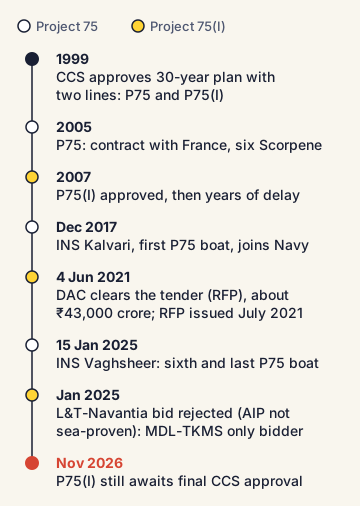
- The 30-year plan (1999): The Cabinet Committee on Security approved a plan in 1999 for the Navy to build submarines in India. It had two production lines: Project 75 and Project 75(I).
- Project 75 (the first line): India signed a contract with France in 2005 to build six Scorpene-class submarines at MDL. They are called the Kalvari class. INS Kalvari was commissioned in December 2017, and the sixth and last, INS Vaghsheer, was commissioned on 15 January 2025 in Mumbai.
- Project 75(I) (the second line): The idea was approved in 2007, but it was delayed for many years. On 4 June 2021, the Defence Acquisition Council cleared the issue of the tender (Request for Proposal, RFP), worth about ₹43,000 crore at that time. The RFP was issued in July 2021.
- Selection: Two Indian partners were shortlisted, MDL (with TKMS) and Larsen & Toubro (L&T, with Spain's Navantia). In January 2025, the Ministry of Defence found L&T's bid non-compliant, mainly because its AIP system was not proven at sea, which the tender required. This left MDL-TKMS as the only remaining bidder.
- Negotiations: TKMS and MDL entered formal contract talks in 2025. Cost negotiations have reportedly been completed, and the project awaits final CCS approval. Reported costs are much higher than the 2021 estimate (figures of about ₹70,000 crore and more have been reported).
How does the Strategic Partnership model work here?
Project 75(I) is the first programme under the Strategic Partnership (SP) model of India's defence buying rules (introduced in 2017 and part of DAP 2020). Under this model:
- The Ministry of Defence first shortlists Indian companies as "strategic partners".
- Each Indian partner picks a foreign maker (called the OEM, Original Equipment Manufacturer) that owns a proven design.
- The submarines are built in India by the Indian partner, with transfer of technology from the foreign maker.
- The aim is that, over time, India learns to design and build such complex platforms itself.
India's position and Indian examples
India's submarine fleet includes the Kalvari-class (Scorpene) boats, older Russian-origin Kilo-class (Sindhughosh class) and German-origin HDW (Shishumar class) boats, and nuclear-powered ballistic missile submarines such as INS Arihant. DRDO is developing its own AIP system based on fuel cells, which is planned to be fitted to the Kalvari-class submarines during their refits. MDL also builds warships and is one of India's main defence shipyards.
Commonly confused concepts
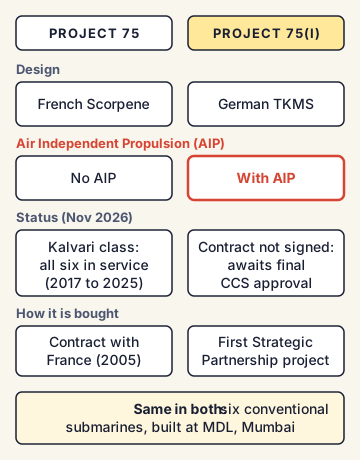
- Project 75 vs Project 75(I): Project 75 is the completed six-submarine Kalvari-class line based on the French Scorpene design, without AIP. Project 75(I) is the new six-submarine line, with AIP, based on a German TKMS design.
- Conventional (SSK) vs nuclear-powered (SSN/SSBN) submarines: Conventional submarines use diesel engines and batteries (plus AIP in newer ones). Nuclear-powered attack submarines (SSN) and ballistic missile submarines (SSBN) use a nuclear reactor and can stay underwater for months. INS Arihant is an SSBN, which carries nuclear missiles.
- AIP vs nuclear propulsion: AIP extends underwater time to a few weeks; nuclear propulsion allows months. AIP submarines are much cheaper and quieter at low speed.
- Strategic Partnership model vs direct import: In direct import, India simply buys a finished product. Under the SP model, the product is built in India by an Indian company with foreign technology.
Issues, criticism and the way forward
- Long delays: the project was approved in principle in 2007, but the contract was still not signed by late 2026. The first submarine is expected years after signing, while older boats keep retiring.
- Rising cost: the reported price has grown far beyond the 2021 estimate, partly due to inflation and the high cost of AIP and technology transfer.
- Single bidder: after L&T's bid was rejected, only one bidder remained. Critics say this weakens India's bargaining power on price.
- Real transfer of technology: experts warn that foreign makers often share how to build, but not how to design. India's goal of designing its own submarines (planned under Project 76) depends on how much real knowledge is transferred.
- Way forward suggested by experts: sign the contract quickly with clear delivery dates; build the DRDO AIP into Indian submarines; keep the submarine-building teams busy without long gaps between projects; and move on to an Indian-designed submarine.
Concepts to Know
- Air Independent Propulsion (AIP): A system that lets a non-nuclear submarine produce power underwater without taking in outside air, so it can stay hidden longer.
- Original Equipment Manufacturer (OEM): The company that designed and first made a product, which owns the technology.
- Request for Proposal (RFP): A formal document in which the buyer explains exactly what it wants and asks companies to send their offers.
- Commissioning: The ceremony at which a new ship or submarine officially joins the Navy and starts service.
- Cabinet Committee on Security (CCS): The top group of Union ministers, led by the Prime Minister, that approves the biggest defence deals.
- Six conventional submarines with AIP; MDL (Mumbai) with TKMS (Germany)
- First programme under the Strategic Partnership model
- DAC cleared the RFP on 4 June 2021 (about ₹43,000 crore at the time); RFP issued in July 2021
- L&T-Navantia bid found non-compliant in January 2025 (AIP not sea-proven)
- Awaiting final CCS approval as of November 2026
- Project 75 (Kalvari class, Scorpene design): six submarines; INS Kalvari commissioned December 2017; INS Vaghsheer (sixth) commissioned 15 January 2025
- 30-year submarine building plan approved by the CCS in 1999
● Tracked since September 23, 2026 · last seen November 16, 2026 · updates as the daily brief publishes