Principal Purpose Test (PPT)
BEPS Action 6 and Treaty Shopping
The Principal Purpose Test (PPT) is a rule written into tax treaties to stop people from misusing them. It says: if it is reasonable to conclude that getting a treaty benefit was one of the principal (main) purposes of a deal, the benefit can be denied. The only exception is when giving the benefit would be in line with what the treaty was meant to do. In short, a treaty benefit is for genuine business, not for deals set up mainly to save tax.
Why does it exist?
Tax treaties give lower tax rates or tax exemptions to residents of the two countries that signed them. Some investors take advantage of this by setting up a company in a country with a friendly treaty, only on paper, and routing their money through it. This is called treaty shopping. Imagine a shop that gives a discount only to people from one colony.
A person from outside rents a tiny room in that colony, just to get the discount, without really living there. The PPT is the rule that lets the shopkeeper say: "You did this only for the discount, so you do not get it."
Where did it come from?
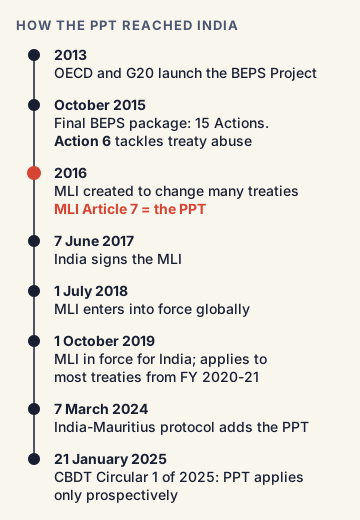
- In 2013, the OECD (Organisation for Economic Co-operation and Development) and the G20 launched the BEPS Project (Base Erosion and Profit Shifting) to stop multinational companies from shifting profits to low-tax places.
- In October 2015, the final BEPS package set out 15 Actions. Action 6 dealt with "Preventing the Granting of Treaty Benefits in Inappropriate Circumstances", that is, treaty abuse.
- Action 6 is one of four BEPS minimum standards, which every member of the BEPS Inclusive Framework (over 140 countries, including India) agrees to adopt.
- To change thousands of treaties quickly, countries created the Multilateral Instrument (MLI) in 2016. Its Article 7 contains the PPT. The MLI came into force globally on 1 July 2018.
- India signed the MLI on 7 June 2017; it entered into force for India on 1 October 2019, and applies to most covered treaties from financial year 2020-21.
- Treaties left out of the MLI, like India's treaty with Mauritius, need a separate bilateral protocol to add the PPT. The India-Mauritius protocol was signed on 7 March 2024.
How does the Action 6 minimum standard work?
Every country must do two things in its treaties:
- Add a new preamble saying the treaty is not meant to create chances for non-taxation or reduced taxation through evasion or avoidance, including treaty shopping.
- Add an anti-abuse rule in one of three ways:
- a PPT alone, or
- a PPT plus a simplified Limitation on Benefits (LOB) clause, or
- a detailed LOB clause plus a rule against conduit (pass-through) arrangements.
Most countries, including India, chose the PPT, because it alone meets the minimum standard. The United States is the main exception; it prefers detailed LOB clauses.
How is the PPT applied, step by step?
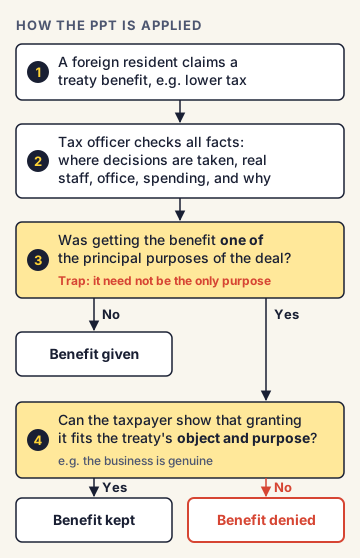
- A foreign resident claims a treaty benefit, such as a lower tax rate on dividends or an exemption on capital gains.
- The tax officer looks at all the facts: where decisions are really taken, whether the company has real staff, office and expenses, and why the structure was set up.
- If it is reasonable to conclude that getting the treaty benefit was one of the main purposes (it need not be the only purpose), the officer can deny the benefit.
- The taxpayer can still keep the benefit by showing that granting it fits the object and purpose of the treaty, for example because the business is genuine.
India's guidance on PPT
The CBDT issued Circular No. 1 of 2025 on 21 January 2025:
- The PPT applies prospectively: only from the date the MLI or the bilateral protocol adding it takes effect for that treaty.
- Gains on Indian shares bought before 1 April 2017 by residents of Mauritius, Singapore and Cyprus, which are protected by "grandfathering" clauses in those treaties, stay outside the PPT.
- Officers may use the BEPS Action 6 Final Report and the UN Model Tax Convention (2021) commentary as extra guidance, subject to India's reservations.
- The aim is to give treaty benefits only to bona fide (genuine) movement of goods, services, capital and people.
Commonly confused concepts
- PPT vs GAAR: The PPT is inside a tax treaty and only decides whether a treaty benefit is given. GAAR is in India's domestic income tax law, applies only when the tax benefit is above ₹3 crore, and can re-work the whole arrangement.
- PPT vs LOB: The PPT is a subjective test about purpose. A Limitation on Benefits clause is an objective test with fixed conditions, such as a minimum level of local spending. For example, the 2016 India-Mauritius protocol treated a company as a shell if its yearly operating spending in Mauritius was below 15 lakh Mauritian rupees (the treaty also gives the figure as ₹27 lakh) in the previous 12 months.
- Tax avoidance vs tax evasion: Avoidance uses legal gaps to pay less tax. Evasion is illegal, such as hiding income. The PPT targets abusive avoidance.
- BEPS vs MLI: BEPS is the overall OECD/G20 project with 15 Actions. The MLI is a single treaty that applies some of these Actions, including the PPT, to many existing treaties at once.
Issues, criticism and the way forward
- Uncertainty: "One of the principal purposes" is a broad and subjective phrase. Investors worry that genuine structures may be questioned, which can slow foreign investment.
- Burden on taxpayers: Taxpayers may need to prove commercial substance with board minutes, staff and office records, which raises compliance costs.
- Officer discretion: Critics fear wide powers may lead to disputes and long court cases. Clear CBDT guidance and advance rulings can reduce this.
- Revenue and fairness: Supporters say the PPT protects India's tax base and stops foreign investors from paying less tax than Indian investors on the same income.
- Way forward: Experts suggest clear examples in guidance, quick dispute resolution through the Mutual Agreement Procedure (MAP) and advance pricing or rulings, and steady application so that genuine investors feel safe.
Concepts to Know
- Treaty shopping: Routing an investment through a third country only to use that country's favourable tax treaty.
- Shell or conduit company: A company that exists mostly on paper, with little real staff or business, used only to pass money through.
- Commercial substance: Real business activity, such as an office, staff, decision-making and spending, in the place where a company claims to be based.
- Tax Residency Certificate (TRC): An official paper from a country's tax department saying a person or company is a tax resident there.
- Grandfathering: Protecting older deals or investments from a new rule, so the new rule applies only to future cases.
- OECD: A group of 38 mostly rich countries, based in Paris, that writes common rules and advice on economic matters, including taxes.
- Mutual Agreement Procedure (MAP): A process in tax treaties where the tax departments of two countries talk to each other to settle a dispute.
- PPT test: deny the benefit if obtaining it was "one of the principal purposes", unless granting it matches the treaty's object and purpose
- BEPS Project launched 2013 by OECD and G20; final package October 2015; 15 Actions; Action 6 = treaty abuse (a minimum standard)
- MLI Article 7 = PPT; MLI in force globally 1 July 2018; India signed 7 June 2017; in force for India 1 October 2019
- India-Mauritius protocol signed 7 March 2024; adds PPT and new preamble
- CBDT Circular No. 1 of 2025 (21 January 2025): PPT prospective; pre-1 April 2017 grandfathered shares (Mauritius, Singapore, Cyprus) outside PPT
- Action 6 options: PPT alone; PPT plus simplified LOB; detailed LOB plus anti-conduit rule
● Tracked since July 19, 2026 · last seen October 14, 2026 · updates as the daily brief publishes