Prime Minister's Internship Scheme (PMIS)
The Prime Minister's Internship Scheme (PMIS) is a central government scheme that places young people in internships at India's large companies. An internship is a short period of on-the-job training: you work inside a real company, learn how things are done, and get a monthly allowance, but it is not a permanent job. The scheme's long-term aim is to give one crore (10 million) internships over five years. It is run by the Ministry of Corporate Affairs (MCA), the ministry that looks after companies and company law.
Why does India need it?
India has one of the youngest populations in the world. Every year, millions of young people finish school, ITI, diploma or college. But many of them cannot find good jobs. One big reason is the skills gap: employers say fresh graduates do not have the practical skills needed at work, and young people say they cannot get experience without first getting a job.
It is like a chicken-and-egg problem. An internship breaks this loop by giving a young person real work experience, a certificate from a known company, and a first line on their CV. It also helps companies find and test future employees.
Where did it come from?
- July 2024: The scheme was announced in the Union Budget 2024-25 (presented on 23 July 2024), as part of a package of schemes for employment and skilling.
- 3 October 2024: The government launched a pilot (a trial run on a small scale) with a target of 1.25 lakh internships in 2024-25 and a budget of about ₹800 crore. Registration on the online portal opened on 12 October 2024, and the first interns joined from December 2024.
- January 2025: The second pilot round began.
- March 2026: After low joining and high dropouts in the first two rounds, the government revamped the scheme.
- 2026: The third pilot round began in the spring, with a target of about 1.1 lakh internships. Offers can be posted until December 2026 and candidates can join until January 2027.
How does it work, step by step?
- The young person registers on the PMIS online portal using Aadhaar-based verification. The portal creates a resume for them.
- They apply for internships, choosing by location, sector and type of role.
- The system shortlists candidates by matching their choices with what companies need, while making sure different social groups are fairly represented.
- The company makes the final selection, sometimes after an interview or test.
- Selected candidates accept the offer on the portal and join the company.
- At least half of the internship time must be spent in a real work environment, not in a classroom.
Who can apply? (eligibility)
After the March 2026 revamp:
- Age 18 to 25 years.
- Not in full-time employment.
- Has passed school (Class 10 or 12), ITI, polytechnic diploma, or a graduation or postgraduation degree. Final-year students can now apply too, with a no-objection certificate from their institution.
The pilot also kept some people out, so that the scheme reaches those who need it most:
- Anyone whose family member holds a regular or permanent government job.
- Graduates of top institutions such as the IITs, IIMs, IISERs, NIDs and IIITs.
- People with professional qualifications such as CA, MBA or MBBS.
- In the original pilot design, families with an annual income above ₹8 lakh were also excluded.
What does an intern get? (the money)
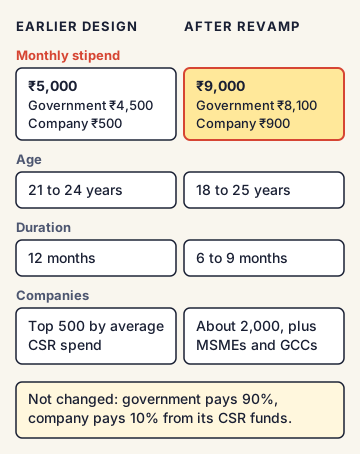
- Monthly stipend: ₹9,000 (raised from ₹5,000 from March 2026). Of this, ₹8,100 is paid by the government directly into the intern's bank account through Direct Benefit Transfer (DBT), and ₹900 (10%) is paid by the company from its CSR funds. Earlier, the split was ₹4,500 (government) and ₹500 (company). Companies may pay more if they wish.
- One-time grant: ₹6,000 for incidental expenses, such as travel or setting up at a new place.
- Insurance: Interns are covered under the government's life and accident insurance schemes, Pradhan Mantri Jeevan Jyoti Bima Yojana and Pradhan Mantri Suraksha Bima Yojana.
- Training costs (trainers, materials) are borne by the company from its CSR budget.
Which companies take part?
In the first two rounds, the scheme covered the top 500 companies, chosen by their average CSR spending over the last three years. From the third round, the pool was widened to about 2,000 companies, plus MSMEs, global capability centres, professional bodies like ICAI, and statutory bodies such as the Airports Authority of India. Participation is voluntary for companies.
How has it performed?
The numbers show why the revamp was needed:
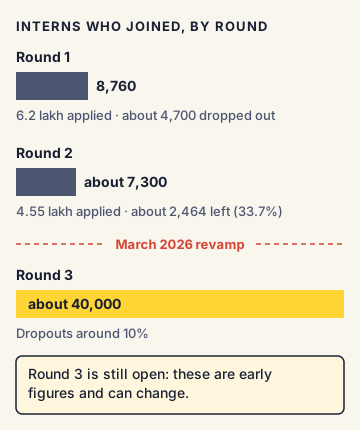
- Round 1: about 6.2 lakh applications, but only 8,760 joined. About 4,700 later dropped out.
- Round 2: about 4.55 lakh applications, and about 7,300 joined. About 2,464 left early, a dropout rate of about 33.7%.
- Round 3 (after the revamp): around 40,000 joined by late 2026, with dropouts falling to around 10%.
- Spending has been far below the money set aside. For 2025-26, ₹10,831 crore was allocated, but only a small fraction (about ₹87 crore by the time of a reply to Parliament) had been spent, mainly because the scheme was still a pilot.
Why did so many leave in the first two rounds? Common reasons reported were the low stipend compared with the cost of living in a new city, internships located far from home, a long 12-month commitment, and some interns getting other jobs or college admissions.
Commonly confused concepts
- Internship vs apprenticeship: An apprenticeship is a legal training contract under the Apprentices Act, 1961, supported by schemes such as the National Apprenticeship Promotion Scheme (NAPS) and the National Apprenticeship Training Scheme (NATS). Companies above a certain size have legal duties to engage apprentices. A PMIS internship is a voluntary scheme, not a legal duty, and focuses on giving work exposure in big companies.
- PMIS vs skilling schemes (like PMKVY): Pradhan Mantri Kaushal Vikas Yojana (PMKVY) gives short skill courses at training centres. PMIS puts the young person inside a real company for months.
- PMIS vs Employment Linked Incentive (ELI) scheme: The ELI scheme, now called the Pradhan Mantri Viksit Bharat Rozgar Yojana, gives money support linked to new jobs (paid through the EPFO system). PMIS gives internships, which are not jobs.
- PMIS vs PMEGP: The Prime Minister's Employment Generation Programme (PMEGP) helps people start their own small business with a loan subsidy. PMIS prepares people to work for companies.
Issues, criticism and the way forward
- No job guarantee: The government has clarified that PMIS does not promise a job after the internship. Its aim is to improve employability. Critics say that without a clear path to jobs, many young people may not see enough value in it.
- Quality of internships: Some reports say interns were given routine or low-skill work. Experts suggest clear learning goals, mentors and regular monitoring for each internship.
- Location mismatch: Many openings are in big cities, while many applicants live in small towns and villages. More local openings, including in MSMEs, and help with housing or travel could reduce dropouts.
- Low spending: The gap between money allocated and money spent shows weak uptake so far. A smooth full rollout will need many more companies to post good internships.
- Way forward: The March 2026 changes (higher stipend, shorter duration, more companies and wider age group) have raised participation. Experts suggest tracking what happens to interns after they finish, such as how many get jobs, to judge whether the scheme truly works.
Concepts to Know
- Stipend: A fixed monthly allowance paid during training. It is not a salary.
- Pilot project: A small trial run of a scheme to test how it works before rolling it out fully.
- Direct Benefit Transfer (DBT): Sending government money straight into the beneficiary's bank account, without middlemen.
- Employability: How ready a person is to get and keep a job, based on skills and experience.
- Attrition (dropout rate): The share of people who leave a programme before completing it.
- MSME: Micro, Small and Medium Enterprises, that is, smaller businesses defined by their investment and turnover.
- Global Capability Centre (GCC): An office set up in India by a foreign company to do its technology, research or business work.
- Announced: Union Budget 2024-25 (23 July 2024); pilot launched: 3 October 2024
- Nodal ministry: Ministry of Corporate Affairs
- Long-term target: 1 crore internships over 5 years; pilot target (2024-25): 1.25 lakh internships
- Revamp (March 2026): stipend ₹9,000/month (₹8,100 government via DBT + ₹900 company CSR); age 18–25; duration 6–9 months; about 2,000 eligible companies
- Earlier design: stipend ₹5,000 (₹4,500 + ₹500); age 21–24; 12 months; top 500 companies by average CSR spend over 3 years
- One-time grant: ₹6,000; insurance under PMJJBY and PMSBY
- At least half the internship period must be in an actual work environment
- Round 1: 8,760 joined; Round 2: about 7,300 joined; Round 3: about 40,000 joined (as of November 2026)
- Excluded: IIT/IIM/IISER/NID/IIIT graduates; CA/MBA/MBBS holders; families with a regular government employee
● Tracked since November 06, 2026 · last seen November 06, 2026 · updates as the daily brief publishes