Pradhan Mantri Viksit Bharat Rozgar Yojana (PMVBRY)
The Pradhan Mantri Viksit Bharat Rozgar Yojana (PMVBRY) is a Government of India scheme that gives money to encourage formal jobs. A formal job is one where the worker is registered with the EPFO and gets benefits like a provident fund. The scheme pays a one-time reward to young people who take their first formal job. It also pays a monthly reward to employers for every extra worker they hire and keep. It was earlier called the Employment Linked Incentive (ELI) Scheme.
Why does India need such a scheme?
India has a huge number of workers, but most of them work without a written contract, paid leave or a pension. These are called informal workers. When a business hires a formal worker, it has to pay its share of the provident fund and follow more rules. So many small businesses avoid formal hiring. PMVBRY tries to lower this cost.
It is like a shop giving a discount to the first customers so that more people try a new product. The government "pays part of the bill" for formal hiring, hoping businesses get used to it and keep doing it.
Where did it come from?
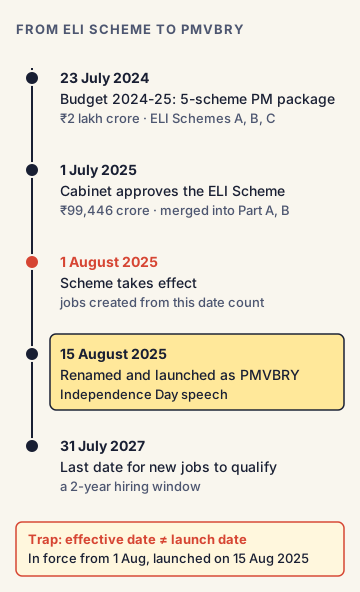
- In the Union Budget 2024-25 (presented on 23 July 2024), the government announced a Prime Minister's package of five schemes for employment and skilling. The package had a central outlay of ₹2 lakh crore and aimed to help 4.1 crore youth over 5 years.
- Three of these five were Employment Linked Incentive schemes: Scheme A (first-timers), Scheme B (job creation in manufacturing) and Scheme C (support to employers in all sectors). The other two were a skilling scheme and an internship scheme in top companies.
- On 1 July 2025, the Union Cabinet approved the ELI Scheme with an outlay of ₹99,446 crore. It merged the three budget ideas into two parts: Part A for workers and Part B for employers.
- On 15 August 2025, in the Independence Day speech, the scheme was renamed and launched as the Pradhan Mantri Viksit Bharat Rozgar Yojana. It took effect from 1 August 2025.
Part A: help for first-time workers
This part rewards a person who joins a formal job for the first time.
- Who qualifies: A worker who is registering with the EPFO for the first time, with a monthly salary of up to ₹1 lakh.
- How much: An amount equal to one month's EPF wage, up to a maximum of ₹15,000. (EPF wage means the part of the salary on which provident fund is calculated, mainly basic pay plus dearness allowance.)
- Two instalments: The first comes after 6 months of service. The second comes after 12 months, but only if the worker finishes a financial literacy programme (a short course on saving, banking and managing money).
- Saving habit: A part of the money goes into a savings instrument or deposit account that the worker can take out only after a fixed time. This is meant to build a habit of saving.
- How it is paid: By Direct Benefit Transfer (DBT) using the Aadhaar Bridge Payment System (ABPS). The worker must verify their Universal Account Number (UAN) using face authentication on the UMANG app.
Part B: help for employers
This part rewards a business for hiring extra workers, not for its old workers.
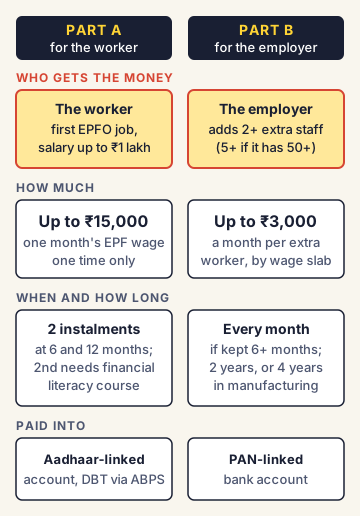
- Who qualifies: Businesses (establishments) registered with the EPFO. They must hire a minimum number of extra workers and keep each new worker for at least 6 months.
- Minimum extra hiring:
- A business with fewer than 50 workers must add at least 2 extra workers.
- A business with 50 or more workers must add at least 5 extra workers.
- Monthly reward for each extra worker, based on that worker's EPF wage:
| EPF wage of the new worker | Reward to employer per month |
|---|---|
| Up to ₹10,000 | Up to ₹1,000 |
| ₹10,001 to ₹20,000 | ₹2,000 |
| ₹20,001 to ₹1,00,000 | ₹3,000 |
- How long: For 2 years in all sectors. In manufacturing, it continues for the 3rd and 4th years too.
- How it is paid: Straight into the employer's PAN-linked bank account.
- Part B is expected to support about 2.6 crore jobs.
How does it work, step by step?
Imagine a small garment factory in Tiruppur with 40 workers. It hires 3 new tailors, each with an EPF wage of ₹15,000. The factory registers them with the EPFO and files its monthly PF return (called the Electronic Challan cum Return, or ECR). The EPFO's system sees 3 extra workers. After they stay 6 months, the factory starts getting ₹2,000 a month for each tailor, for up to 4 years, because it is in manufacturing.
If one tailor is in their first formal job, that tailor also gets up to ₹15,000 from Part A, in two parts. No separate application is needed from the worker; the employer's monthly PF filing is the base.
India's position and related efforts
PMVBRY works alongside other steps to make work more formal:
- Four Labour Codes came into force on 21 November 2025, replacing 29 old central labour laws. The Code on Social Security, 2020 widens social security, including for gig and platform workers.
- The e-Shram portal (2021) registers unorganised workers so that the government knows who they are.
- Earlier hiring-incentive schemes did similar things: Pradhan Mantri Rojgar Protsahan Yojana (PMRPY) from 2016 and Aatmanirbhar Bharat Rojgar Yojana (ABRY) from October 2020, launched after COVID-19.
Commonly confused concepts
- PMVBRY vs PLI Scheme: The Production Linked Incentive (PLI) scheme rewards companies for producing and selling more. PMVBRY rewards them for hiring more formal workers. One is linked to output, the other to jobs.
- PMVBRY vs MGNREGA (now VB-G RAM G): The rural job scheme gives guaranteed wage work directly by the government. PMVBRY does not create government jobs. It gives a subsidy to private and other employers to hire.
- PMVBRY vs PM Internship Scheme: The internship scheme gives young people 12 months of training in top companies, with a monthly stipend. It is not a job, and the intern is not a regular employee.
- PMVBRY vs ABRY: ABRY (2020) paid the PF contributions directly for new hires during COVID. PMVBRY gives a fixed cash reward per worker and adds a special reward for first-time workers.
- Part A vs Part B: Part A pays the worker (one-time, up to ₹15,000). Part B pays the employer (monthly, up to ₹3,000 per worker).
Issues, criticism and the way forward
- Real jobs or just registration? Critics point out that some "new" EPFO members may be old informal workers who are simply being registered now. This shows more formalisation, but not always more new jobs.
- Deadweight cost: Some firms would have hired these workers anyway. Paying them is a cost without any extra benefit. Economists call this a "deadweight" loss.
- What happens after the money stops? If firms hire only for the reward, they may let workers go once it ends. The six-month minimum stay helps, but only partly.
- Small firms find it hard: Many tiny businesses are not registered with the EPFO at all, so they cannot use the scheme.
- Data gaps: EPFO payroll data and the Periodic Labour Force Survey often show different pictures of jobs. Good independent evaluation is needed.
- Way forward: Experts suggest strict checks to stop fake hiring, tying rewards to skills and longer job stays, and simpler rules so that small firms join the EPFO system.
Concepts to Know
- Formal job: A job with a written contract and social security, such as provident fund, pension or health insurance, usually through the EPFO or ESIC.
- Outlay: The total money the government plans to spend on a scheme.
- Direct Benefit Transfer (DBT): A system where the government sends money straight into a person's bank account, so there is no middleman.
- Aadhaar Bridge Payment System (ABPS): A system that uses a person's Aadhaar number to send money to the bank account linked with it.
- Universal Account Number (UAN): A 12-digit number the EPFO gives every member. It stays the same even if the worker changes jobs.
- Financial literacy: Basic knowledge of how to save, borrow, use a bank and avoid money frauds.
- Deadweight loss (in schemes): Money paid for something that would have happened even without the payment.
- Earlier name: Employment Linked Incentive (ELI) Scheme; announced in Budget 2024-25 as part of a ₹2 lakh crore, five-scheme PM package for 4.1 crore youth
- Cabinet approval: 1 July 2025; outlay ₹99,446 crore; launched as PMVBRY on 15 August 2025, effective 1 August 2025
- Covers jobs created from 1 August 2025 to 31 July 2027
- Target: 3.5 crore+ jobs, including about 1.92 crore first-time workers
- Ministry: Labour and Employment; implemented by EPFO
- Part A: first-time EPFO members, salary up to ₹1 lakh; one month's EPF wage, max ₹15,000; two instalments (6 months, 12 months + financial literacy course)
- Part B: ₹1,000 / ₹2,000 / ₹3,000 a month per extra worker by wage slab (up to ₹1 lakh); 2 years, extended to 4 years in manufacturing
- Minimum extra hiring: 2 (firms under 50 workers), 5 (firms with 50 or more); each new worker kept at least 6 months
● Tracked since October 30, 2026 · last seen October 30, 2026 · updates as the daily brief publishes