Open Coalition on Compliance Carbon Markets (OCCCM)
The Open Coalition on Compliance Carbon Markets (OCCCM) is a group of countries that run government-made carbon markets and want those markets to work in compatible ways. It was proposed by Brazil at the COP30 climate summit in Belém (November 2025) and formally launched by the European Union, China and Brazil in Florence, Italy, on 7 May 2026.
It does not set emission targets for anyone. Instead, it is a platform where members share methods, agree on common standards and slowly move towards markets that can "talk" to each other.
Why does it exist?
Many countries now put a price on carbon pollution, but each does it differently. One measures emissions one way, another uses a different method, and their carbon credits are not accepted by each other. This is like many countries using different-sized plugs: each works at home, but nothing connects. The OCCCM tries to create common "plug sizes" for carbon markets. This can lower the cost of cutting emissions, prevent double counting, and reduce trade fights over carbon taxes at the border.
Where did it come from?
The idea grew out of three trends.
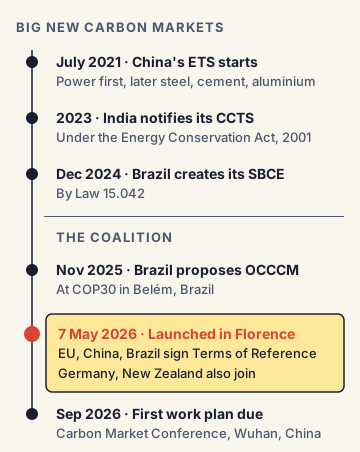
- Carbon pricing spread: By 2025, the World Bank counted about 80 carbon pricing instruments (carbon taxes and emissions trading systems) in operation, covering about 28% of global emissions and raising over $100 billion for governments in 2024.
- Big new markets: China's national emissions trading system started in July 2021 and expanded from power to steel, cement and aluminium. Brazil passed a law creating its own system (SBCE, Law 15.042) in December 2024. India notified its CCTS in 2023.
- Climate clubs: As UN climate talks slowed, groups of willing countries began working together outside the formal negotiations. These groups are often called "climate clubs".
Brazil proposed the coalition at COP30, where it was endorsed by a group of countries and the EU. At Florence, China, Brazil and the EU signed its Terms of Reference (its basic rule book).
Who can join, and who runs it?
- Members: countries that run a nationwide compliance carbon market, either an emissions trading system or a carbon tax.
- Observers: sub-national governments with carbon pricing (such as a state or province) and organisations working on similar goals.
- Leadership: Brazil chairs it for the first two years. China and the European Commission are co-chairs.
- Structure: high-level meetings (the top decision-making body), executive-level meetings, thematic working groups and a Secretariat.
- Founding members: the EU, China and Brazil. Germany and New Zealand joined at Florence as the first new members. Canada, France, Norway, Singapore, Türkiye and the UK joined later.
What does it work on?
Its focus areas are technical but very important:
- MRV (monitoring, reporting and verification): common ways to measure and check how much a factory emits.
- Carbon accounting methods: agreed rules for counting emissions, so one tonne means the same thing everywhere.
- High-integrity credits: rules on when carbon offsets (credits from projects outside the market) can be used, so that only genuine emission cuts count.
- Interoperability: in the long run, making markets compatible enough that they could be partly linked.
The first work plan was due for adoption at the Carbon Market Conference in Wuhan, China, in September 2026.
How does linking carbon markets help?
Suppose cutting one tonne of carbon costs ₹2,000 in India but ₹8,000 in Europe. If markets are linked, a European company could pay an Indian company to cut that tonne instead. The world gets the same cut at a lower cost, and money flows to the country that cuts more. But linking only works if both sides trust each other's measurements, which is why MRV and accounting come first.
India's position
India runs a compliance market (the CCTS) under the Energy Conservation Act, 2001. The CCTS supports India's Nationally Determined Contribution (NDC), which includes cutting the emissions intensity of GDP by 45% by 2030 from 2005 levels, and its goal of net zero by 2070. As of October 2026, India has not joined the OCCCM. Those in favour of joining point to three gains: shaping global rules from inside, better preparation for border carbon taxes like CBAM, and possible future income from selling credits. Brazil's role as chair also shows that developing countries can lead the group.
Commonly confused concepts
- Compliance market vs voluntary market: A compliance market is set up by law, and covered companies must take part (EU ETS, China's ETS, India's CCTS compliance part). In a voluntary market, companies buy credits by choice, often to meet their own "net zero" promises.
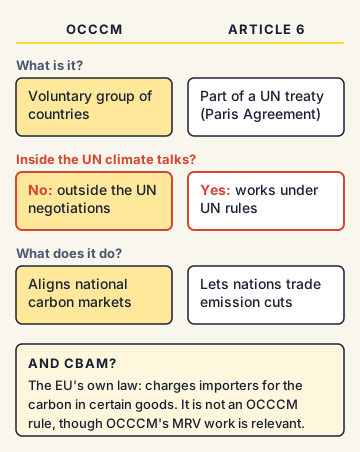
- OCCCM vs Article 6 of the Paris Agreement: Article 6 is part of a UN treaty and lets countries trade emission cuts under UN rules. The OCCCM is a voluntary coalition outside the UN negotiations, focused on aligning national compliance markets.
- OCCCM vs CBAM: CBAM is the EU's own law that charges importers for the carbon in certain goods. The OCCCM is a multi-country platform. Its work on measurement and accounting is relevant to CBAM, but it does not mention CBAM directly.
- Carbon tax vs emissions trading system (ETS): A carbon tax fixes the price per tonne and lets the amount of pollution vary. An ETS fixes the quantity (or intensity) and lets the price be set by trading. Both count as compliance carbon pricing for OCCCM membership.
Issues, criticism and the way forward
- Sovereignty concerns: Developing countries worry that common standards written mainly by richer members could later be used to judge or penalise them.
- CBDR principle: India argues that climate rules must respect Common But Differentiated Responsibilities and Respective Capabilities (CBDR-RC), a UNFCCC principle meaning richer countries that polluted more must do more. A uniform carbon price could clash with this.
- Risk of a "club" turning into a trade bloc: Some analyses discuss carbon coalitions with common prices for members and penalties for non-members.
- Different starting points: India's CCTS uses intensity targets (emissions per unit of product), while the EU ETS uses an absolute cap. Linking such systems is technically hard.
- The case for joining: The coalition does not force targets on members, and being inside lets a country shape decisions. Supporters argue the bigger risk lies in being an outsider.
- Way forward: India can strengthen its MRV systems and registry, study the coalition's work plan closely, and decide on membership while protecting the CBDR principle.
Concepts to Know
- Carbon pricing: Putting a money cost on each tonne of greenhouse gas released, so polluters pay for the harm and have a reason to cut emissions.
- Emissions trading system (ETS): A market where the government limits emissions and companies trade permits or credits. Those who pollute less can sell to those who pollute more.
- Carbon credit / offset: A certificate showing one tonne of carbon dioxide (or equivalent gas) was reduced or removed.
- MRV (Monitoring, Reporting and Verification): The system of measuring emissions, reporting them, and having an independent party check the numbers.
- Interoperability: The ability of two different systems to work together, for example accepting each other's carbon credits.
- COP (Conference of the Parties): The yearly summit of countries under the UN climate convention (UNFCCC).
- Nationally Determined Contribution (NDC): Each country's own climate action plan and targets under the Paris Agreement.
- Proposed by Brazil at COP30, Belém (November 2025); formally launched in Florence, Italy, on 7 May 2026
- Founders: European Union, China and Brazil; Brazil chairs for the first two years, China and the European Commission are co-chairs
- First new members: Germany and New Zealand; later Canada, France, Norway, Singapore, Türkiye and the UK
- Membership: countries with nationwide compliance carbon markets (ETS or carbon tax); sub-national bodies as observers
- Focus: MRV, carbon accounting methods, high-integrity credits, long-term interoperability
- First work plan: Carbon Market Conference, Wuhan, China, September 2026
- World Bank (2025): about 80 carbon pricing instruments, covering about 28% of global emissions; over $100 billion revenue in 2024
- India: not a member as of October 2026
● Tracked since October 18, 2026 · last seen October 18, 2026 · updates as the daily brief publishes